
Ray Dalio Explains Why Gold Will Remain Superior to Bitcoin
Bridgewater Associates founder Ray Dalio maintains that Bitcoin falls short of replacing gold as a premier store of value, pointing to institutional adoption, market development and its correlation with risk assets.

Key takeaways
- According to Ray Dalio, Bitcoin's inability to match gold's millennia-long track record as a monetary instrument prevents it from becoming the dominant global store of value, as gold remains fundamentally integrated into worldwide financial infrastructure.
- The presence of gold within central bank reserve holdings provides it with an institutional credibility that Bitcoin has yet to establish, encouraging governments to depend on gold when navigating economic instability.
- In Dalio's assessment, Bitcoin demonstrates characteristics of a risk asset, frequently correlating with technology equities and speculative positions instead of functioning as a conventional safe-haven during periods of market volatility.
- Gold's market dimensions and established infrastructure substantially surpass Bitcoin's, benefiting from centuries of development through central banking systems, sovereign wealth funds, industrial applications and sophisticated investment platforms.
The question of whether Bitcoin (BTC) might eventually supplant gold as the predominant global store of value has occupied the attention of investors and market analysts for several years.
Bitcoin advocates frequently describe it as "digital gold," contending that its predetermined supply cap and decentralized architecture position it as a contemporary hedge against inflation.
Nevertheless, prominent investor and billionaire Ray Dalio has taken a contrary stance on this matter. Although Dalio acknowledges Bitcoin's unique characteristics and its expanding role within financial markets, he maintains that it lacks the capacity to displace gold. His reasoning stems from gold's extensive historical legacy, its established position within global commerce, central banking practices and its integration into the world's monetary infrastructure throughout multiple centuries.
The perspective offered by Dalio delivers a valuable analytical lens through which investors can examine the ongoing discussion between traditional safe-haven assets such as gold and emerging digital alternatives like Bitcoin.
This analysis explores the rationale behind Ray Dalio's conviction that Bitcoin is incapable of superseding gold as the world's foremost store of value. It addresses reservations regarding central bank acceptance, patterns of market behavior, privacy considerations and technological vulnerabilities, while simultaneously clarifying why he continues to regard Bitcoin as a supplementary asset within well-diversified investment portfolios.
Who Ray Dalio is and why his views matter
As the founder of Bridgewater Associates, Ray Dalio oversees one of the world's most prominent hedge funds. Throughout his career, he has established himself as among the most influential voices in macroeconomic analysis and financial theory.
His reputation rests primarily on his comprehensive examination of extended debt cycles, central bank policies and transformations in worldwide economic dominance. His research into the manner in which currencies experience ascendance and decline across centuries has shaped investment strategies for institutions, governmental bodies and leading asset management firms.
Given his recognized expertise, when Dalio articulates opinions on stores of value, especially in contexts of economic turbulence, his perspectives command considerable attention throughout the financial community.

Dalio's key view: "There is only one gold"
When articulating his perspective on Bitcoin's potential function within the worldwide financial architecture, Dalio has maintained clarity regarding gold's distinctive status as a monetary instrument.
His argument emphasizes that gold ought not to be considered directly equivalent to Bitcoin, as though these two assets were mutually substitutable. From his standpoint, gold transcends the classification of merely another commodity or investment vehicle for speculation.
Rather, Dalio characterizes gold as "the most established form of money" throughout the span of human civilization. Across thousands of years, this precious metal has functioned as a dependable wealth preservation mechanism spanning diverse cultures, economic frameworks and political transformations.
Given this extended historical function, Dalio contends that no emerging asset possesses the capacity to supplant gold, regardless of whether it takes digital or alternative forms.
Did you know? The use of gold as a monetary instrument extends back over 4,000 years. Early civilizations including Egypt and Mesopotamia prized it for its scarcity, resilience and ability to be divided, establishing it as among the first universally accepted vessels of wealth.
How demand by central banks makes gold unique
A critical component of Dalio's analysis centers on the distinctive role that central bank demand plays in establishing gold's position. Monetary authorities across the globe maintain substantial gold holdings as components of their foreign currency reserves. These institutions utilize gold to achieve asset diversification and preserve economic stability when confronting financial uncertainty.
The extensive institutional reliance on gold confers upon it a governmental legitimacy that Bitcoin has not successfully obtained to date.
Regarding the prospect of central banks building Bitcoin reserve positions in the foreseeable future, Dalio expresses considerable doubt. Governmental entities characteristically favor assets possessing extensive track records, substantial and consistent liquidity and thoroughly developed marketplace infrastructure.
Given that Bitcoin represents a relatively recent innovation, it continues to mature both from technological and regulatory perspectives. In the absence of central bank adoption, Dalio maintains, Bitcoin will struggle to attain the equivalent monetary standing that gold commands.
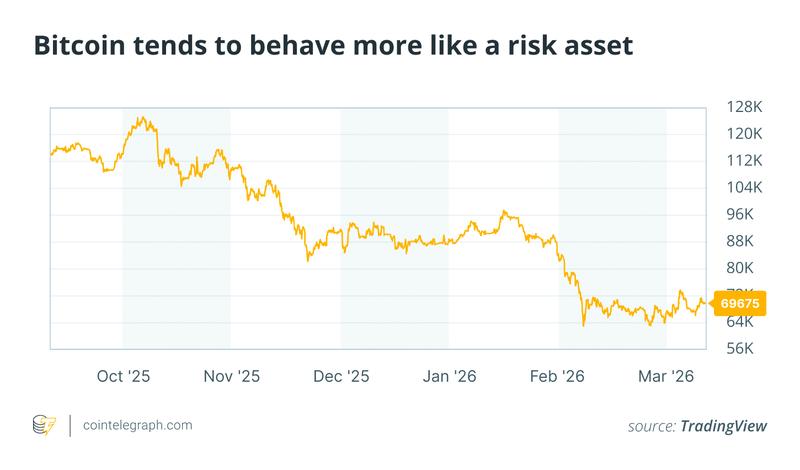
Bitcoin behaves more like a risk asset
Dalio draws attention to distinctions in Bitcoin's performance throughout various market conditions.
Historically, gold has functioned as a safe-haven instrument. When investors confront periods characterized by market turbulence, weakening currencies or geopolitical tensions, they have consistently gravitated toward gold as a protective measure.
Bitcoin, in contrast, has exhibited an alternative behavioral pattern.
According to Dalio's observations, Bitcoin regularly demonstrates correlation with technology equities and additional risk-oriented assets. During episodes of market disruption or tightening liquidity conditions, investors have tended to liquidate Bitcoin holdings alongside equities instead of employing it as a protective hedge.
From Dalio's perspective, this behavioral tendency indicates that Bitcoin presently operates more as a speculative growth vehicle than as a conventional wealth preservation instrument.
The scale and maturity of gold markets
When comparing market infrastructure, gold markets demonstrate substantially greater scale and sophistication relative to Bitcoin markets.
The international gold marketplace has developed throughout millennia and commands extensive institutional participation, encompassing central banking systems, sovereign wealth management entities, jewelry consumption, industrial applications and investment vehicles.
This market depth delivers robust liquidity alongside enhanced price stability.
In comparison, while Bitcoin's market holds significance within the cryptocurrency sector, it remains considerably smaller and more susceptible to fluctuations in investor sentiment. The asset continues experiencing pronounced price volatility, leveraged trading activity and speculative patterns that exert substantial influence on its valuation.
Dalio interprets this disparity in market development as an additional factor supporting gold's continuing dominance as a value storage mechanism.
Did you know? The total supply of Bitcoin is immutably limited to 21 million coins, a fundamental design characteristic that replicates the scarcity inherent in precious metals. This programmed limitation represents one primary justification supporters frequently cite when drawing comparisons between Bitcoin and gold.
Privacy concerns with Bitcoin
Dalio has additionally raised considerations regarding Bitcoin's transparent nature.
Given that Bitcoin operates on a publicly accessible blockchain network, each transaction becomes permanently documented and remains traceable through blockchain analysis technologies. Although participants are identified solely through wallet addresses, transaction sequences can frequently be connected and monitored.
From Dalio's viewpoint, this degree of transparency may diminish Bitcoin's attractiveness to particular institutions or governmental entities as a long-term reserve holding.
Gold, existing as a tangible physical asset, operates independently of any publicly observable transaction recording system.
The potential threat from quantum computing
Among the concerns Ray Dalio has articulated, quantum computing emerges as a notable risk factor for Bitcoin.
The security architecture of Bitcoin depends upon cryptographic algorithms designed to safeguard private keys and authenticate transactions. Prospective advances in quantum computing technology could theoretically undermine or defeat these current cryptographic frameworks.
While quantum computing remains largely within the realm of theoretical consideration, Dalio recommends that such technological vulnerabilities warrant inclusion in any comprehensive long-term evaluation of Bitcoin's sustainability as a store of value.
Gold, maintaining its status as a physical commodity, operates without reliance on software systems or cryptographic protection. Consequently, it remains immune to these categories of technological threats.
Did you know? Gold holdings form part of central bank reserve portfolios. Nations maintain these reserves to serve as protection against currency volatility, geopolitical threats and episodes of financial crisis.
Dalio's broader macroeconomic perspective
Dalio's inclination toward gold rather than Bitcoin also reflects his comprehensive interpretation of global economic conditions.
He has issued warnings suggesting that the world may be transitioning into a period characterized by substantial economic and geopolitical upheaval, distinguished by mounting debt obligations, currency volatility and realignments in international power structures.
Under such circumstances, Dalio contends that investors ought to emphasize assets possessing demonstrated histories of maintaining value during episodes of financial system distress.
Throughout centuries, gold has reliably fulfilled this function amid conditions of inflation, currency debasement and geopolitical instability.
This extensive historical performance constitutes a fundamental reason Dalio continues regarding gold as a comparatively resilient vehicle for wealth preservation.
Bitcoin still has a role in portfolios
Despite maintaining skepticism regarding Bitcoin's capacity to surpass gold, Dalio nevertheless acknowledges it as a legitimate element within investment portfolios. He recognizes that Bitcoin's distinctive features, specifically its supply limitation and decentralized structure, reflect certain advantages traditionally associated with gold.
Instead of advocating selection of one asset to the exclusion of the other, Dalio proposes that both assets fulfill a comparable function.
- Portfolio allocation: Dalio has suggested that investors consider dedicating roughly 15% of their portfolio to a blended position in gold and Bitcoin.
- Hedging strategy: This allocation functions as protection against erosion of purchasing power and broader economic volatility.
- Complementary assets: According to his framework, Bitcoin does not substitute for gold. Rather, these two assets can occupy complementary positions within a diversification strategy.
The ongoing debate between Bitcoin and gold
The contrasting positions regarding Bitcoin and gold illuminate a fundamental division within financial markets. Bitcoin emphasizes digital transferability, programmed scarcity and technological advancement, whereas gold embodies multigenerational heritage, physical substance and institutional confidence.
At its core, this discussion revolves around how societies establish and maintain trust in monetary systems. Though innovative technology can generate efficient financial instruments, the profound institutional trust necessary for establishing a global monetary benchmark typically develops across centuries rather than decades.