Digital Euro Essential for European Payment Independence Amid Global Weaponization, ECB's Cipollone Warns
Piero Cipollone, a senior official at the European Central Bank, has emphasized that heightened geopolitical conflicts necessitate a payment infrastructure under European sovereignty.

Growing geopolitical pressures are amplifying the argument for a digitally-native payments infrastructure controlled by Europe, according to Piero Cipollone, a member of the European Central Bank (ECB) executive board.
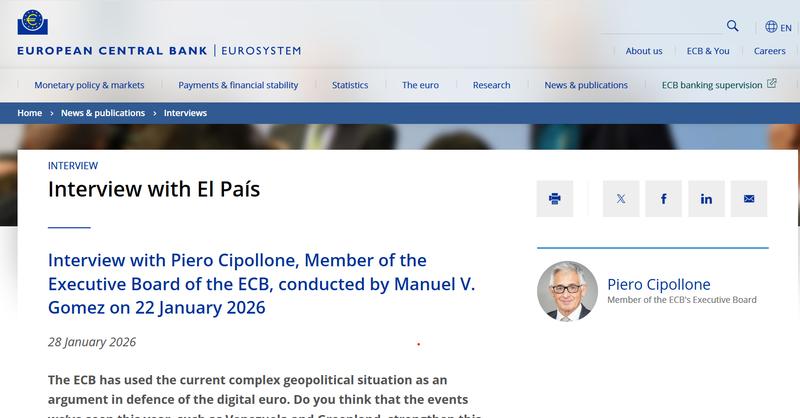
During a conversation with El País, a Spanish publication, which the ECB published on Wednesday, Cipollone characterized the planned digital euro as representing "public money in digital form." He emphasized its necessity to serve as a complement to physical currency and to tackle Europe's increasingly dispersed payments ecosystem, particularly with the expansion of online shopping.
Cipollone observed that physical currency represented approximately one-quarter (24%) of everyday transaction values during 2024, representing a steep decline compared to 2019 when it stood at 40%. He stated the ECB bore an obligation to evolve its delivery of currency as a societal public good.
Geopolitics reshape Europe's payments debate
Cipollone connected this obligation explicitly to international power dynamics, cautioning that the "weaponisation of every conceivable tool" alongside escalating worldwide tensions underscored the necessity for a European retail payment infrastructure "fully under our control." He stressed it must be constructed using European technological capabilities and infrastructure as opposed to relying on providers from outside the continent.
His position was that this kind of infrastructure ought to possess the capability to satisfy the entirety of Europe's payment requirements while avoiding the creation of "excessive dependencies" on international payment schemes.
The ECB representative further underscored the legal tender designation of the digital euro, declaring that any business currently accepting electronic payments "will have to accept" the digital currency, suggesting a practically obligatory acceptance framework for transactions using the digital euro.
Digital euro to drive unified EU payments
Cipollone dismissed suggestions to postpone the initiative while awaiting a completely private sector solution, pointing out that the ECB has "been calling on the private sector to come up with a pan-European solution for many years now."
Rather, his perspective was that launching a digital euro featuring a unified, accessible standard that all retailers would accept would increase the probability that financial institutions and financial technology companies would ultimately deliver an authentically continent-wide retail payment infrastructure, instead of being displaced by it.
Cipollone additionally countered proposals that the digital euro ought to be available exclusively in an offline format.
His reasoning was that a central challenge the initiative aimed to address involved the absence of a workable European payment option for online commerce, and he raised questions about how a solution restricted to offline usage could operate in digital commercial environments.
His statements come after an open letter dated Jan. 11 from approximately 70 economists and policymakers calling on EU lawmakers to "let the public interest prevail" regarding the digital euro matter and cautioning that additional postponements might intensify Europe's reliance on powerful private and extra-European payment service providers.
Cointelegraph reached out to Piero Cipollone's office for comment, but had not received a response by publication.