Court Permits Shareholder Insider Trading Case Against Coinbase Executives to Continue
A shareholder lawsuit claiming Coinbase executives Brian Armstrong and Marc Andreessen engaged in insider trading has been greenlit to move forward by a Delaware court.
A judge in Delaware has given the green light for a shareholder lawsuit to move forward, alleging that multiple Coinbase directors engaged in insider trading, even though an internal company investigation exonerated the executives of any misconduct.
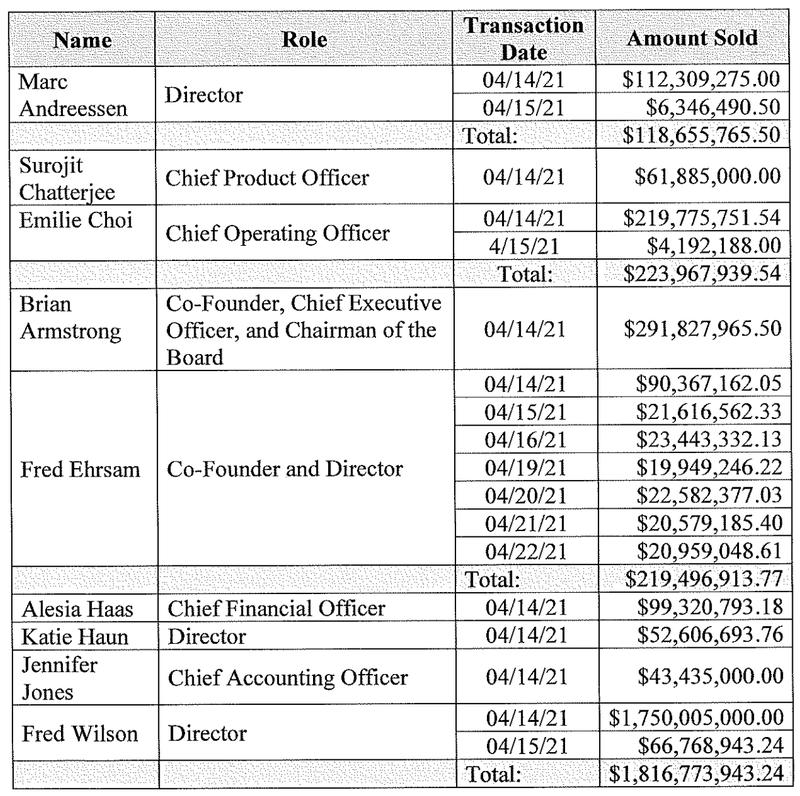
The lawsuit, brought forward by a Coinbase shareholder in 2023, claims that company directors—among them CEO Brian Armstrong and board member Marc Andreessen—leveraged non-public information to avoid over $1 billion in financial losses by disposing of shares around the time of the company's market debut in 2021. The complaint states that insiders liquidated more than $2.9 billion in stock, with Armstrong alone selling approximately $291.8 million worth of shares.
Last Friday, Delaware Chancery Court Judge Kathaleen St. J. McCormick turned down a motion to throw out the lawsuit following an investigation conducted by a special litigation committee established by Coinbase, according to Bloomberg Law's reporting. Although the judge acknowledged that the committee's conclusions offer a robust defense for the directors, she determined that concerns about the impartiality of one committee member were sufficient grounds to allow the case to proceed, the report stated.
The allegations focus on Coinbase's choice to enter the public markets via a direct listing instead of a conventional initial public offering (IPO). In contrast to an IPO, the direct listing approach did not incorporate a lockup period, which enabled existing shareholders to divest their holdings right away, and it also didn't involve creating new shares that might have diluted existing ownership stakes.
Andreessen accused of selling $118 million in Coinbase shares
Andreessen, who became a Coinbase board member in 2020, stands accused of liquidating approximately $118.7 million worth of shares via his venture capital firm, Andreessen Horowitz. The plaintiff contends that the directors were aware that Coinbase's market valuation was overinflated and disposed of their stock to circumvent later losses.
Both Coinbase and the defendants have rejected the accusations, maintaining that no evidence exists to demonstrate they held or traded on material nonpublic information. According to Bloomberg Law, Coinbase expressed being "disappointed by the court's decision" and pledged to keep challenging these "meritless claims."
The legal action was put on hold last year during a 10-month examination by the special litigation committee. The committee ultimately advised terminating the case, finding that the stock sales were restricted in scope and primarily designed to ensure adequate liquidity for the direct listing. The committee also contended that Coinbase's stock price mirrored Bitcoin (BTC)'s price fluctuations closely, dismissing allegations that the transactions were motivated by privileged information.
Nevertheless, the shareholder contested the committee's impartiality, highlighting previous commercial relationships between committee member Gokul Rajaram and Andreessen's venture capital firm. McCormick concurred that these associations presented valid concerns, though she noted there was no indication of malicious intent.
Cointelegraph contacted Coinbase requesting a statement, but had not heard back at the time of publication.
Coinbase faces new insider trading allegations
In the meantime, fresh allegations of insider trading have emerged following claims by cryptocurrency researchers that specific traders might have gained profits from prior knowledge of token listings on Coinbase. These allegations indicate that blockchain analytics and technical indicators may have been leveraged to predict which digital assets the exchange was getting ready to list, permitting certain market participants to execute trades before official public disclosures.
As a response, Coinbase announced its intention to modify its token listing procedures during the upcoming quarters to minimize information breaches and disparate access to market intelligence.