Could a Private Credit Collapse Threaten Bitcoin's Stability?
An emerging crisis in private credit markets threatens to create liquidity shortages that might initially push Bitcoin prices downward, though Federal Reserve intervention could subsequently spark a substantial BTC price surge.

Market analysts are sounding the alarm that an approaching crisis within the private credit sector, driven by escalating redemptions and increasing defaults, may have significant ramifications for Bitcoin (BTC) and the broader cryptocurrency markets.
Key takeaways:
- The private credit industry, now valued at $2 trillion, confronts potential crisis conditions stemming from defaults, investor redemptions, and insufficient regulatory supervision.
- Investors facing a liquidity squeeze might be compelled to liquidate easily accessible holdings, including Bitcoin, as their initial response.
- Past financial crises demonstrate that Federal Reserve emergency measures typically trigger substantial Bitcoin rallies as investors seek protection from monetary expansion.
The private credit ticking time bomb?
The private credit industry, representing the non-banking lending landscape that has expanded beyond $2 trillion from $500 billion over the last five years, is displaying troubling indicators of a potential crisis ahead.
Driven by an extended period of low interest rates and institutional demand for higher-yielding investments, this sector has achieved comparable scale to conventional banking institutions while operating under significantly less stringent regulatory frameworks.
In 2024, the International Monetary Fund (IMF) warned that the private credit sector "warranted closer watch," adding:
"Rapid growth of this opaque and highly interconnected segment of the financial system could heighten financial vulnerabilities given its limited oversight."
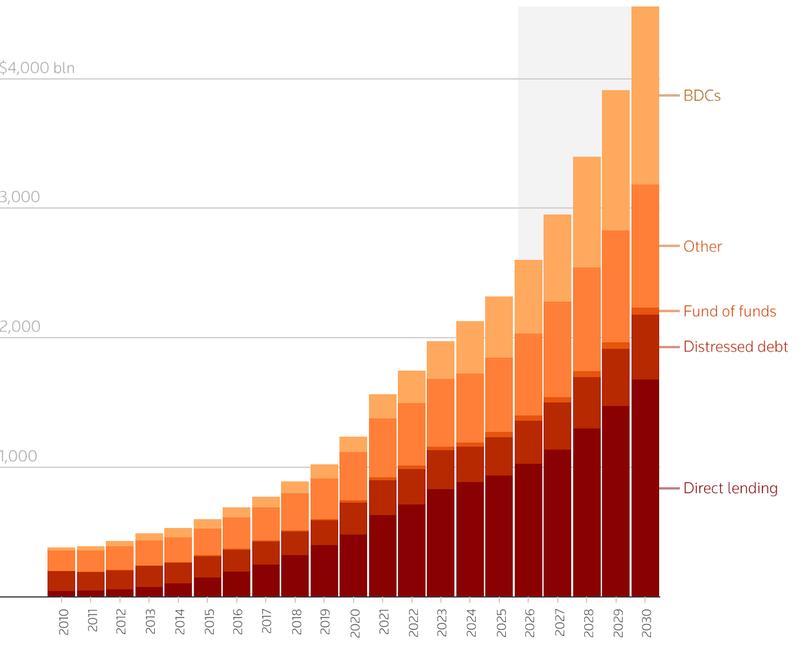
Currently, vulnerabilities are emerging across the private credit landscape that could potentially precipitate a broader financial crisis.
BlackRock, holding the position as the globe's largest asset manager, overseeing in excess of $10 trillion under management, imposed restrictions on withdrawals from its $26 billion flagship credit funds, reported Bloomberg.
Blue Owl Capital suspended redemptions completely following difficulties in the software industry caused by AI-related disruptions, while UBS warns of default rates hitting 15% in worst-case scenarios.
On Wednesday, Reuters reported that JPMorgan restricted lending to its private credit funds while Morgan Stanley and Cliffwater Private Credit Fund joined the growing list of asset managers under distress.
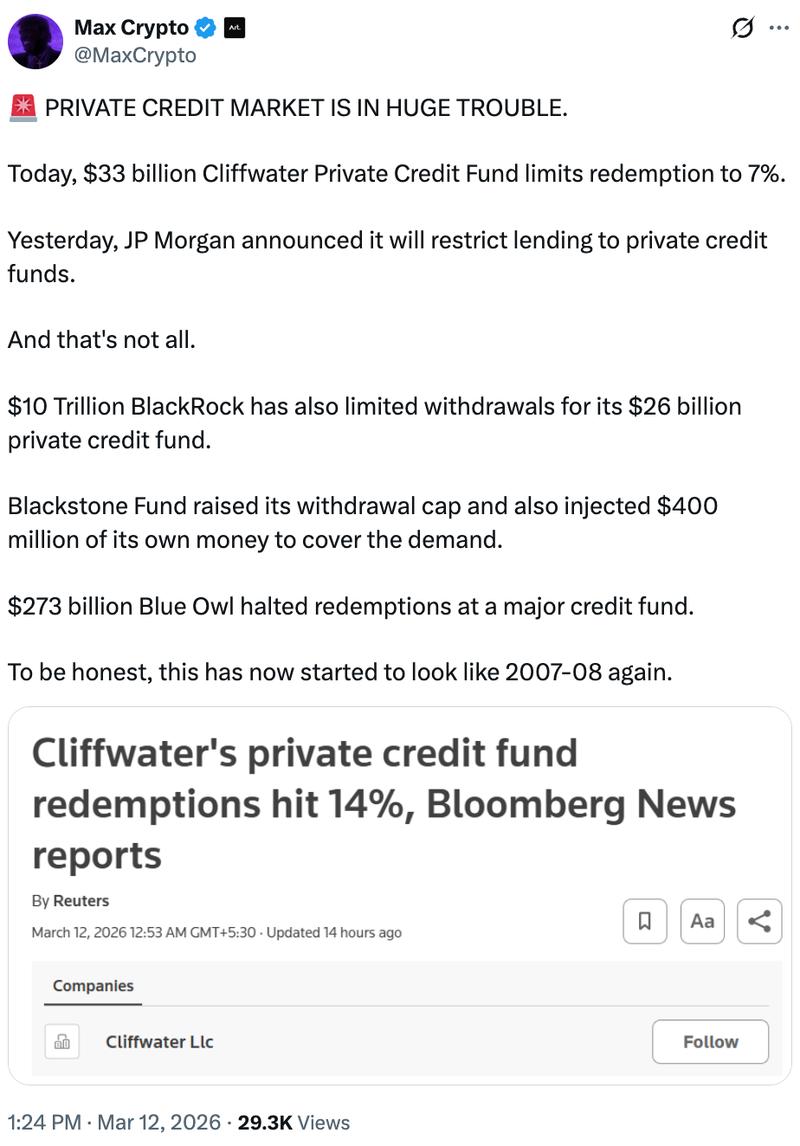
"Bond King" Jeffrey Gundlach, founder at Double Line said that the private credit fund of funds in 2026 closely mirrors CDO-squared in early 2007, before the 2008 global financial crisis.
"Financial repression is incoming," market analyst MartyParty said in an X post on Thursday, attributing the problems to the sector's rapid growth in the face of 'increasing scrutiny' over liquidity during periods of investor outflows.
"Either the Fed injects liquidity, or we go into crisis."
International geopolitical tensions and broader macroeconomic uncertainty compound these challenges, potentially postponing Federal Reserve monetary easing while simultaneously increasing pressure on equity markets and the Bitcoin price.
As Cointelegraph reported, futures markets are pricing less than a 1% chance of Fed rate cuts at the March 18 FOMC meeting.
Liquidity crunch could crash Bitcoin price, at first
Although the redemption restrictions have direct implications primarily for the private credit sector, the consequences could reverberate well beyond conventional financial markets.
Withdrawal limits are a "big deal for crypto," crypto investor Paul Barron said in a recent post on X, adding:
"When giants like Blackrock lock the gates on private funds, it signals a 'liquidity crunch.' Investors stuck in private credit might sell their 'liquid' assets (Bitcoin/ETH) to raise cash elsewhere."
The implication is that when investors find themselves unable to withdraw capital from illiquid private credit holdings, they may redirect their attention to assets offering immediate liquidity in publicly traded markets.
Bitcoin, operating continuously throughout a 24/7 trading cycle, frequently becomes the initial asset liquidated under these circumstances. Its price dropped sharply by 50% in March 2020 as the market priced in the COVID-19 crisis.
However, such market dislocations typically trigger governmental responses: emergency liquidity provisions and interest rate reductions, designed to prevent systemic financial collapse.
In 2020, Fed actions post-crash fueled Bitcoin's surge to its previous all-time high of $69,000 by year-end from $4,400, a 1,400% rally.
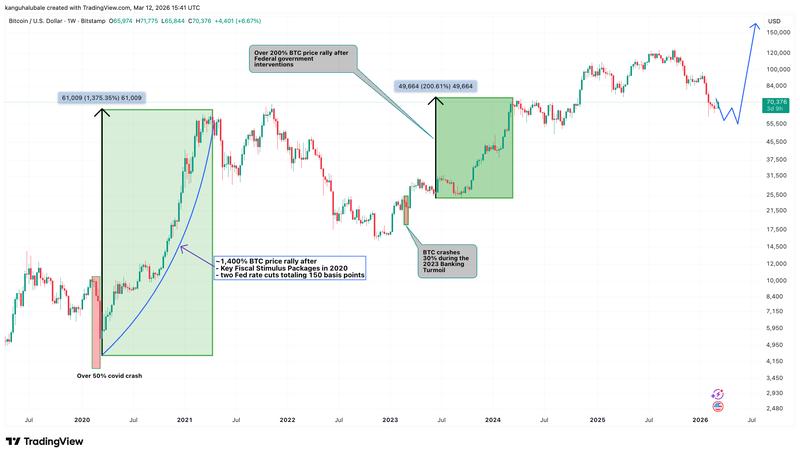
In a comparable scenario, during the March 2023 banking turmoil, Bitcoin initially sold off on contagion fears, then rallied more than 200% as markets priced in a Fed pause on rate hikes.
These historical patterns indicate that a deterioration in the private credit market could eventually lead to additional monetary supply expansion, propelling BTC price to new highs.
As Cointelegraph reported, BitMEX co-founder Arthur Hayes will wait until the Fed loosens its monetary policy before buying any more Bitcoin. BTC price will then rise to $250,000, he predicted.