BPS Financial faces $9.3M court-ordered fine for deceptive Qoin Wallet practices
BPS Financial has been ordered by Australia's Federal Court to pay penalties totaling $9.3 million, including $1.3 million for operating without proper licensing and $8 million for deceptive and misleading conduct.

The Australian Securities and Investments Commission (ASIC) has achieved a significant legal win against BPS Financial Pty Ltd (BPS), as the Federal Court mandates the financial services firm to pay 14 million Australian dollars ($9.3 million) in total penalties related to the marketing and management of its Qoin Wallet offering.
This decision comes after several years of litigation initiated by the Australian Securities and Investments Commission (ASIC), which charged BPS with operating a financial services enterprise without proper licensing and making deceptive statements regarding its cryptocurrency-related payment solution.
Given the nature of these products, providers must have the appropriate licenses and authorisations, and investors must be able to make decisions based on clear and correct statements, especially as crypto products can be highly volatile, inherently risky and complex.
ASIC Chair Joe Longo
BPS Financial hit with fines, restrictions
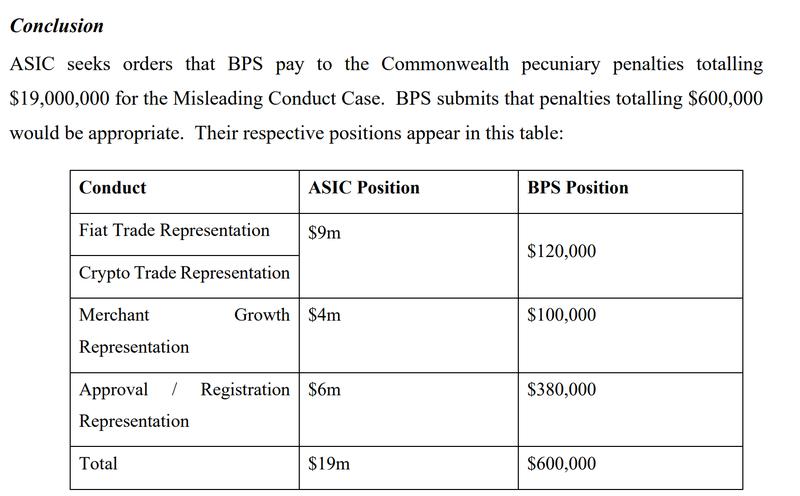
The court-imposed penalty consists of $1.3 million for conducting business without appropriate authorization and $8 million for engaging in misleading and deceptive practices. Judge Downes, in her ruling, characterized BPS's behavior as "serious and unlawful misconduct," highlighting the participation of upper-level management and pointing to the firm's insufficient compliance frameworks.
In addition to the monetary sanctions, the court has placed numerous operational constraints on BPS. The firm is now prohibited from conducting any financial services operations without obtaining proper licensing for a period of 10 years. Additionally, BPS must publish court-approved public notices through both the Qoin Wallet application and its website, and the company is required to pay the majority of ASIC's litigation expenses.
In 2022, ASIC launched civil penalty proceedings against BPS Financial over alleged misleading claims and unlicensed conduct linked to its Qoin token.
According to previous court rulings delivered in 2024 and confirmed upon appeal in 2025, the court determined that BPS participated in misleading and deceptive behavior by making untruthful assertions about the Qoin Wallet. Such false representations included statements suggesting the product had received official approval or registration, that Qoin tokens were easily convertible to traditional currency or alternative crypto-assets, and that the token enjoyed widespread merchant acceptance.
ASIC eases licensing rules for stablecoins
In December, ASIC finalized new exemptions to simplify the distribution of stablecoins and wrapped tokens, removing the need for intermediaries to hold separate Australian Financial Services licenses.
These regulatory adjustments permit companies to utilize "omnibus accounts" when accompanied by proper record-keeping procedures, building upon previous relief measures and decreasing compliance burdens for enterprises active in the digital asset and payments industries.
In a Tuesday report titled "Key issues outlook 2026," ASIC's Longo flagged retail exposure to opaque private credit, operational failures in superannuation, high-risk investment sales that threaten retirement savings, AI-related consumer harm and regulatory gaps in digital assets and fintech as key risk areas for the year ahead.