Think tank urges Taiwan to explore Bitcoin reserves as wartime contingency
A Bitcoin Policy Institute research fellow argues Taiwan needs to reassess Bitcoin as a strategic reserve to protect against international instability and potential military conflict.
A research fellow from the Bitcoin Policy Institute has called on Taiwan to reevaluate the possibility of establishing Bitcoin as a strategic reserve asset, positioning it as a safeguard against worldwide instability and potential military confrontation.
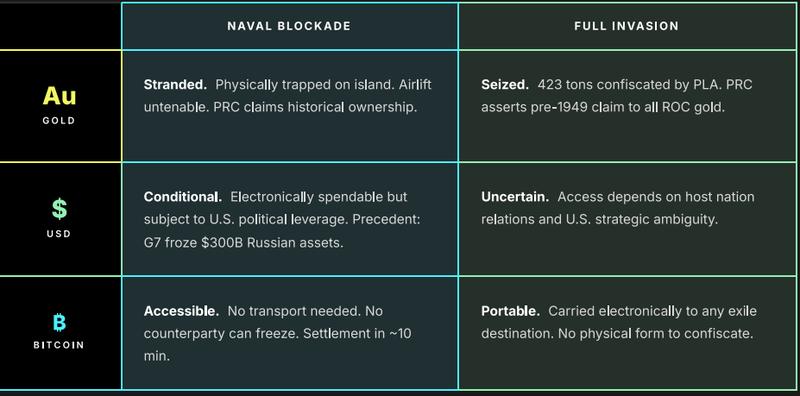
Jacob Langenkamp released a report on Tuesday arguing that if China were to attempt forcible reunification with Taiwan through either a naval blockade or complete military invasion, Bitcoin (BTC) would be the sole reserve asset maintaining full accessibility and usability in both circumstances.
"Uniquely for Taiwan, Bitcoin provides geopolitical resilience: in a PRC blockade or invasion, gold is stranded or seized and USD reserves face potential restrictions, but Bitcoin remains fully accessible without physical transport," he added.
Countries around the world have started examining the possibility of creating strategic Bitcoin reserves, a development viewed as positive momentum for Bitcoin's future prospects.
During the previous year, Taiwan's central banking authority initiated an examination into creating a nationwide Bitcoin reserve. Nevertheless, the institution dismissed the proposal in December, pointing to concerns regarding price volatility, market liquidity and secure storage challenges, ultimately identifying the US dollar as a more secure option.
US currency debasement is a risk to Taiwan: Langenkamp
According to Langenkamp, Taiwan faces significant vulnerability to US dollar debasement risks, given that its central banking reserves consist of no less than 80% USD-denominated assets, with the majority of its international commerce conducted in the same currency.
The escalating US national debt, Federal Reserve monetary policy expansion, a possible artificial intelligence market correction and diminishing semiconductor industry revenues could all contribute to faster dollar debasement, according to his analysis.
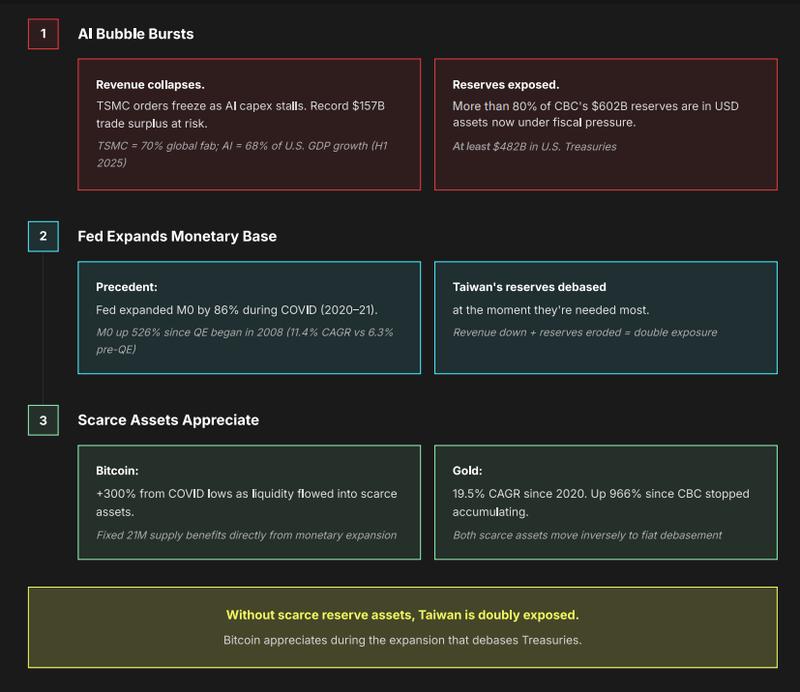
"Bitcoin can couple with gold to offer that hedge against USD debasement. It can provide another opportunity for the CBC to adopt a reserve asset before its peers and benefit the people of Taiwan with the subsequent price appreciation," Langenkamp added.
"It can offer geopolitical insurance against scenarios that hopefully do not come to pass. It can open new methods of trade with less friction. Bitcoin can provide Taiwan with a great measure of monetary resilience."
While Langenkamp acknowledged the CBC's apprehensions regarding Bitcoin's market liquidity and price volatility as legitimate concerns, he maintains that both challenges will decrease as the digital asset develops maturity and achieves broader acceptance among sovereign nations.
"The CBC's concerns are valid but addressable with institutional expertise on custody, liquidity, and volatility," he added.
Taiwan has at least 210 Bitcoin
Although rejecting a Bitcoin reserve in the immediate term, the CBC pledged to continue evaluating the technology through additional testing in a digital asset experimental environment utilizing cryptocurrency already in the nation's possession.
Ko Ju-Chun, a Taiwanese lawmaker, disclosed on X last year that the country's Ministry of Justice maintains custody of 210 Bitcoin, valued at $14 million, which were seized during law enforcement criminal investigations.
Taiwan does not appear in BitBo's country reserve rankings; however, its revealed holdings would position it as the seventh-largest sovereign Bitcoin holder globally, trailing El Salvador but surpassing Finland in the rankings.