Supreme Court Blocks Trump's Tariff Authority as President Vows Alternative Approach
In a significant ruling, the US Supreme Court has determined that President Trump cannot impose tariffs using powers granted under the International Emergency Powers Act (IEEPA).
On Friday, the Supreme Court of the United States (SCOTUS) delivered a decision that invalidated the majority of President Donald Trump's tariff measures, with a 6-3 majority of justices determining that the Executive Branch does not possess the power to impose tariffs through the International Emergency Economic Powers Act (IEEPA).
The Friday decision stated that "IEEPA does not authorize the President to impose tariffs," further noting that during peacetime, the president possesses "no inherent authority" to levy tariffs using the provisions found within the IEEPA. According to the ruling:
"In IEEPA's half-century of existence, no president has invoked the statute to impose any tariffs, let alone tariffs of this magnitude and scope. That 'lack of historical precedent,' coupled with the breadth of authority that the President now claims, suggests that the tariffs extend beyond the President's 'legitimate reach.'"
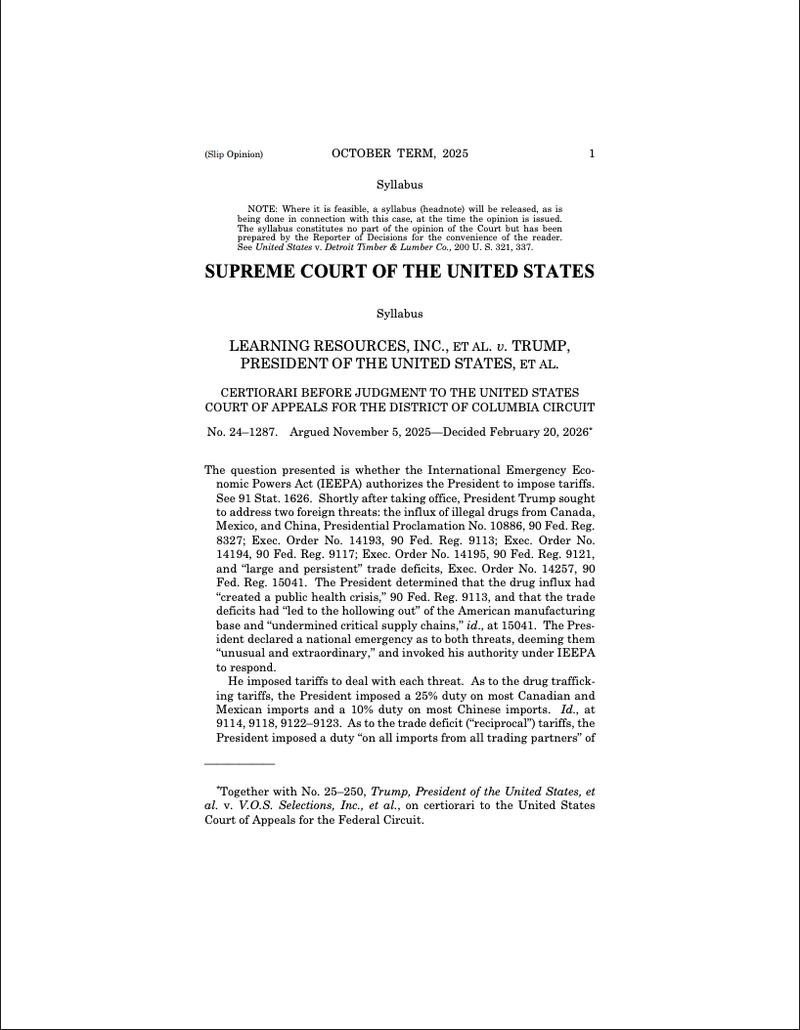
President Trump had argued that the alleged influx of illegal drugs from Canada, China and Mexico, along with the "hollowing out" of America's industrial base, represented a national emergency under IEEPA sufficient to warrant the tariff implementation, an argument the court ultimately rejected.
Trump criticizes court, says he'll get tariffs reinstated
During a press briefing that took place after the ruling was announced, Trump launched criticism at the justices who supported striking down the tariffs and pledged to have them reinstated, according to a Politico report.
Politico quoted him as stating: "The Supreme Court's ruling on tariffs is deeply disappointing, and I'm ashamed of certain members of the court, absolutely ashamed, for not having the courage to do what's right for our country."
The president indicated that he would restore the tariffs through the use of "other alternatives."
The tariff policies implemented by Trump created significant turbulence across asset markets throughout 2025, triggering sharp declines in both cryptocurrency and equity markets whenever new tariff measures were announced or merely suggested, amplifying macroeconomic uncertainty.
Trump claims tariffs could replace income tax, but crypto markets are paying the price
During the campaign period in October 2024, Trump proposed the concept of eliminating the federal income tax system and replacing it with revenue collected from tariffs. According to Trump, the tariff revenue would significantly reduce the US budget deficit.
In April 2025, Trump stated that federal taxes would be "substantially reduced" for individuals and households earning under $200,000 annually once the tariff revenues began flowing into government coffers.
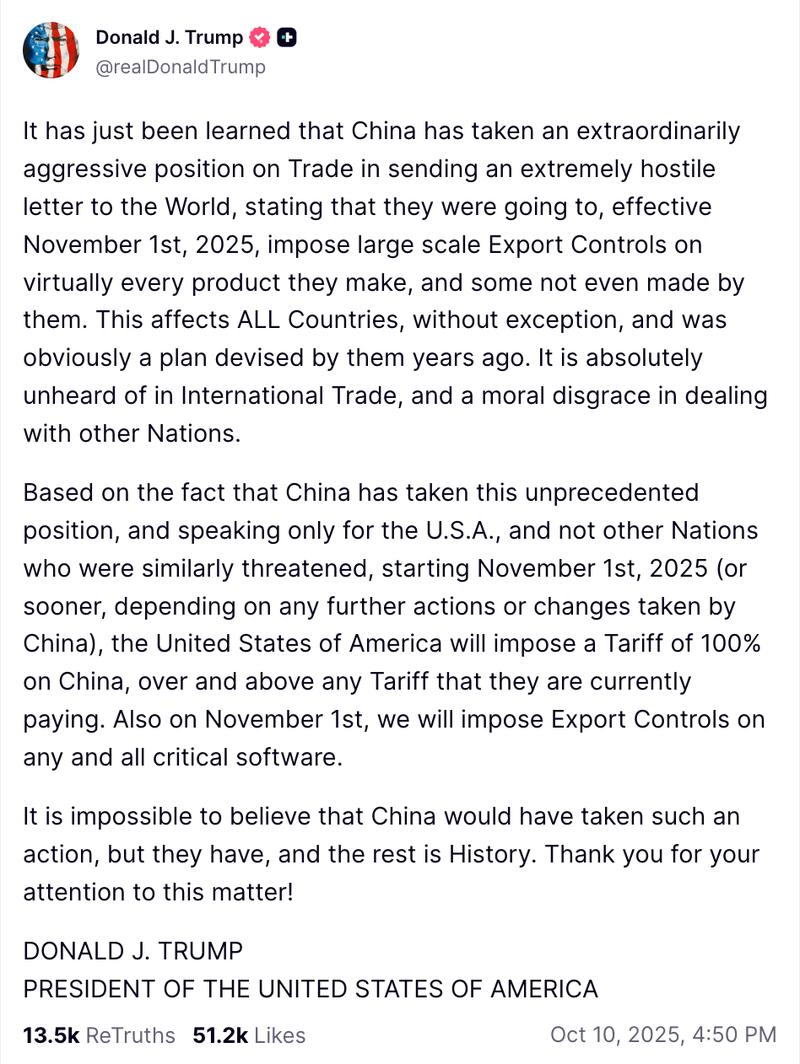
On Oct. 10, 2025, Trump declared 100% tariffs on China. Almost immediately, cryptocurrency markets experienced a severe downturn, with the price of Bitcoin (BTC) falling from approximately $122,000 to roughly $107,000 on the very same day the tariff announcement was made.
Market analysts pointed to multiple factors behind the market collapse, including excessive leverage positions. Nevertheless, according to data from Santiment, a market sentiment analysis platform, traders overwhelmingly identified the 100% China tariffs as the primary trigger for the cryptocurrency market crash.
Cryptocurrency valuations have not yet rebounded from the October downturn, with BTC continuing to trade approximately 50% lower than its all-time peak of over $125,000 that was achieved on October 6, even though Trump has since reversed course on his tariff strategies.