Q1 2026 DeFi Breaches: Hackers Drain $169M Across 34 Platforms, DefiLlama Reports
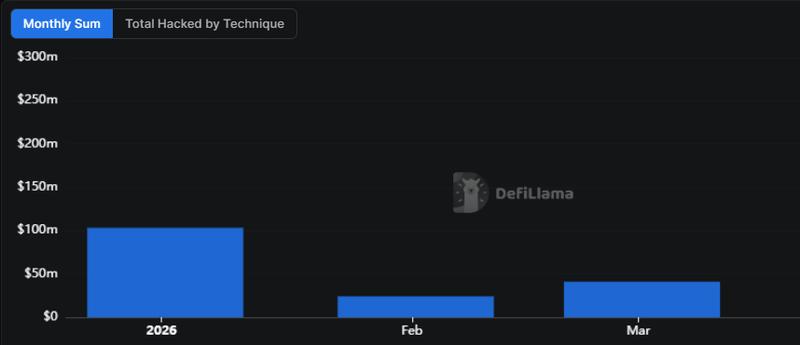
DefiLlama data reveals that hackers exploited a minimum of 34 DeFi platforms during Q1 2026, making off with over $168 million across the three-month period, representing a substantial decrease compared to the equivalent timeframe in the previous year.

During the opening quarter of 2026, malicious actors successfully extracted more than $168.6 million worth of digital assets from a total of 34 decentralized finance (DeFi) platforms, marking a notable decrease when compared to figures from the identical timeframe the year prior, as reported by DefiLlama's tracking data.
According to the available information, the most substantial security breach of the quarter involved a private key compromise affecting Step Finance in January, which resulted in losses totaling $40 million. Coming in second place was an attack exploiting smart contract vulnerabilities that siphoned $26.4 million worth of ether (ETH) from the Truebit platform on Jan. 8. Rounding out the top three incidents was another private key compromise, this time affecting stablecoin provider Resolv Labs on March 21.
This three-month total appears relatively modest when considering that during the corresponding quarter of 2025, the cryptocurrency sector experienced losses amounting to $1.58 billion, with the overwhelming majority attributed to the massive $1.4 billion Bybit security breach. Nevertheless, security professionals caution against assuming that cryptocurrency-related hacking incidents follow predictable seasonal patterns throughout the calendar year.
Hackers are more active when industry is booming
Speaking with Cointelegraph, Nick Percoco, who serves as chief security officer at the Kraken cryptocurrency exchange, explained that malicious cyber activity within the digital currency space typically intensifies in correlation with market momentum and significant industry events, rather than adhering to predetermined timeframes.
Additionally, malicious actors gravitate toward locations where liquidity has become densely concentrated, which means that attack frequency tends to surge in areas experiencing the most rapid value accumulation, Percoco noted.
"Bull markets, major product launches and fast-moving growth phases all create more attractive conditions for attackers because more value is at stake and new infrastructure can introduce risk," he said.
"That said, attacks are not confined to just these periods. Vulnerabilities can be exploited in any market environment, particularly in complex or rapidly evolving systems, underlining that security in crypto must be continuous."
Crypto attackers are a "broad and evolving mix"
Threat actors with suspected ties to North Korea have established themselves as an ongoing menace to both cryptocurrency investors and organizations operating in the Web3 ecosystem.
Multiple cyberattacks have raised suspicions of involvement by hackers associated with the nation, including the recent Wednesday incident targeting Drift Protocol, a decentralized digital currency exchange platform that suffered estimated losses of approximately $285 million resulting from a private key exposure.
According to Percoco's assessment, the current threat environment comprises actors demonstrating varying degrees of technical capability, ranging from highly organized collectives focusing on critical infrastructure to structured cybercriminal operations and opportunistic individuals actively searching for exploitable vulnerabilities in smart contract code and user-facing platforms.
"It is a broad and evolving mix, but they are ultimately targeting the same thing: global, liquid and accessible value. Targeting is rarely purely random. In many cases, attackers are deliberate in how they assess infrastructure, code, access controls and even human behavior," he said.
"At the same time, crypto's transparency makes it easier for opportunistic actors to spot weaknesses as they emerge. The most attractive targets tend to be those combining large concentrations of value, technical complexity and gaps in operational security."
In earlier discussions with Cointelegraph, cybersecurity specialists predicted that 2026 would probably witness a rise in advanced credential theft techniques, enhanced social engineering tactics, and attack methods powered by artificial intelligence.