Has the Bitcoin-to-gold correlation chart lost its reliability?
BTC has fallen beneath historical threshold levels against gold that traditionally signaled cycle lows and preceded significant dollar-denominated price surges.

Throughout multiple years, those trading Bitcoin (BTC) have monitored the cryptocurrency's valuation compared to gold (XAU) to identify signals indicating when BTC reaches its lowest points measured in US dollars. However, as 2026 unfolds, this traditional BTC-versus-gold indicator appears to be becoming increasingly unreliable.
Key takeaways:
- Bitcoin reaches undervalued territory against gold and has fallen beneath its Power Law trajectory.
- The BTC/XAU ratio has already dropped under the 200-2W EMA that previously corresponded with market bottoms.
- Gold's upcoming price action will likely determine if BTC experiences a recovery bounce.
Bitcoin continues falling against gold
During the current week, the ratio between BTC and XAU, representing Bitcoin's value measured against gold, moved away from its historical "Power Law" trajectory for the first recorded instance, according to observations from analyst Julius.
The Power Law represents a long-range trend line that certain market analysts employ to project Bitcoin's developmental trajectory across extended timeframes. From a trading perspective, this model can indicate potential price excesses when valuation extends beyond the upper curve, and possible price discounts when it falls underneath.
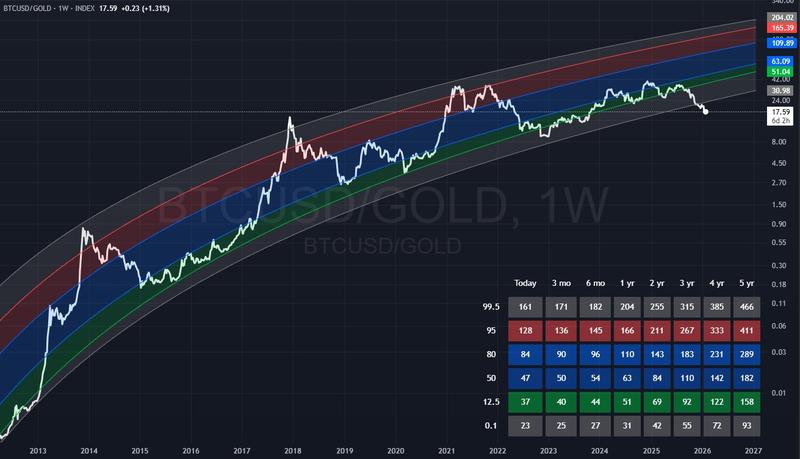
By January's arrival, the BTC/XAU pair had reached its deepest undervaluation point. This valuation level materialized as gold broke through the historic $5,000 threshold and financial markets shifted toward risk-aversion amid concerns about yen intervention measures and potential US government shutdown scenarios.
This development also coincided with numerous Wall Street institutions forecasting additional upward movement for gold throughout 2026, with Bank of America projecting last week that the precious metal would climb beyond $6,000 before the year concludes.
Meanwhile, Bitcoin trading communities expressed worries regarding the validity of the four-year-cycle hypothesis. According to this framework, BTC's price peaked at approximately $126,200 during October 2025, with potential further depreciation to levels under $50,000 during upcoming months.
This development pointed toward a prolonged downward trajectory for BTC/XAU over the next several weeks, as opposed to a typical cyclical bottom formation pattern.
Do technical indicators point toward a BTC price low?
An ongoing decrease in the BTC/XAU metric would additionally risk a definitive breakdown beneath the 200-2W EMA (200-2W EMA; the blue wave), a threshold that has historically corresponded with authentic BTC/USD cyclical bottom formations.
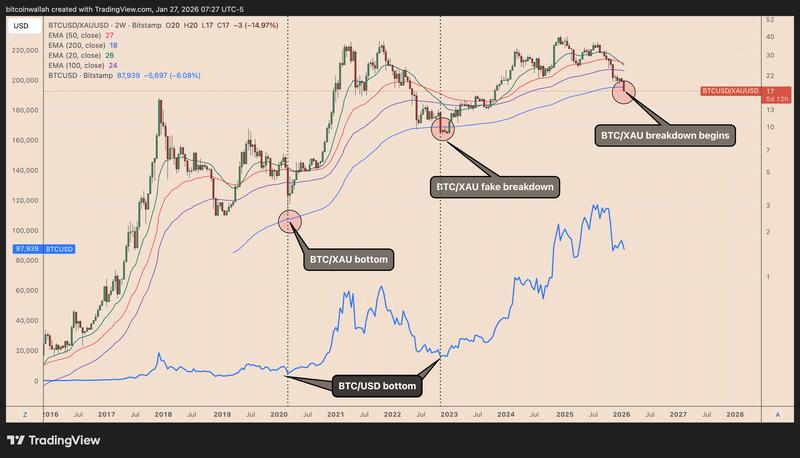
This historical pattern encompasses a false breakdown occurrence in 2022, during which BTC/XAU penetrated below its 200-2W EMA before subsequently recovering it as a support floor following a two-month period.
Throughout 2026, the ratio has already descended beneath that identical EMA, with macroeconomic factors increasing the probability of additional downward movement, thereby potentially invalidating the historical BTC/XAU bottom pattern.
On the other hand, Citi issued a warning that gold's upward momentum might pause or change direction later during 2026 should actual US yields climb, the dollar achieves stability and market participants regain risk tolerance. Under such circumstances, the appetite for protective, risk-averse investment vehicles could diminish.
Should gold experience a price correction, this could ease certain downward pressures on BTC/XAU, potentially reviving Bitcoin's prospects of reaching $140,000 or more ambitious price objectives, as forecasted by Standard Chartered along with additional financial institutions.