Financial institutions express stablecoin deposit concerns while experts question actual risk
Traditional financial institutions raise alarms about stablecoins potentially draining banking deposits, though regulatory authorities and policy analysts indicate minimal concrete evidence supporting these concerns.

Traditional banking institutions have raised concerns that stablecoins — particularly those offering yield — might withdraw deposits from conventional banking systems, though regulatory authorities and policy analysts maintain there is minimal concrete evidence supporting these claims at present.
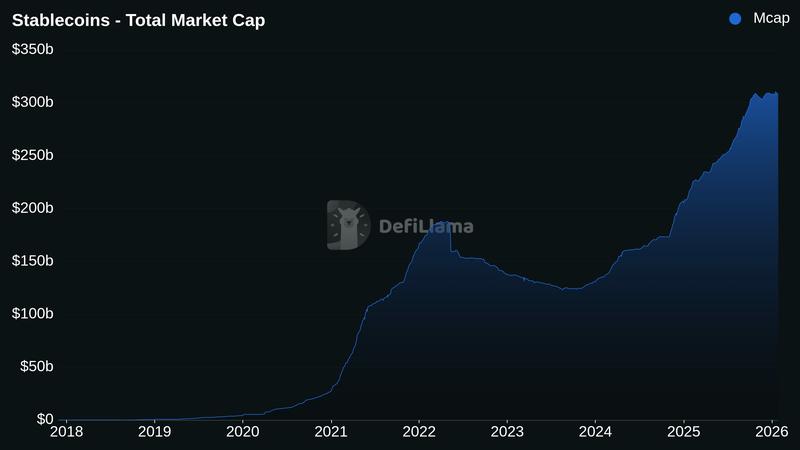
In a recent research analysis, major US financial institution Standard Chartered projected that the expansion of stablecoins could result in deposit drainage from traditional banks. According to their estimates, "US bank deposits will decrease by one-third of stablecoin market cap," a figure that currently reaches $308.15 billion based on data from DeFiLlama.
This discussion has gained momentum as United States legislators consider whether interest payments on stablecoin holdings should be banned under a proposed iteration of the cryptocurrency market structure legislation, known as the CLARITY Act. The bill has experienced delays following objections from cryptocurrency industry participants, despite receiving backing from the banking sector.
Traditional financial institutions contend that permitting stablecoins to bear yield could hasten the exodus of deposits, whereas skeptics argue that such risks remain predominantly hypothetical in nature.
Limited evidence of deposit outflows
Aaron Klein, a senior fellow in Economic Studies at the policy research institution Brookings, told Cointelegraph that, so far, stablecoins have primarily been used for crypto-related activities and as a store of value in non-dollar countries. "You will find little evidence that stablecoins have drained bank deposits," he said.
Regulators in Europe appear to hold comparable perspectives. An official from the European Banking Authority (EBA) indicated that stablecoins throughout the European Union are predominantly regarded as payment mechanisms within the cryptocurrency ecosystem and continue to see limited consumer adoption. "Because of low engagement in [or] use of stablecoins currently within the EU, we do not see current currency substitution, capital flight or dollarisation risks," they said.
Nevertheless, Klein indicated that circumstances could evolve. He emphasized that what can be discovered are "arguments that if stablecoins take off as their supporters claim they will, then it will likely result in a drain in bank deposits."
According to Klein, this scenario would diminish available capital, since "bank deposits support bank lending, so reduced bank deposits reduce the supply of credit available through bank-based products."
In a similar vein, the EBA official informed Cointelegraph that should stablecoin adoption grow substantially, it would create potential "financial stability risks from stablecoins jointly issued by EU and non‑EU entities."
Such risks would encompass bank run scenarios, cross-border legal complications, regulatory arbitrage opportunities and supervisory obstacles. The EBA official noted that dollarization represents a primary concern for emerging market economies and that a "shift away from euro‑denominated settlement assets toward US dollar‑backed stablecoins is not foreseen in the EU."
An official from a prominent EU central banking institution expressed a more optimistic perspective regarding stablecoin-related technologies. The representative proposed that tokenized deposits alongside properly regulated euro-denominated stablecoins could enhance Europe's strategic independence by decreasing reliance on third-country stablecoins."
However, the official acknowledged that stablecoins might present financial stability threats due to their connections with the traditional financial system, though EU regulatory frameworks are designed to address those risks, with the European Central Bank actively monitoring related developments.
Stablecoin proponents disagree
Colin Butler, head of markets at Mega Matrix, said banning compliant stablecoins from offering yield would sideline regulated institutions while accelerating capital migration beyond US oversight and failing to protect the US financial ecosystem.
Jeremy Allaire, CEO of the publicly listed stablecoin issuer Circle, recently said that interest payments on stablecoins do not pose a threat to banks.
During his appearance on the World Economic Forum platform in Davos, Allaire characterized such bank-run worries as "totally absurd." He maintained that yields "help with stickiness, they help with customer traction," but cannot undermine monetary policy.
Earlier this month, Anthony Scaramucci, founder of asset manager SkyBridge Capital, claimed that banks simply "do not want the competition from the stablecoin issuers, so they're blocking the yield."
This January, the People's Bank of China, the country's central bank, allowed commercial banks to pay interest on digital yuan deposits. According to Scaramucci, this development positions China at an advantage relative to the US.
"In the meantime, the Chinese are issuing yield, so what do you think the emerging countries will choose as a rail system, the one with or without yield?" he said.