Dmail Network to discontinue operations on May 15 amid financial pressures
Following unsuccessful fundraising attempts, elevated infrastructure expenses, and insufficient token functionality, Dmail Network announces service termination effective May 15.

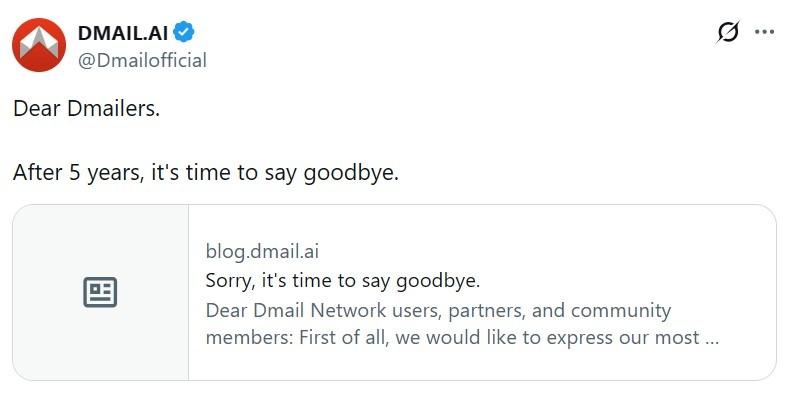
After operating for five years, Dmail Network, a decentralized email service, has announced its closure. The platform attributes its shutdown to mounting infrastructure expenses, insufficient revenue generation, unsuccessful attempts to secure funding, and a lack of meaningful token utility that would sustain operations.
According to the announcement, the service will begin a phased shutdown process commencing May 15, with users being strongly advised to retrieve and export their data prior to this deadline. The company emphasized that once all nodes are taken offline following this date, user emails and account information will become permanently inaccessible.
The platform had established itself as a Web3-focused communication service that specialized in decentralized email functionality tied to wallet addresses, secure encrypted messaging capabilities, and blockchain-based notification systems. Data from DappRadar in January 2025 showed Dmail securing the second position among AI-powered decentralized applications, recording 4.9 million unique active wallets during that period.
The demise of Dmail Network demonstrates that substantial user engagement alone proved insufficient to maintain the viability of a Web3 product with significant infrastructure requirements, particularly when faced with the combined challenges of elevated operational expenses, inadequate revenue streams, and unsuccessful capital-raising efforts.
Dmail points to costs, failed fundraising and weak token use
According to Dmail, maintaining the financial viability of operating a decentralized communication infrastructure had become progressively more challenging. The company's shutdown announcement detailed how bandwidth requirements, data storage needs, and computational resources consumed substantial portions of the operational budget, with these expenditures escalating proportionally with user base expansion.
The platform indicated that its team investigated various subscription-based models and alternative monetization strategies, but ultimately could not identify a revenue approach that users would embrace on a sufficient scale to ensure sustainability.
Dmail indicated that deteriorating cryptocurrency market conditions compounded these existing challenges. The organization revealed that several attempts to secure financing across multiple funding rounds were unsuccessful, potential acquisition opportunities did not materialize, and available capital reserves were approaching depletion. The company also noted that key personnel departures among core team members left the remaining staff without adequate resources to continue infrastructure maintenance.
The announcement further stated that the project's native token failed to establish a meaningful, scalable utility within the ecosystem, and the token's economic framework never achieved the self-reinforcing循环 necessary for long-term viability. In the aftermath of this announcement, data from CoinGecko shows that Dmail Network's token plummeted to a record low valuation of $0.0002067.
Dmail joins growing list of Web3 closures
The closure of Dmail Network adds to an expanding series of Web3 project shutdowns in recent months, as platforms grapple with insufficient market demand and mounting financial constraints.
Just weeks earlier on March 18, Tally, a platform providing tools for decentralized autonomous organizations, announced its wind-down after determining that sustainable market demand for its offerings did not exist. Shortly thereafter on March 24, Balancer Labs, a blockchain development firm, revealed plans to cease operations merely four months following a security breach that resulted in losses exceeding $100 million.