Centralized Exchanges Losing Ground to Alternative Crypto Laundering Methods: Chainalysis Report
A new Chainalysis report reveals that on-chain money laundering operations handled $82 billion in 2025, with Chinese-speaking networks emerging as the primary facilitators.

Centralized cryptocurrency exchanges are experiencing a decline in their use for washing illicit digital assets, while money laundering networks operating in Chinese-language channels have reached unprecedented levels of activity, new data from Chainalysis reveals.
According to a Tuesday report from Chainalysis, informal service-oriented networks operating through Chinese-language channels provide an extensive range of laundering-as-a-service operations that leverage money mules, informal over-the-counter trading desks, and gambling sites to blend and exchange cryptocurrencies.
These networks first appeared at the beginning of the COVID-19 pandemic in early 2020, and they currently "dominate known crypto money laundering activity."
In recent years, centralized cryptocurrency exchanges have taken significant steps to strengthen their customer verification processes and security measures, responding to increasingly stringent regulatory requirements imposed by authorities worldwide aimed at eliminating illicit cryptocurrency transactions.
Chinese-language networks see 20% of illicit crypto flows
Over the past five years, Chainalysis has calculated that these Chinese-language networks have handled approximately 20% of monitored illicit cryptocurrency funds, a trend that has occurred alongside a consistent decrease in centralized exchange usage, which the firm attributes to the fact that "exchanges can freeze funds."
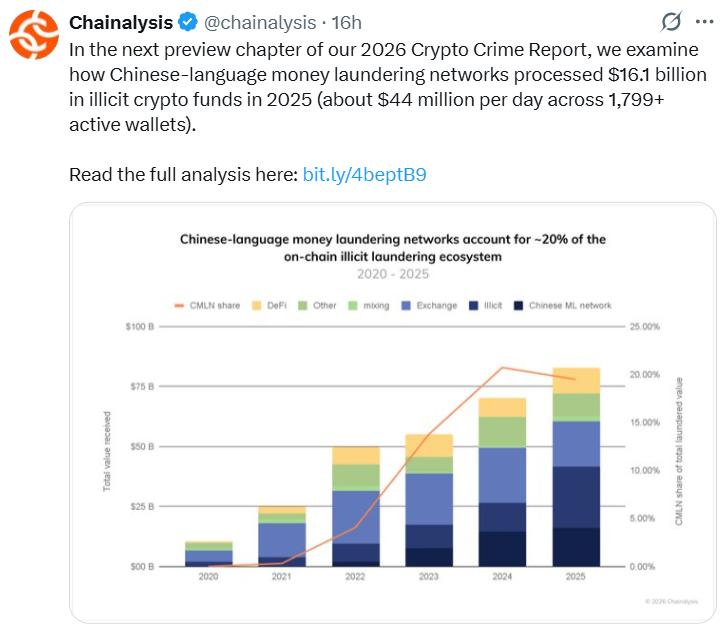
According to Chainalysis, "compared to other laundering endpoints" since 2020, the volume of inflows directed to identified Chinese-language networks expanded 7,325 times more rapidly than flows to centralized exchanges.
"While [Chinese-language networks] are by no means the only facilitator of on-chain laundering, Chinese-language Telegram-based services now account for a disproportionate share of the attributed global on-chain money laundering landscape," it added.
On-chain laundering ecosystem is growing
The ecosystem for on-chain money laundering has experienced substantial expansion, with Chainalysis calculating that more than $82 billion in illicit funds underwent laundering in 2025, a dramatic increase from $10 billion in 2020.
According to the report, the Chinese-language networks handled $16 billion, equating to approximately $44 million per day, with a primary catalyst for this expansion being the growing accessibility and widespread adoption of cryptocurrency.
"This substantial topline growth reflects the growing accessibility and liquidity of cryptocurrencies, as well as a fundamental shift in how this laundering activity occurs and by whom," Chainalysis said.
Law enforcement needs to upskill
According to Chainalysis, law enforcement agencies must focus on targeting the illicit operators and vendors, together with their advertising platforms, in order to dismantle on-chain money laundering operations.
Tom Keatinge, the director of the Centre for Finance & Security at the think tank the Royal United Services Institute, told Chainalysis, "there is a chasm in most countries between the capabilities of criminals and law enforcement when it comes to crypto use."
"Whilst blockchain tracing companies have provided welcome assistance in some cases, this capacity building is just the tip of the iceberg," he said.
Keatinge added that a "systemic global effort to upskill the crypto capabilities of law enforcement around the world and create better information sharing mechanisms is urgently needed."