VersaBank introduces cross-border FX capabilities for tokenized deposit platform
Adding USD–CAD currency exchange to its tokenized deposit offering, the Canadian financial institution facilitates instant cross-border payments as banking sector explores blockchain settlement infrastructure.

A federally chartered Canadian digital banking institution specializing in institutional lending, VersaBank, is incorporating foreign exchange capabilities into its tokenized deposit offering, giving users the ability to exchange US and Canadian dollars through a blockchain-powered infrastructure.
The enhancement, made public on Tuesday, facilitates around-the-clock, instant currency exchange utilizing Real Bank Tokenized Deposits (RBTDs), which serve as digital equivalents of fiat currency deposits that are issued and fully supported by the financial institution based in Ontario.
The capability aims to enhance cross-border payment flows by minimizing dependence on conventional foreign exchange infrastructure, which typically operates more slowly and faces restrictions tied to standard banking operational hours.
This enhancement represents a gradual advancement toward market availability instead of a complete product rollout. The bank has been running tests on its tokenized deposit infrastructure since the previous year, with the incorporation of US dollar and Canadian dollar exchange broadening its capabilities for international payments, especially for transactions between these two nations.
According to the American Bankers Association, RBTDs represent tokenized forms of banking deposits that can be moved across blockchain networks while continuing to function as obligations of the bank that issues them and maintaining full 1:1 backing through customer deposits. In contrast to stablecoins, which are generally issued by entities outside the banking sector, these tokens function within the conventional banking framework.
Financial institutions explore tokenized deposits
Banking institutions are progressively examining tokenized deposits as a method to merge the rapid processing and programmable features of blockchain technology with the security provided by conventional deposits, especially for applications such as international payments and financial settlement, as KPMG has documented.
A significant illustration is BNY's introduction of tokenized deposits designed for institutional customers, created to facilitate collateral and margin obligations. According to BNY, this initiative responds to institutions seeking "faster and more efficient ways to move assets."
On an international scale, Singapore's Project Guardian is examining asset tokenization within financial markets, incorporating experimental initiatives that involve tokenized deposits along with additional digital assets.
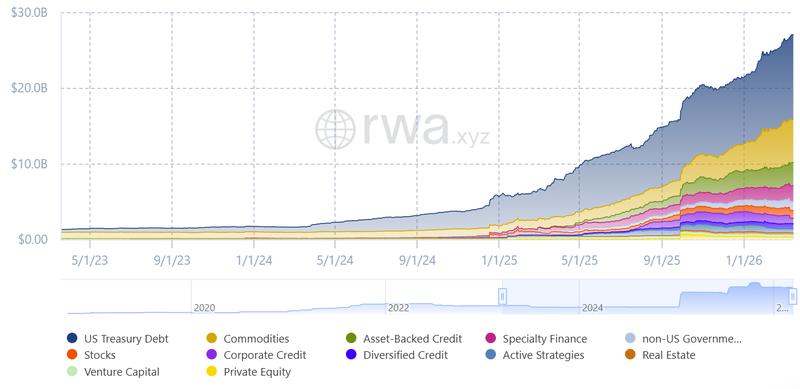
This initiative arrives as tokenization develops into one of blockchain technology's most rapidly expanding applications. Data from the industry indicates over $27 billion in tokenized assets spanning various products from private credit to US Treasury bonds and equities.