
Senate Panel in Australia Endorses Legislation for Cryptocurrency Platform Licensing
A new regulatory framework is advancing in Australia that would require cryptocurrency trading venues and tokenization services to obtain licensing under the nation's Australian Financial Services Licence system.

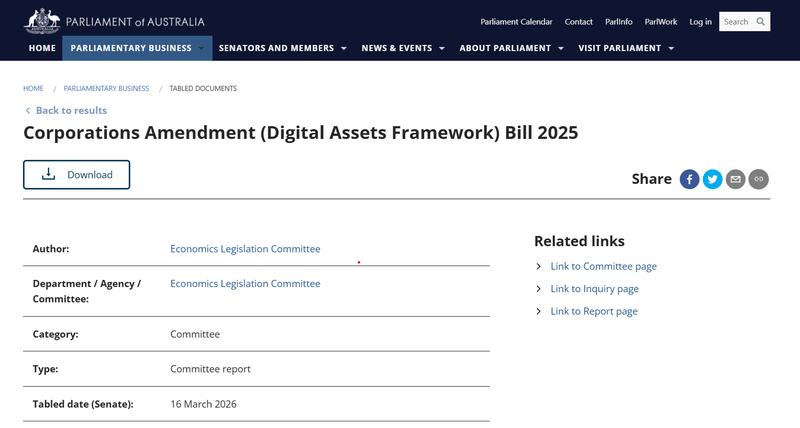
A parliamentary committee in Australia known as the Senate Economics Legislation Committee has thrown its support behind proposed legislation that would mandate cryptocurrency trading platforms and tokenization services to adhere to the nation's current financial services regulatory structure, with a formal recommendation for the passage of the Corporations Amendment (Digital Assets Framework) Bill 2025.
This development on March 16 advances Australia closer toward establishing a specialized licensing system for what the legislation terms "digital asset platforms" (DAPs) and "tokenised custody platforms" (TCPs), designed to address regulatory shortcomings in the supervision of platforms holding client funds in the wake of prominent digital asset company failures, including FTX.
The proposed legislation, which was initially presented by Daniel Mulino, who serves as Assistant Treasurer and Financial Services Minister, in November 2025, would classify DAPs and TCPs as financial products according to the Corporations Act and Australian Securities and Investments Commission (ASIC) Act, compelling the majority of centralized trading platforms and tokenized custody operations that maintain control of customer assets to obtain licensing under the Australian Financial Services Licence regime.
Platforms that receive licensing will be required to satisfy custody and settlement standards established by ASIC, adhere to customized disclosure regulations for retail customers, and function under platform-specific conduct and governance obligations, though smaller operators with yearly transaction volumes below 10 million Australian dollars ($7 million) and certain public blockchain infrastructure will be granted exemptions.
Industry groups warnings around terminology
Various industry organizations referenced in the committee's report, including the legal practice Piper Alderman, raised concerns that the expansive "digital token" and "factual control" criteria could unintentionally capture wallet software developers and infrastructure service providers operating in non-unilateral-control arrangements, such as widely used multi-party computation (MPC) configurations.
Ripple Labs, a blockchain company based in the United States, expressed support for "control" as the "appropriate nexus" to determine the regulatory boundary, though it contended that the proposed bill requires better accommodation for contemporary security frameworks like MPC wallets.
The company cautioned that under a literal interpretation of the "factual control" criteria, technology service providers that hold only a single key fragment could be incorrectly categorized as regulated custodial entities, and called upon legislators to make clear that an organization does not exercise factual control unless it possesses the ability to unilaterally move an asset without obtaining the client's cooperation.
While the committee recognized these apprehensions, it aligned with Treasury's approach to refine the regulatory boundaries through subsequent regulations instead of revising the fundamental definitions.
Coinbase hails progress but warns on debanking risk
Through an email correspondence with Cointelegraph, John O'Loghlen, who holds the positions of Coinbase Australia director and APAC managing director, expressed approval of the recommendation as "an important step for Australia's standing in the global digital economy." He maintained that the nation possesses the financial resources and skilled workforce to become a leader in digital assets, though emphasized that transparent regulatory guidelines remain necessary to realize that potential.
O'Loghlen additionally cautioned that "the anti-competitive practice of debanking is rampant despite the government endorsing measures to address it back in 2022," and called upon Canberra to make implementation of the Council of Financial Regulators' recommendations a priority.
Having secured the committee's endorsement, the proposed legislation will now proceed to the Senate for discussion and a final voting process at a future date.