
Federal Reserve Chair Powell Faces Mounting Pressure from Trump for Immediate Rate Cuts
The President has once more called for immediate interest rate reductions by the Federal Reserve, though CME Fedwatch data indicates minimal probability of any rate adjustment at this week's central bank gathering.
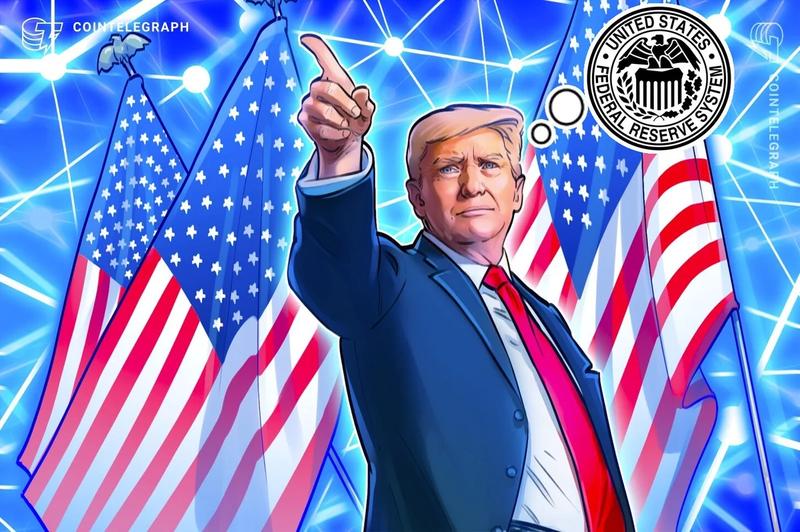
President Donald Trump has once more applied pressure on the Federal Reserve to slash interest rates without delay, declaring during a White House gathering that the central bank should convene a "special meeting" to implement rate reductions.
"What's a better time to cut interest rates than now? A third-grade student would know that," Trump continued, based on video footage circulated on X.
The president has repeated his demands for reduced rates following his statement on Truth Social Thursday in which he insisted that the Federal Reserve chair "should be dropping interest rates, IMMEDIATELY."
In January, the president contended that the United States should maintain "substantially lower" rates and "the lowest in the world," characterizing Powell as "too late" and asserting he is "hurting our country, and its National Security" through the continuation of elevated interest rate levels.
The president has pushed for reduced rates to diminish the expense of managing the enormous $39 trillion US national debt and to boost economic expansion, the housing sector, and equity markets.
Reduced rates can additionally drive investors toward higher-risk investment vehicles such as equities and cryptocurrency. More affordable borrowing costs also stimulate wider market liquidity, which translates to increased capital flowing into speculative investment vehicles.
No rate changes likely at Fed's Wednesday meeting
The United States central bank begins its two-day March gathering on Tuesday and is expected to reveal its rate determination on Wednesday.
Nevertheless, CME futures markets tell a contrasting story, presently showing a 99% likelihood that rates will stay at the current level in the 3.50% to 3.75% range this week.
The projected outcome for the April 29 gathering is comparable with a 97% likelihood of remaining unchanged.
This persists despite expectations that Trump's selection for Fed chair successor, Kevin Warsh, who will assume leadership in mid-May upon the conclusion of Powell's tenure, could be more receptive to implementing rate cuts.
The conflict with Iran has additionally triggered a spike in oil prices, resulting in elevated fuel expenses and is expected to drive up food and additional goods prices through increased transportation costs, contributing to elevated inflation, which could potentially prompt the Fed to increase rates.
The present inflation rate in the United States held steady at 2.4% in February, though it is anticipated to climb in March, based on Trading Economics projections.
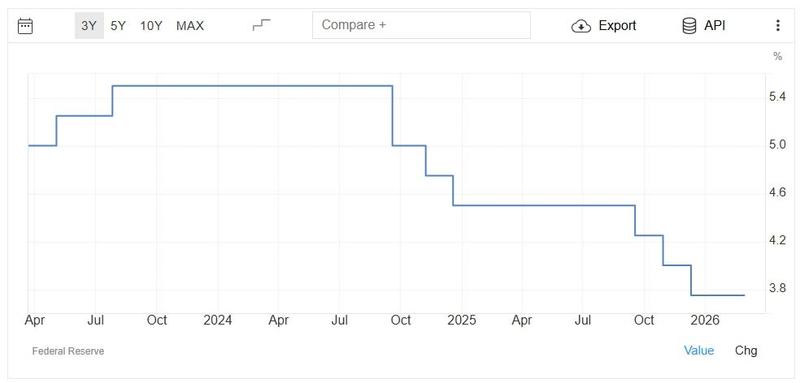
Fed will play the waiting game
Given the US-Iran conflict's influence on increasing oil prices, "traders have already priced in the likelihood of zero cuts this year," Jeff Mei, chief operations officer at the BTSE exchange, told Cointelegraph.
This should indicate that there will be "less downward pressure on crypto asset prices," due to the fact that oil's influence on inflation is "unclear at this point," and the Fed will probably "continue to wait out the situation."