ETH plunges beneath $2,800 threshold as technical indicators signal potential 22% decline ahead
Ether fell under the $2,800 mark while blockchain metrics indicated a shift toward bearish territory. Technical analysis suggests ETH could reach $2,100.

Ether (ETH) may experience an additional significant decline following the breach of its critical $2,800 support threshold, as both technical chart patterns and blockchain metrics point toward a continuation of the bearish trend.
Key takeaways:
- Both descending and symmetrical triangle formations targeting Ether point to a $2,100 price level.
- Based on blockchain data, Ether currently sits at price levels that have historically led to more substantial downward corrections.
Technical chart patterns for Ether align at $2,100 target
Over the past three days, the ETH/USD trading pair has experienced a decline exceeding 10%, breaking beneath the critical $2,800 support threshold.
Since Dec. 3, 2025, Ether has not seen prices at this level, and the loss of this support indicates that additional ETH price declines may be approaching.
At the time of publication, ETH is changing hands near $2,700, which Metacryptox described as a "do or die level for bulls," further noting:
"A failure to hold here confirms the bearish dominance, potentially opening the doors to the $2,500 mid-range."
The horizontal support line of a descending triangle formation aligns with the $2,800 threshold, which was broken through on Thursday.
The subsequent major level of support sits at $2,500, aligning with the 200-week simple moving average (SMA), illustrated in the following chart.
Should prices fall below that threshold, Ether could descend to the triangle pattern's measured objective of $2,150, representing approximately 20% downside from present levels.
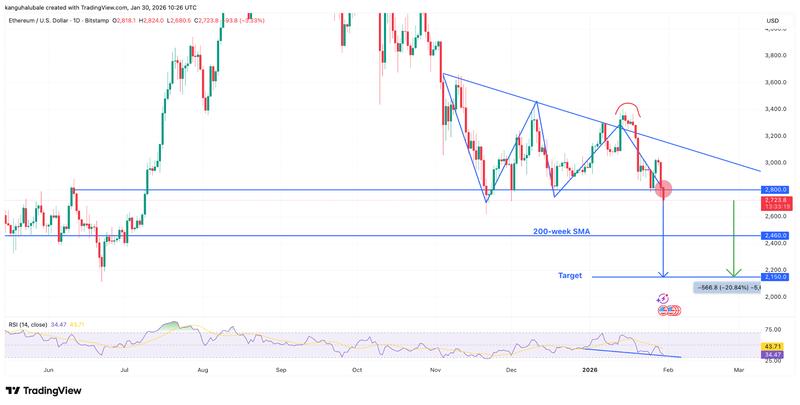
The relative strength index displays a bearish divergence pattern, declining from 68 in early January to 34, indicating deteriorating upward price momentum.
Additionally, experienced market analyst Peter Brandt stated that the "burden of proof" now rests with bullish traders following the ETH/USD pair's breakdown below the lower boundary of a symmetrical triangle pattern.
The chart analysis presented by Brandt indicates additional downward pressure, especially following the decline beneath the $2,800 price point.
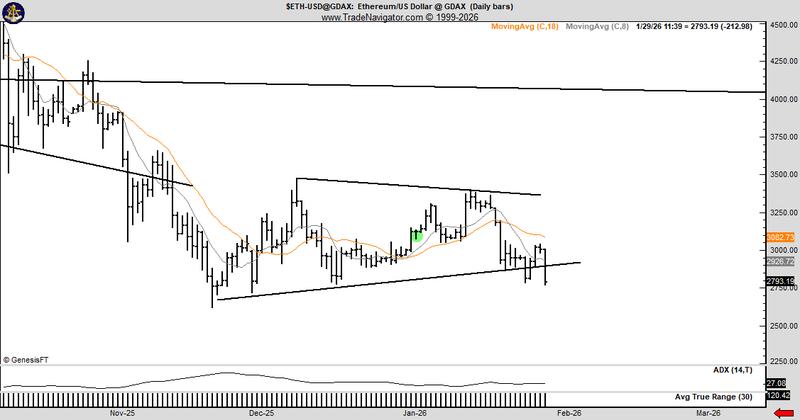
The pattern's measured objective, determined by measuring the triangle's maximum width and projecting it from the breakdown level, reaches $2,100, which would constitute a 22% drop from current trading levels.
According to previous Cointelegraph reporting, the price range spanning $3,000 to $2,800 represented a crucial support area for Ether, and breaking through this zone has exposed ETH to the possibility of additional downside movement.
Current Ethereum setup resembles historical bear market patterns
Blockchain analytics data also shows parallels between Ether's present market configuration and earlier bearish cycles.
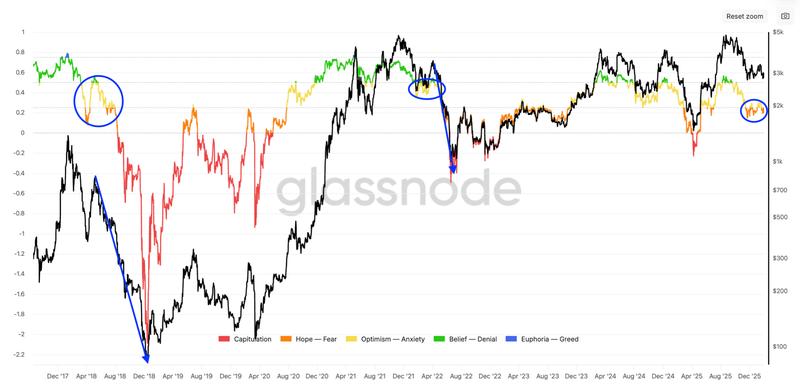
The net unrealized profit/loss (NUPL) metric for Ether has moved from the "anxiety (yellow)" phase into the "fear zone (orange)," a territory typically correlated with the initiation of bear market conditions.
The NUPL indicator calculates the differential between the relative unrealized gains and the relative unrealized losses held by ETH investors.
Throughout earlier market cycles, the shift into the fear territory has been accompanied by prolonged price corrections, as demonstrated in the chart presented below.
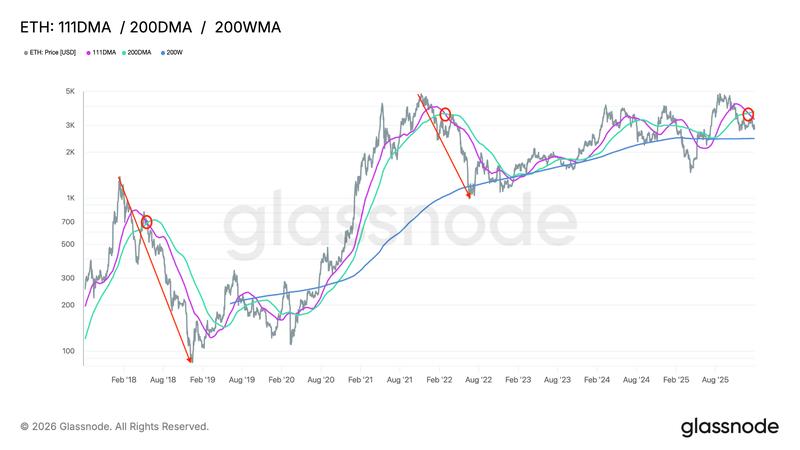
At the same time, technical chart indicators reveal that the 111-day moving average (MA) has recently crossed below the 200-day MA. Comparable crossover events have historically marked the beginning of more severe ETH price corrections during the 2018 and 2022 bear market periods, as illustrated in the chart below.