
Diverging signals: What Bitcoin's growing adoption and stagnant price reveal
Institutional embrace of Bitcoin continues to accelerate through banks, corporations, and governments, yet market prices remain surprisingly flat. Understanding this contradiction.

Key takeaways
The market price of Bitcoin responds to immediate buying and selling activity at the margins, whereas adoption represents fundamental, long-term infrastructure changes. Network expansion through new owners, institutional infrastructure, and payment acceptance can grow rapidly even during periods of sideways or declining prices.
Throughout 2025, Bitcoin achieved unprecedented penetration among institutional investors, banking systems, corporate treasuries, payment networks, and national governments. These developments signal deeper integration into the global financial architecture, despite lackluster price performance in the short term.
Large-scale institutional purchasing absorbed significant Bitcoin volumes, yet this demand was counterbalanced by selling from early adopters and long-term holders. When Bitcoin ownership transfers between different groups, prices often consolidate rather than experience dramatic upward movements.
The Lightning Network and merchant payment infrastructure experienced remarkable growth, enhancing Bitcoin's practical utility. Yet most merchants immediately convert Bitcoin to traditional currencies, which minimizes sustained buying pressure unless they choose to hold the cryptocurrency they accept.
The divergence between Bitcoin's (BTC) adoption trajectory and its price performance has reached unprecedented levels. Throughout the previous year, while price charts showed values substantially below all-time highs, network metrics told a dramatically different story. During 2025, Bitcoin experienced silent but substantial integration across banking institutions, corporate balance sheets, and government treasuries worldwide.
This apparent contradiction emerges because immediate price discovery depends heavily on short-term speculation and trading flows, while fundamental adoption reflects institutional infrastructure development happening across extended timeframes. Bitcoin's underlying network metrics and integration continue accelerating at historically unprecedented rates even during periods when prices remain range-bound.
This analysis examines why Bitcoin's foundational expansion throughout institutional channels, financial advisory firms, corporate entities, and payment processors has intensified despite disappointing price movements. It illuminates how ownership redistribution, conservative allocation strategies, and macroeconomic liquidity conditions can postpone the price impact of accelerating adoption trends.
Bitcoin adoption and price track fundamentally distinct phenomena
References to Bitcoin adoption typically describe incremental, foundational transformations across extended periods:
Which entities are acquiring and retaining Bitcoin positions?
What organizations or services are introducing Bitcoin-integrated products and offerings?
Which businesses have started accepting it for transactions?
What institutional players, businesses, or governmental bodies are adding it to their treasuries or strategic reserves?
Such foundational transformations progress methodically, accumulating gradually across quarters and years.
Price formation, conversely, occurs at the marginal edge of supply and demand instantaneously. It reacts predominantly to:
Current market participants actively buying and selling
Available liquidity and depth at various price levels
Derivatives markets, leverage ratios, and futures positioning
General macroeconomic conditions and investor risk preferences
Distribution or accumulation patterns from established holders
Robust adoption trends can systematically expand the holder base without producing immediate upward price pressure. These trends can coexist with sideways or downward price movements when distribution from veteran holders offsets inflows from new participants. Ownership redistribution across cohorts can occur without triggering significant price adjustments.
Did you know? As of March 15, 2026, more than 20 million Bitcoin had been mined out of a maximum total supply of 21 million, representing more than 95% of all BTC that will ever exist. The final Bitcoin is not expected to be mined until around 2140.
How expansion dynamics seems to be unfolding
Despite Bitcoin's comparatively subdued price performance as of March 2, 2026, underlying adoption metrics demonstrated continued robustness:
Institutions are accumulating at scale
Throughout 2025, institutional entities reportedly acquired approximately 829,000 Bitcoin spanning corporate treasuries, governmental reserves, investment funds, and exchange-traded funds (ETFs). This represented not merely incremental adjustment but fundamental transformation in ownership distribution.
Critically, institutional holdings provide exposure to millions of individual stakeholders accessing Bitcoin through traditional brokerage platforms, pension accounts, sovereign investment vehicles, and company balance sheets.
A substantial portion of this incoming demand met with distribution from veteran holders and early ecosystem participants. When pioneering large holders sell into enhanced institutional liquidity, prices need not rise dramatically. Rather, ownership transitions from one holder category to another.
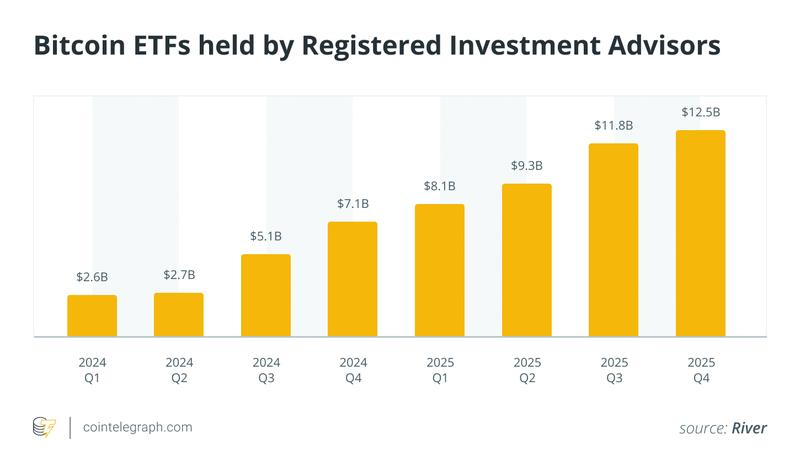
Investment advisors have been net buyers for eight consecutive quarters
Registered investment advisors (RIAs) control approximately $146 trillion in global client assets. Following the introduction of Bitcoin ETFs, RIAs have maintained consistent capital allocation, reportedly averaging around $1.5 billion quarterly, without experiencing any quarter of net outflows.
This persistence carries significant implications.
Nevertheless, typical allocation percentages remain minimal. Numerous advisors maintain Bitcoin positions representing only fractional percentage points within diversified portfolios. Unless allocations expand from minimal basis points toward 1% to 2% target weights, immediate price effects may remain gradual.
Put differently, distribution channels have opened, but volume throughput continues ramping up incrementally.
Banks are once again developing Bitcoin-related products
An expanding proportion of major United States banking institutions are actively building Bitcoin custody solutions, trading platforms, advisory services, and associated infrastructure. Enhanced regulatory certainty compared to prior years has diminished institutional hesitation and facilitated broader engagement.
This expanding engagement from established banking institutions represents crucial progress toward mainstream normalization. Bitcoin is transitioning from a speculative, fringe asset toward integration within conventional financial infrastructure and established institutional frameworks.
However, product development differs substantially from achieving widespread distribution. Early rollouts frequently focus on ultra-wealthy individuals, institutional counterparties, or operate within constrained pilot programs. Expanding toward comprehensive retail availability demands considerable time, regulatory compliance, and operational infrastructure.
Fundamentally, this foundational infrastructure functions as a critical enabler supporting future adoption waves rather than an immediate catalyst driving rapid price appreciation.
Corporate Bitcoin adoption and the weight it brings
Bitcoin accumulation by corporate entities impacts markets through multiple mechanisms:
It progressively withdraws Bitcoin from actively circulating, liquid supply.
It signals strong conviction through treasury-level commitment from legitimate operating businesses.
It creates peer pressure dynamics, motivating additional corporations toward similar strategies.
Nevertheless, substantial portions of corporate purchases execute through over-the-counter (OTC) arrangements or via deliberately measured, phased accumulation strategies engineered to minimize spot market disruption. This disciplined methodology means corporate acquisition frequently reshapes ownership distribution across longer horizons rather than catalyzing immediate explosive price movements.
Stated concisely, corporate purchasing may reshape long-term supply dynamics more significantly than driving near-term price volatility.
Did you know? Bitcoin mining now consumes less energy than many traditional industries, including gold mining and the global banking system, according to several comparative energy studies.
Surge in merchant adoption of Bitcoin
Merchant integration of Bitcoin payment systems experienced dramatic expansion throughout 2025. During November 2025, the Bitcoin Lightning Network processed a record $1.17 billion in transaction volume. This demonstrates the network has evolved beyond experimental microtransactions into infrastructure supporting substantial institutional settlement operations.
Bitcoin delivers compelling operational benefits for merchants, including:
Substantially reduced transaction costs versus conventional payment card networks
Complete or near-complete elimination of chargeback exposure
More efficient, cost-effective international payment settlements
The overwhelming majority of merchants continue choosing immediate conversion of Bitcoin receipts into traditional fiat currencies via payment intermediaries. Consequently, rising payment transaction volumes do not necessarily create persistent net demand pressure on Bitcoin itself.
Payment integration substantially enhances Bitcoin's functional utility. Nevertheless, utility expansion alone does not create enduring scarcity or upward price momentum unless merchants elect to retain the BTC they receive.
Bitcoin adoption by countries continues to grow
During 2025, Bitcoin's emergence as a strategic reserve asset accelerated substantially as five additional nations incorporated the cryptocurrency into their holdings. This adoption wave encompassed diverse geographical regions and financial structures, including sovereign wealth funds in Saudi Arabia and Luxembourg, the Czech Republic's central bank, and direct acquisitions by Taiwan and Brazil.
Governmental participation in Bitcoin adoption carries weight for multiple reasons. National governments operate across multidecade strategic horizons rather than quarterly reporting periods. They generally implement strategic, extended holding frameworks rather than active trading approaches. Sovereign entity adoption bestows substantial legitimacy upon any asset category, communicating to markets, institutions, and populations that Bitcoin is integrating into established financial infrastructure.
Did you know? Lost Bitcoin is estimated to total several million coins, permanently reducing the effective circulating supply and increasing long-term scarcity.
Bitcoin's volatility continues to decline
Among the most overlooked signals of advancing adoption maturity is Bitcoin's progressively declining volatility profile. Across the previous decade, Bitcoin's annualized volatility has decreased steadily. Sequential market cycles have generated increasingly constrained percentage fluctuations and drawdowns compared to the extreme movements characterizing earlier bull and bear phases.
This fundamental volatility compression reflects several mutually reinforcing developments:
Substantially enhanced and more resilient market depth
Broader ownership distribution across varied holder categories
Increased institutional and professional market participation
More advanced, liquid derivatives infrastructure (futures, options, and perpetuals) providing shock absorption
Bitcoin's current volatility characteristics increasingly mirror those of mature asset classes including equities, commodities, and currency markets. This convergence aligns with requirements of conservative institutional allocators, including pension systems, endowment funds, and risk-averse capital pools.
Why hasn't Bitcoin price reacted more aggressively?
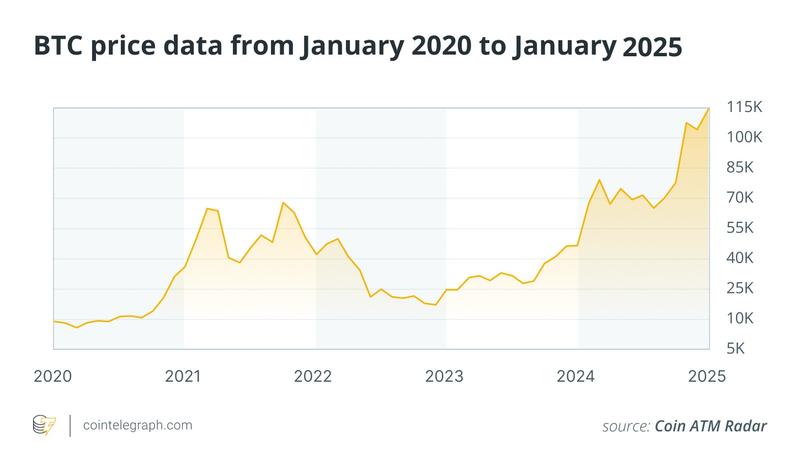
Despite accelerating institutional and sovereign adoption throughout 2025, immediate market price responses remained surprisingly restrained. This quiet accumulation period indicates that authentic impacts from substantial capital deployment were obscured by unfavorable macroeconomic conditions.
Ownership transfer absorbs demand: When veteran Bitcoin holders distribute supply into institutional demand channels, markets can accommodate substantial volumes without generating sharp upward price trajectories. Supply ownership simply transitions across holder cohorts while adoption expands and prices remain range-bound.
Adoption widens the base, not the margin: Marginal market participants actively buying and selling determine immediate cryptocurrency pricing. Structural adoption expands the overall ownership foundation without necessarily shifting aggressive marginal bidding immediately. Until incremental demand materially exceeds available supply, prices can persist within established ranges.
Allocation sizes remain small: Numerous institutions and advisory firms now hold Bitcoin positions, yet at extremely modest portfolio weights. Should this dynamic shift, marginal demand could intensify significantly.
Macro liquidity matters: Bitcoin operates within broader macroeconomic contexts. Capital flow determinants include prevailing liquidity environments, interest rate trajectories, and global risk sentiment. Expanding Bitcoin adoption does not insulate it from macroeconomic cycle influences.