Bitcoin Surges Back to $72K Following Fed's Decision to Maintain Current Interest Rates
The cryptocurrency market witnessed BTC's recovery to $72,000 after the Federal Reserve announced it would keep interest rates steady, reversing earlier pre-FOMC declines.

The positive momentum Bitcoin (BTC) experienced at the beginning of the week came to an abrupt stop on Wednesday, with the cryptocurrency declining 3.4% to reach $70,900 as US equities experienced widespread selling pressure.
The downturn came on the heels of a Producer Price Index (PPI) reading that exceeded expectations, registering 0.7% above the anticipated 3.4% annual estimate. Notwithstanding the market downturn, available data indicates that spot market demand for BTC remained resilient, with market participants stepping forward to counteract the selling momentum. This buying appetite became evident when Bitcoin recovered above the $72,000 threshold following the Federal Reserve's announcement maintaining current interest rate levels.
Although market participants had largely anticipated that the Fed would opt to keep rates steady, uncertainty stemming from fluctuating oil prices, turbulent equity markets, and ongoing geopolitical tensions surrounding the recently commenced US and Israel-Iran conflict kept investors anxious.
Critical support zones Bitcoin bulls must maintain
Examining the four-hour timeframe, Bitcoin demonstrates a pattern of ascending lows, preserving the near-term bullish trajectory. The current price movement remains positioned above both the 100-period and 200-period exponential moving averages (EMAs), which are functioning as active support levels.
These technical indicators calculate average price points across specified timeframes and help identify trend orientation when positioned beneath current pricing.
This technical alignment could enable BTC to find stability around the $71,000 mark, potentially establishing a foundation following Wednesday's downward pressure.
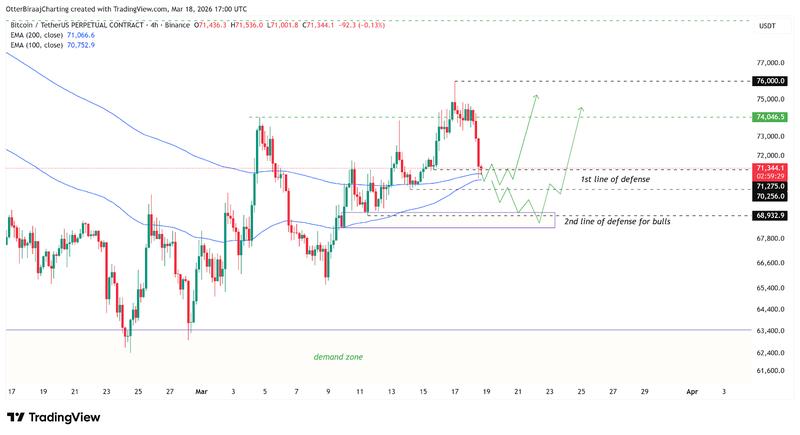
Analyzing the technical landscape, BTC must successfully hold the $70,250 to $71,275 trading range, which corresponds to internal liquidity zones established during Monday's upward breakout.
This price territory identifies areas where previous orders found execution, potentially drawing another liquidity test.
A breach below this range would reveal the subsequent liquidity zone situated near $68,900. This level corresponds with a modest order block spanning $68,300 to $69,100, where previous buying interest temporarily countered downward pressure.
Preserving these support levels sustains the shorter timeframe bullish structure for BTC, with ascending lows indicating persistent buying interest during price dips.
Short-term holder profit-taking encounters buying pressure beneath $74,000
Before Wednesday's pullback, Bitcoin onchain metrics revealed increasing sell-side pressure from short-term holders (STHs) on Tuesday. Based on analysis from crypto researcher Darkfost, more than 48,000 BTC in profitable positions were transferred to exchanges within a 24-hour period as prices neared $75,000. This suggested that market participants were continuing to realize profits, utilizing price rallies as opportunities to exit positions.
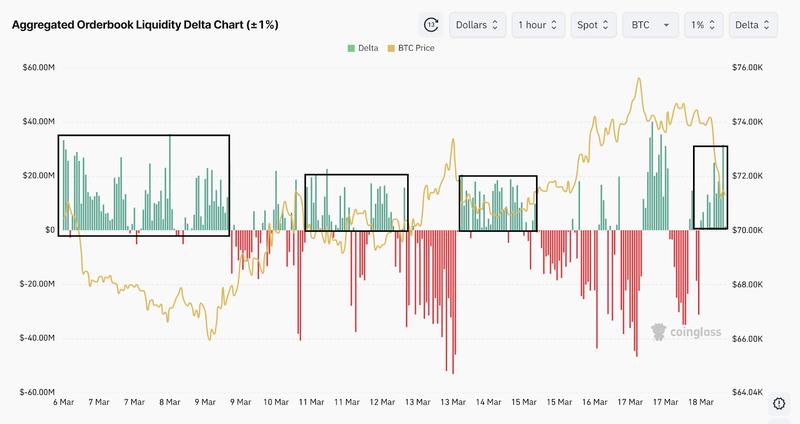
Simultaneously, information from CoinGlass demonstrates that passive buy orders were executed during the decline from $74,000 to $71,000. Comparable absorption dynamics witnessed throughout the previous two weeks have been followed by near-term price recoveries, underscoring reliable demand at reduced price points.
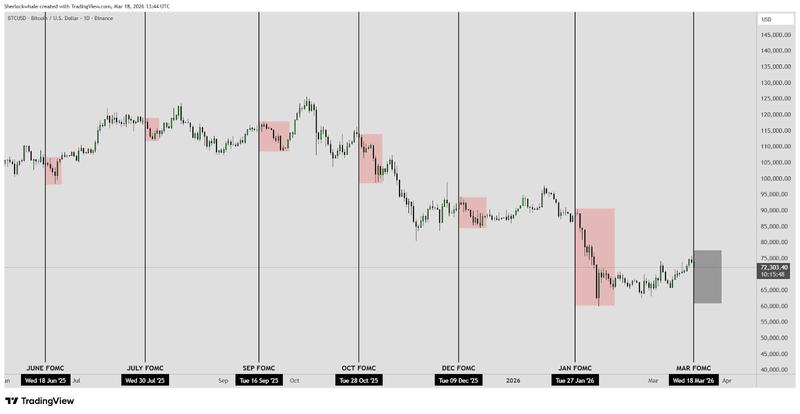
Furthermore, BTC's historical response to prior Federal Reserve announcements provided valuable context. According to market researcher Sherlock, beginning in June, 2025, Bitcoin has experienced declines following each of the previous six Federal Open Market Committee (FOMC) gatherings, irrespective of whether rates were adjusted.
Given that markets are anticipating another pause in rate adjustments, trader focus may now turn toward Bitcoin's price behavior around existing liquidity concentrations, particularly in the vicinity of $71,000.