
Bitcoin miner Cango records massive $285M fourth-quarter deficit amid soaring operational expenses
Stock price plummeted from approximately $4.50 during October to roughly $0.68, representing an over 84% drop across a six-month period as the company navigates significant losses and organizational restructuring.
Cryptocurrency mining company Cango Inc. disclosed a quarterly net deficit totaling $285 million during the final three months of 2025, as asset impairment expenses, fair-value adjustments and elevated operational costs for mining activities overshadowed income generated from its growing Bitcoin extraction operations.
According to the company's quarterly financial disclosure released on Monday, Cango achieved fourth-quarter revenue totaling $179.5 million, with Bitcoin mining operations contributing $172.4 million to that figure, even as aggregate operating costs and expenses climbed to $456.0 million.
The significant financial setbacks stemmed partially from an $81.4 million write-down on cryptocurrency mining equipment and a substantial $171.4 million loss associated with fair value fluctuations in Bitcoin (BTC)-collateralized receivables. Additionally, the company experienced elevated production expenses, with comprehensive mining costs reaching $106,251 for each BTC produced during the three-month period.
The financial outcomes demonstrate how increasing revenue from cryptocurrency mining activities was counterbalanced by asset write-downs, mark-to-market valuation changes and rising operational expenses as Cango expanded its mining enterprise.
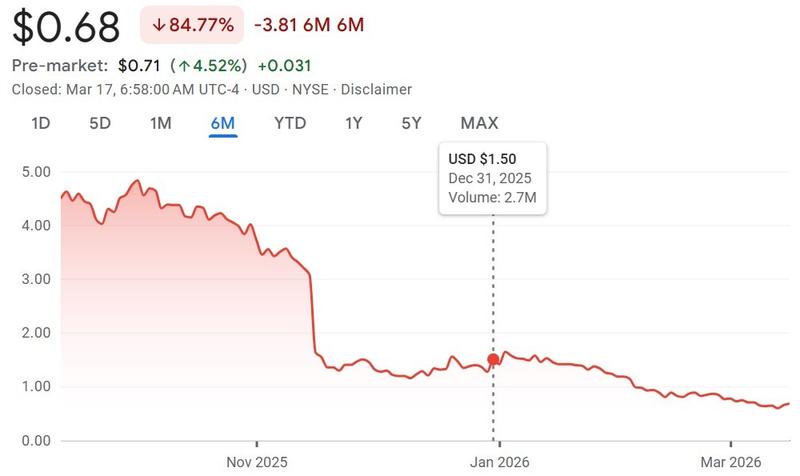
Market data from Google Finance indicates that Cango's stock price dropped from approximately $4.50 on Oct. 1 to roughly $1.50 by Dec. 31. As of the current writing, shares are trading at $0.68, representing a decrease exceeding 84% during the preceding six-month timeframe.
Cango posted a net loss of $452.8 million for full-year 2025
Examining the complete fiscal year, Cango disclosed aggregate revenue of $688.1 million, with Bitcoin mining operations accounting for $675.5 million of that total. The organization successfully mined 6,594.6 Bitcoin throughout 2025, averaging approximately 18.07 Bitcoin daily, during its inaugural full year of large-scale operations within the cryptocurrency mining industry.
Cango documented aggregate operating costs and expenditures totaling $1.1 billion throughout 2025, encompassing $338.3 million in asset impairment charges on mining equipment and $96.5 million in fair-value adjustments on Bitcoin-collateralized receivables, underscoring the substantial cost challenges linked to expanding its cryptocurrency mining infrastructure.
Overall, Cango recorded a net deficit of $452.8 million for the complete year. Chief financial officer Michael Zhang attributed the loss primarily to one-time transformation expenses and market-influenced fair-value modifications.
Cango's Bitcoin mining pivot
Cango's financial performance arrives during a comprehensive strategic transformation that has fundamentally altered the company's operational focus throughout the previous year.
During April 2025, Cango reached an agreement to divest its traditional China-based automotive financing business operations for $352 million to Ursalpha Digital Limited, a corporate entity associated with Bitmain.
The transaction additionally encompassed the acquisition of 32 exahashes per second (EH/s) of cryptocurrency mining infrastructure to the organization, strategically transforming Cango into a publicly listed Bitcoin mining enterprise.
In February, Cango successfully secured $75.5 million through equity capital raising initiatives following the sale of 4,451 Bitcoin for approximately $305 million as part of efforts to decrease financial leverage.
The organization stated that this financial maneuver strengthens its strategic transition toward artificial intelligence computing infrastructure, with intentions to convert its mining facilities into distributed computational resources designed for AI processing requirements.