Understanding the CLARITY Act's Role in Defining Cryptocurrency Market Regulations
Discover how the CLARITY Act seeks to establish clear crypto market structure through its framework for categorizing tokens, regulating exchanges, mandating disclosures and defining regulatory authority.

Key takeaways
- The CLARITY Act seeks to resolve years of regulatory ambiguity by establishing a structured framework that explicitly defines digital assets, the roles of intermediaries and requirements for disclosure.
- Under its provisions, the CFTC would oversee most spot trading of qualifying tokens, whereas the SEC would maintain responsibility for primary offerings, required disclosures and protections for investors.
- The legislation emphasizes regulating activities alongside assets, establishing registration requirements and conduct standards for exchanges, brokers and dealers to enhance transparency and market integrity.
- While the GENIUS Act regulates stablecoins, the CLARITY Act applies only in complementary contexts, including disclosures and any reward-related features associated with stablecoin usage.
The CLARITY Act (Digital Asset Market Clarity Act of 2025) seeks to resolve the industry's ongoing legislative stalemate through a dual-faceted strategy that both defines digital assets and assigns oversight responsibilities according to their marketplace functions. Rather than relying on ad hoc enforcement measures, the legislation proposes an all-encompassing framework covering asset classification, the responsibilities of intermediaries and required disclosures.
This article provides clarity on what the CLARITY Act entails and its significance, outlines the bill's core objectives and explores its proposed approach to stablecoin governance. Additionally, it discusses the mature blockchain concept, principal criticisms leveled against the CLARITY Act and where it currently stands in the legislative process.
Why the CLARITY Act matters
The CLARITY Act tackles a persistent challenge within the cryptocurrency sector: the lack of regulatory clarity.
Over the past several years, companies operating in the digital asset space have encountered a perplexing jurisdictional overlap between the US Securities and Exchange Commission (SEC) and the US Commodity Futures Trading Commission (CFTC). While the SEC frequently characterizes numerous tokens as securities, the CFTC views them as commodities. This regulatory ambiguity has hindered innovation, made compliance more challenging, left investors frustrated and generated confusion for businesses in the crypto industry.
The CLARITY Act seeks to eliminate this deadlock by providing clear definitions for digital assets and distributing regulatory responsibilities according to the asset type and the activities involved. Through a predefined framework, market participants gain the ability to understand which rules apply from the start rather than navigating uncertainty created by enforcement actions.
Main objectives of the CLARITY Act
The legislation employs three fundamental approaches to build the necessary regulatory infrastructure:
Defining asset categories more precisely
The CLARITY Act establishes the concept of "digital commodity," describing a digital asset whose value is primarily derived from utilizing its associated blockchain system. This classification excludes conventional securities and stablecoins. Consequently, spot trading for many qualifying tokens would come under CFTC supervision. Acknowledging the practical obstacles encountered by crypto networks, the classification emphasizes blockchain functionality and adequate decentralization.
Clarifying regulatory jurisdiction
The legislation separates oversight based on function:
- The CFTC receives primary authority over transactions involving digital commodities, especially in secondary and spot markets and on trading platforms.
- The SEC maintains authority over primary offerings, protections for investors, mandatory disclosures and initial sales.
The legislation also promotes collaborative rulemaking in areas where jurisdictions overlap, such as disclosures.
Establishing consistent disclosures and conduct rules
To protect investors and promote fair markets, the bill requires standardized disclosures from both developers and issuers. These disclosures would encompass technical details about the blockchain, token economics and significant risks, providing market participants with comparable information for evaluating projects. Intermediaries including digital commodity exchanges, brokers and dealers would face registration, reporting and oversight obligations, primarily supervised by the CFTC for activities related to trading.
In summary, the CLARITY Act attempts to substitute regulatory gray zones with transparent guidelines, fostering innovation while preserving investor protections and maintaining market integrity.
Did you know? Debates surrounding crypto market structure are shaping how policymakers think about regulating AI models, given that both involve unclear accountability and rapidly evolving innovation cycles.
How the CLARITY Act deals with stablecoins
The GENIUS Act, which became law in 2025, created a federal framework designed specifically for payment stablecoins. It exempts qualifying stablecoins from being classified as securities or commodities, as long as they satisfy stringent reserve, redemption and oversight standards.
The CLARITY Act neither supersedes nor replicates this stablecoin regulatory regime. Rather, its provisions function in complementary capacities, especially concerning rewards associated with stablecoins, relevant disclosures and their interaction with wider digital asset markets.
The concept of "mature" blockchains
Through a mechanism allowing assets to evolve, the CLARITY Act establishes a pathway by which a blockchain can attain "mature" designation by satisfying decentralization and other functional benchmarks.
Upon meeting these benchmarks, the corresponding token transitions toward being treated as a digital commodity under CFTC supervision. This transition can substantially decrease regulatory obligations, including registration, assuming the project fulfills other relevant conditions.
The mature blockchain concept embodies the perspective that regulatory treatment ought to evolve as networks grow more decentralized and broadly distributed. It provides projects with a more transparent progression toward reduced compliance burdens.
Did you know? In previous regulatory conflicts, courts have occasionally relied on decades-old investment cases to evaluate crypto tokens, illustrating how existing legal frameworks are being extended to accommodate entirely new digital markets.
Ongoing criticisms of the CLARITY Act
Despite the bill's promise of clarity, skepticism persists. Critics contend that its definitions may create loopholes, especially in decentralized finance (DeFi), where projects frequently do not conform easily to conventional regulatory frameworks.
Others maintain that the investor protections do not measure up to established securities standards. Further concerns center on possible overlaps, including how the SEC's anti-fraud authority would function in domains where the CFTC holds primary jurisdiction, particularly for tokens exhibiting hybrid characteristics.
Legislative status of the CLARITY Act
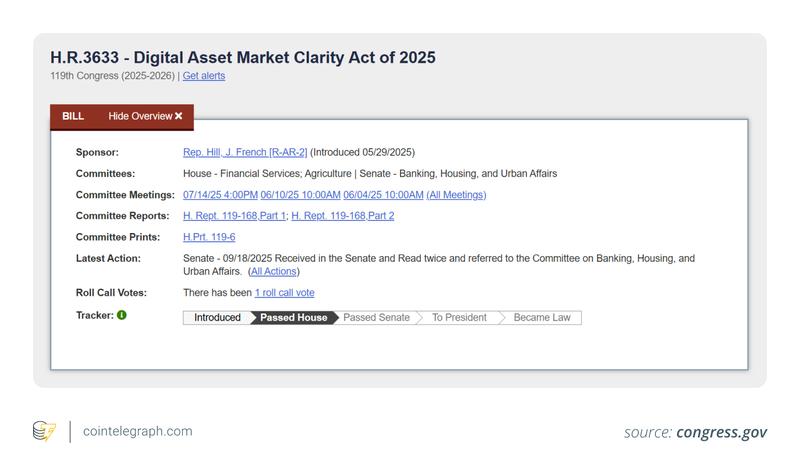
The US House of Representatives approved the CLARITY Act (H.R. 3633) in July 2025 with bipartisan support. As of January 2026, the legislation awaits consideration in the US Senate, where it has been assigned to the Senate Committee on Banking, Housing, and Urban Affairs. The legislative process also includes contributions from the Senate Committee on Agriculture, Nutrition, and Forestry on issues related to CFTC oversight.
As of January 2026, Senate committees have conducted hearings, released discussion drafts, suggested amendments and moved forward versions of broader market structure legislation. Nevertheless, markups have experienced delays and revisions amid debates over topics including stablecoin yields and investor safeguards. Reconciliation between Senate drafts and the House-passed version remains in progress, with no final Senate vote scheduled yet.
If passed in a compatible format, the CLARITY Act would constitute the first comprehensive US federal framework for digital asset market structure.
Did you know? Certain blockchain networks now publish real-time transparency dashboards displaying validator concentration, token velocity and governance participation. Regulators occasionally reference these metrics when discussing whether a network qualifies as "sufficiently decentralized."
Assessing the CLARITY Act's blueprint
Fundamentally, the CLARITY Act confronts a persistent obstacle in crypto: ambiguous regulatory boundaries that discourage innovation and promote reactive enforcement rather than proactive compliance.
The legislation creates defined asset categories, requires consistent disclosures and designates distinct responsibilities to the SEC and CFTC. Its objective is to forge a more predictable environment where market participants comprehend the applicable rules from the beginning.
Legislation, nonetheless, is merely the beginning. Implementation, rulemaking and potential modifications will determine the CLARITY Act's practical impact. Whether it ultimately provides the promised clarity will influence US crypto policy and competitiveness for years ahead.