The Push for Simplified 'One-Click Staking' Solutions on Ethereum
Engineers working on Ethereum are championing one-click staking solutions designed to streamline validator management, draw institutional participants and bolster network decentralization.

Key takeaways
- Staking Ether has experienced substantial expansion, reaching close to 1 million validators with approximately 30% of ETH currently staked. Nevertheless, technical barriers continue to discourage numerous institutional players from direct participation, even though yield opportunities exist.
- Engineering teams are pursuing "one-click staking" initiatives, representing a streamlined deployment approach that enables institutions to operate validators via automated, standardized frameworks without demanding extensive technical knowledge.
- A crucial component enabling this transition is DVT-lite, a system permitting several nodes to collectively oversee a validator, enhancing fault tolerance while decreasing setup complexity and limiting risks like slashing penalties.
- When successfully deployed, one-click staking has the potential to encourage institutional adoption, expand validator diversity, enhance network resilience and facilitate Ethereum's subsequent growth phase.
Ethereum's proof-of-stake (PoS) infrastructure has emerged as a fundamental element within the decentralized finance (DeFi) landscape. After the historic shift away from proof-of-work (PoW) through the 2022 Merge, a significant software transformation that removed energy-demanding mining operations, the number of validator participants has grown substantially.
Yet, as Vitalik Buterin, Ethereum's co-founder, has indicated, a substantial obstacle persists. The technical demands of staking continue to be excessively high for retail users and institutional organizations alike.
To overcome this challenge, developers are investigating methods to optimize validator configuration. Specifically, they are advancing toward a one-click experience for users. This effort, leveraging "DVT-lite" or streamlined distributed validator technology, would enable organizations to operate nodes without requiring dedicated technical personnel.
This piece examines the reasoning behind Ethereum developers' advocacy for one-click staking to streamline validator configuration for institutions, decrease dependence on third-party services, improve decentralization and facilitate wider validator involvement.
Why Ethereum is revisiting the institutional staking user experience
Ethereum is re-examining the staking user experience (UX) designed for institutions because, notwithstanding considerable growth in participation levels, significant market participants continue to avoid direct involvement owing to operational challenges.
Ether (ETH) staking has witnessed considerable expansion throughout recent years. By early 2026:
- Between 37 million and 38 million Ether is currently staked.
- This represents approximately 30% to 32% of the available circulating supply.
- The network presently maintains close to one million validators actively operating.
- Standard base staking returns range between 2% to 3% on an annual basis.
These numbers illustrate the ecosystem's growing maturity. However, the staking proportion simultaneously indicates substantial potential for additional growth.
Major entities including crypto funds, financial technology companies and corporations maintaining Ether within their balance sheets typically refrain from direct staking activities. The primary obstacle relates less to potential returns and more to operational complexities that arise.
Operating validators directly generally requires:
- Comprehensive infrastructure planning and configuration
- Sophisticated key management procedures
- Continuous validator client upgrades and maintenance activities
- Uninterrupted monitoring to guarantee uptime
- Thorough risk evaluation and mitigation strategies against slashing penalties
For institutional entities accustomed to the efficient workflows common in traditional finance, these technical requirements and continuous responsibilities frequently seem unnecessarily complex and incompatible with their established operational frameworks.
Did you know? Distributed validator technology shares conceptual similarities with multi-signature wallets, where authority is distributed among participants. Rather than depending on a single key holder, several nodes collaborate, diminishing the dangers associated with a single point of failure.
What one-click staking means
When Buterin discusses one-click staking, he refers to streamlining the deployment of native validators, rather than custodial earning products provided by centralized exchanges.
This methodology aims to simplify direct validator operations for institutional participants. Within this framework, an institution would:
- Select the computing hardware or servers designated to operate the validator nodes.
- Configure a setup file containing distributed validator information, including a shared key distributed across nodes.
- Initiate a standardized, containerized deployment.
Following initiation, the infrastructure would autonomously handle:
- Node networking and peer discovery processes
- Distributed key generation (DKG) protocols
- Validator coordination mechanisms
- Staking activation procedures
Buterin has suggested utilizing Docker containers, Nix images or comparable standardized formats. This approach would enable node operators to launch validators similarly to contemporary cloud applications, through a single click or straightforward command executed on each node.
This transformation would convert staking infrastructure into something more akin to standard software deployment instead of a specialized blockchain operation.
Why today's validator setup still intimidates institutions
Ethereum's existing validator configuration continues to discourage numerous institutions, notwithstanding the protocol's focus on security and decentralization, chiefly due to its technical complexity.
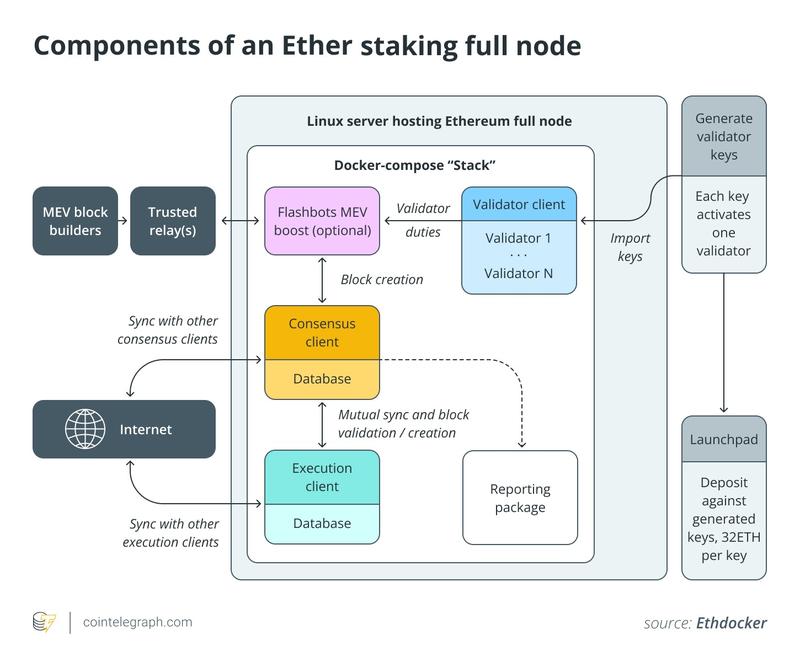
Running a validator demands managing multiple distinct software elements:
- Consensus clients: Manage the Beacon Chain, proof-of-stake mechanics, validator responsibilities and network consensus operations
- Execution clients: Handle transactions, run smart contracts and preserve the Ethereum Virtual Machine (EVM) state
- Validator clients: Execute attestation and block proposal responsibilities on the consensus layer
- Secure key storage systems: Safeguard validator signing keys
Institutional participants must additionally navigate critical operational hazards, such as:
- Slashing penalties: Financial losses initiated by protocol infractions like double-signing or alternative forms of misconduct
- Downtime penalties: Diminished rewards or inactivity leaks occurring when validators cannot attest or propose blocks due to outages
- Security vulnerabilities: Especially those concerning the exposure or compromise of validator private keys
Even entities possessing considerable resources frequently lack the specialized blockchain knowledge necessary to administer these requirements effectively. Consequently, they commonly rely upon third-party staking service providers.
When an excessive number of validators are managed by identical large service providers, this dependence can generate concentration hazards.
Did you know? Certain institutional investors already generate returns on idle holdings through conventional mechanisms such as repo markets. Ether staking is frequently compared to this, functioning as a crypto-native yield mechanism for treasury-held Ether.
Why Buterin opposes expert-only staking
Buterin firmly opposes a staking environment restricted to specialist or professional operators, perceiving it as a fundamental threat to Ethereum's foundational decentralization values.
He has condemned the notion that validator operation should remain a complicated, expert-exclusive activity, characterizing that perspective as detrimental and explicitly contrary to decentralization objectives.
Should staking infrastructure become controlled by a limited group of professional service providers:
- Validation authority could become unduly concentrated among few entities.
- The network might become increasingly susceptible to regulatory pressure or coercion targeting those dominant operators, potentially impacting the entire blockchain.
- Total system resilience could deteriorate, as breakdowns, attacks or coordinated downtime involving major operators could disrupt consensus more significantly.
For these considerations, Buterin regards simplifying validator deployment through methods like one-click configurations and reduced operational barriers as a deliberate tactic to maintain decentralization.
This explains why simplifying validator deployment is considered not merely a user experience enhancement but additionally a decentralization tactic.
How DVT helps
DVT occupies a fundamental position in initiatives to make staking more approachable.
Instead of depending on a single machine controlling a validator via one private key, DVT permits several nodes to operate a single validator cooperatively.
Within this arrangement:
- Signing duties are distributed across multiple machines
- No single node holds the complete validator key
- Should one node experience downtime, the remaining nodes can maintain operations
This framework improves fault tolerance and substantially decreases the probability of slashing penalties resulting from downtime or failures.
Multiple projects throughout the Ethereum ecosystem have developed DVT implementations during recent years.
Did you know? Ethereum validators do not compete in the manner miners previously did. Rather than racing to solve computational puzzles, validators are randomly chosen to propose and attest to blocks, creating a more energy-efficient and predictable system.
What sets DVT-lite apart
Complete DVT can provide considerable advantages, yet it frequently involves significant technical complexity. To expedite wider adoption, Buterin has promoted a simplified variation termed DVT-lite.
This streamlined methodology retains the fundamental advantages while removing more cumbersome components:
- Distributed validator responsibilities across several nodes
- Automated network configuration processes
- Integrated distributed key generation
The objective is to reduce unnecessary complexity, permitting institutions to launch validators swiftly and effectively.
Rather than constructing customized, highly specialized staking configurations, organizations can employ standardized, automated solutions that manage the majority of the configuration workflow.
The Ethereum Foundation's 72,000 Ether experiment
The Ethereum Foundation has already commenced testing this simplified methodology. According to Buterin, the Foundation is presently staking 72,000 Ether using a DVT-lite infrastructure.
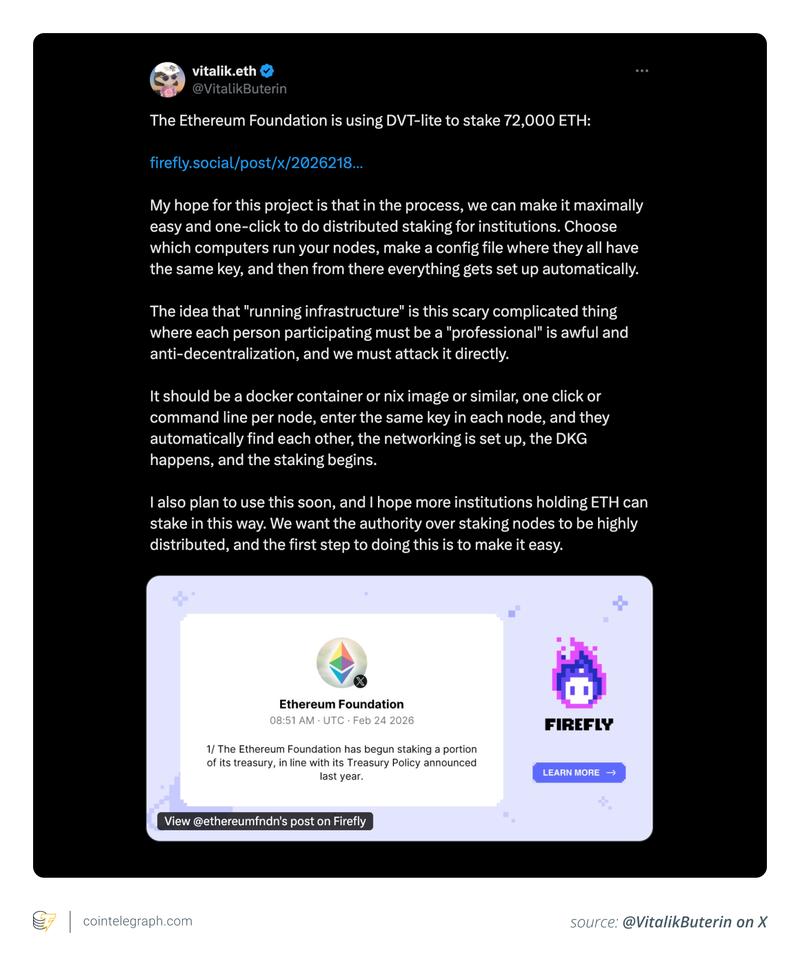
This practical pilot assesses whether simplified distributed staking can operate dependably at an institutional magnitude.
A positive result could provide a viable blueprint for crypto funds, corporations and digital asset treasuries wanting to stake their Ether directly instead of through intermediaries.
The experiment additionally emphasizes that Ethereum developers regard enhanced validator accessibility as a vital priority for the network's ongoing development.
Why institutions may finally begin staking
Should one-click staking become reality, it could fundamentally transform the economics surrounding institutional Ether holdings.
Organizations already maintaining substantial Ether reserves would gain the ability to generate staking yield internally without delegating to external parties.
Primary potential benefits encompass:
- Substantially reduced infrastructure and operational overhead
- Decreased dependence on centralized staking providers
- Enhanced operational transparency
- Improved resilience facilitated by distributed validator configurations
For entities administering thousands of Ether, these modifications could shift the calculus decisively toward direct staking involvement.
Why developers believe simpler staking improves decentralization
From a protocol perspective, broadening validator participation reinforces the Ethereum network.
A more extensive and varied group of participants operating validators results in:
- Enhanced geographic distribution of nodes
- Decreased concentration of validation authority
- Heightened resistance to censorship
- Enhanced resilience when confronting failures or disruptions
Through lowering barriers via easier staking tools, both institutional entities and individual operators can engage more readily as validators, strengthening Ethereum's security framework.
This methodology aligns with Ethereum's enduring emphasis on widespread participation over dependence on centralized infrastructure.
Why the timing is significant in 2026
Multiple simultaneous developments throughout the network are rendering direct institutional staking more practical.
Forthcoming Ethereum upgrades concentrate on enhancing validator efficiency and scalability. For example, proposals connected to the Pectra upgrade would increase the maximum effective balance for validators from 32 Ether to 2,048 Ether. This would permit operators to administer larger stakes within a single validator instance and decrease the operational burden of operating numerous separate validators.
When combined with simplified DVT deployments, these modifications could considerably reduce the technical and administrative obstacles involved.
Meanwhile, the staking ecosystem continues demonstrating momentum:
- Validator entry queues periodically contain millions of Ether awaiting activation
- Exit queues stay relatively minimal
- Annual staking rewards currently exceed $2 billion
These indicators demonstrate sustained, long-term confidence in Ethereum's staking framework.
Did you know? The concept of "one-click deployment" within crypto draws inspiration from cloud computing platforms like Amazon Web Services (AWS) and Kubernetes, where complicated infrastructure can be initiated with minimal manual configuration.
Challenges that persist in Ethereum development
Despite the promise of one-click staking, obstacles continue to exist. Among the principal challenges are:
- User interface design: Institutions need interfaces that simplify deployment while still presenting essential security considerations
- Regulatory uncertainty: Organizations must understand and comply with developing cryptocurrency regulations within their respective jurisdictions
- Operational oversight: Automated systems continue to require ongoing monitoring, auditing and compliance with security best practices
Developers must thoughtfully balance ease of use with sufficient safeguards to guarantee automation does not introduce unanticipated vulnerabilities.
Could simpler staking introduce new risks?
Excessively simplified tools might unintentionally generate new centralization dangers:
- Widespread adoption of identical staking software stacks among institutions could diminish infrastructure diversity
- Standardized systems could become high-value targets for exploits or attacks
- Users could grow excessively dependent on automation, potentially neglecting underlying operational risks
Ethereum developers must consequently emphasize accessibility while simultaneously preserving a diverse and resilient validator infrastructure.
What success would look like
Should the one-click staking vision be realized, it could produce multiple changes:
- Expanded direct staking by institutions holding Ether
- Wider distribution of validators across diverse organizations and geographic locations
- Diminished reliance on centralized staking services
- Improved overall network resilience
In such a scenario, operating a validator would become a routine infrastructure responsibility instead of a highly specialized technical endeavor.