Ripple's CLARITY Act Feedback Gets SEC Crypto Task Force Support on New Asset Framework
In response to the CLARITY Act debate, the SEC's Crypto Task Force endorsed Ripple's position that mere speculative interest shouldn't automatically invoke securities regulations.
An official statement appearing on the US Securities and Exchange Commission's Crypto Task Force webpage aligned with objections previously presented by Ripple, asserting that mere speculative activity should not serve as sufficient grounds to automatically bring cryptocurrencies under the purview of federal securities regulations, even as legislative discussions surrounding the CLARITY Act remain ongoing.
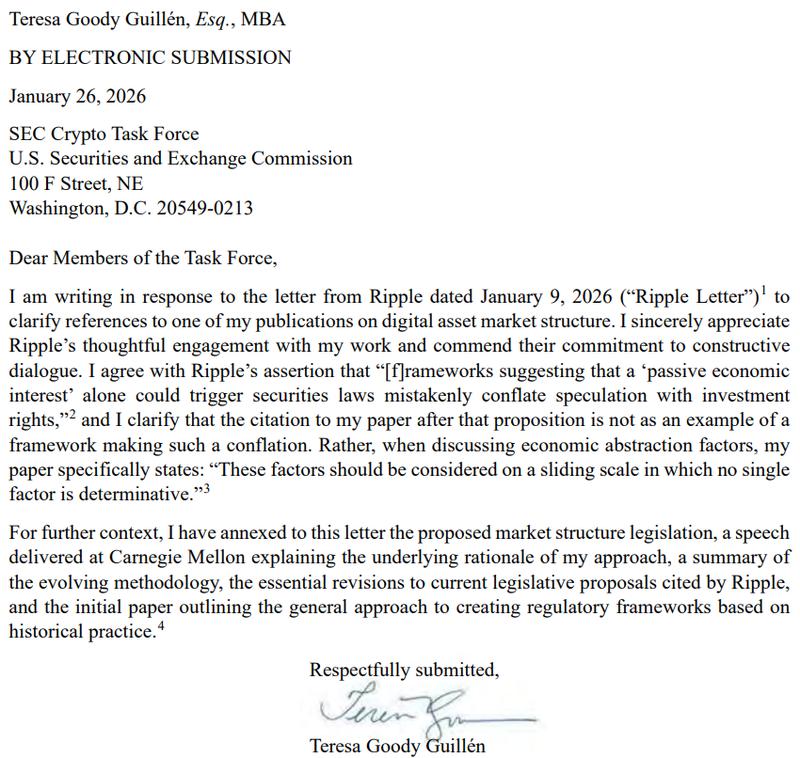
The statement, authored by Teresa Goody Guillen, an attorney specializing in digital asset regulatory matters, and made public Monday through the SEC's official website as part of the public comment process, contended that maintaining what she described as a "passive economic interest," which could include purchasing a digital token with expectations of price appreciation, ought not automatically invoke securities oversight. Guillen's position advocates for digital assets to be evaluated through a more comprehensive framework utilizing multiple criteria weighted on a proportional basis.
"I agree with Ripple's assertion that "[f]rameworks suggesting that a 'passive economic interest' alone could trigger securities laws mistakenly conflate speculation with investment rights [...]," Gullen said, citing prior academic work.
She clarified that her commentary should not be interpreted as establishing a definitive regulatory standard and does not represent the official position of the SEC.
The correspondence serves as a direct reply to Ripple's Jan. 9 submission, which identified several points of concern regarding the current market structure draft legislation. It recommended that legislators avoid utilizing the concept of "decentralization" as a primary legal benchmark, and emphasized that passive economic interests alone should not activate securities law requirements, given that such an approach incorrectly equates speculative activity with formal investor entitlements.
SEC proposes new crypto asset classification
In a parallel development, Guillen released a preliminary discussion draft outlining the "Digital Markets Restructure Act of 2026," which has yet to receive endorsement from senior officials at either the SEC or the Commodity Futures Trading Commission. This draft framework introduces a classification for specific cryptocurrencies as "Digital Value Instruments" in instances where they cannot be readily categorized under traditional definitions like securities or commodities.
Under the proposed framework, cryptocurrencies would qualify as Digital Value Instruments upon demonstrating a minimum of three out of five specified attributes: unrestricted transferability, providing holders with a passive economic interest, granting only minimal individual contractual entitlements to holders, maintaining systemic reliance on the issuing enterprise or protocol sponsor, or possessing no mechanism enabling holders to exercise oversight or replacement authority over the systems that influence the instrument's valuation or functionality.
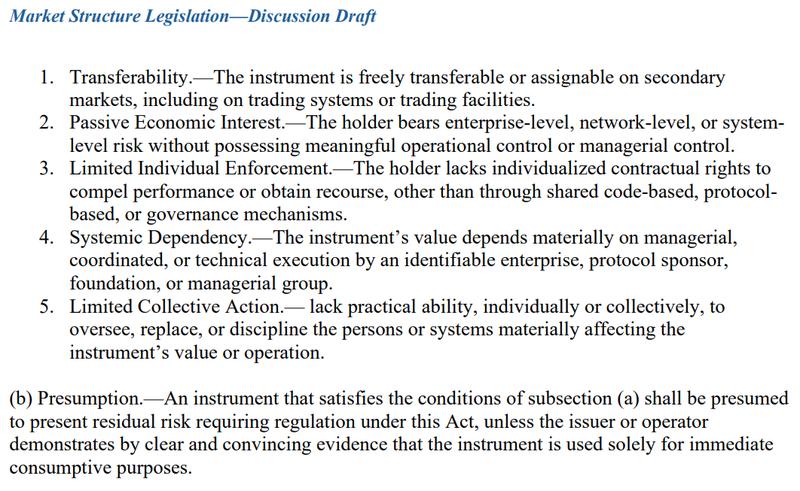
The proposed legislation additionally advocates for implementing risk-oriented jurisdictional authority shared between the SEC and the CFTC, establishing federal supremacy over conflicting state-level regulatory applications, and incorporating safe harbor protections designed to encourage continued innovation in the sector.
The release of these public submissions arrives in advance of a collaborative SEC–CFTC meeting currently slated for Thursday, which will focus on enhancing regulatory coordination regarding digital assets.
Originally scheduled to take place on Tuesday, the "harmonization" conference was postponed by forty-eight hours and will additionally include an informal fireside discussion featuring SEC Chair Paul Atkins alongside CFTC Chair Mike Selig.
The US Senate Agriculture Committee similarly postponed its markup session for the cryptocurrency market structure legislation following a major winter storm that impacted the US.