Institutional Partnerships Force DAOs to Reconsider Decentralized Governance Models
The cryptocurrency industry's shift toward institutional partnerships is creating a difficult choice for DAOs between preserving their decentralized ethos and securing lucrative business agreements.
The foundational ideology that gave rise to decentralized autonomous organizations (DAOs) is now confronting practical business challenges, as the principles of decentralization clash with institutional requirements for clearly defined legal ownership and centralized control mechanisms.
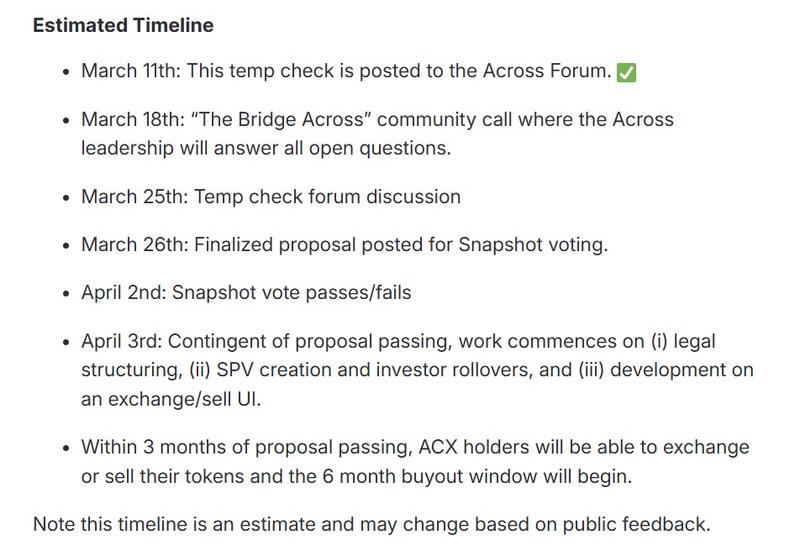
Across Protocol's DAO put forward a contentious proposal on March 11 to restructure into a privately held corporation via a token-to-equity exchange buyout mechanism. According to Risk Labs, the development team operating Across (ACX), the existing token and DAO framework has created "material" obstacles in their pursuit of partnership agreements with institutional players and enterprise clients.
The cryptocurrency community's response has been divided. DeFi research analyst Ignas characterized the move as representing a "huge failure of crypto."
"It feels like a betrayal of the crypto spirit: investment access for everyone, anywhere, globally," Ignas said on X. "I hope other DAOs don't follow them."
Across Protocol's stablecoin operations face constraints from DAO governance
At present, Crosschain Bridge Across Protocol functions under a token-based DAO governance framework, with development oversight provided by Risk Labs through a foundation-based organizational model.
The proposal from Risk Labs details a transformation into a newly established C-corporation registered in the United States that would assume responsibility for both protocol development activities and commercial operations. Token holders of ACX would be given the option to convert their tokens into equity shares in the new corporate entity or participate in a buyout arrangement.
"[DAOs] were supposed to replace the archaic organizational infrastructure that is marked by greed and a lack of trust," Matthew Pinnock, founder of DeFi project Altura, told Cointelegraph.
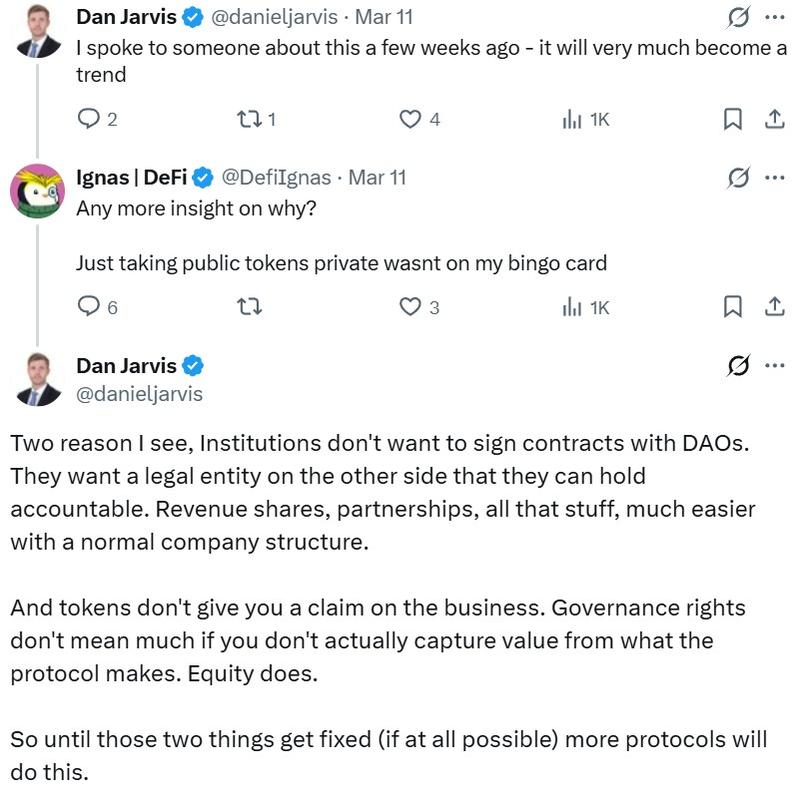
"However, as the industry increasingly moves toward real-world assets and institutional capital, protocols are running into structural limitations. Institutions typically need a clear legal counterparty that can sign contracts and undergo due diligence, something a decentralized collective cannot easily provide," Pinnock added.
Hart Lambur, co-founder of Across, stated that for Across Protocol specifically, maintaining a token structure "generally hurts more than it helps."
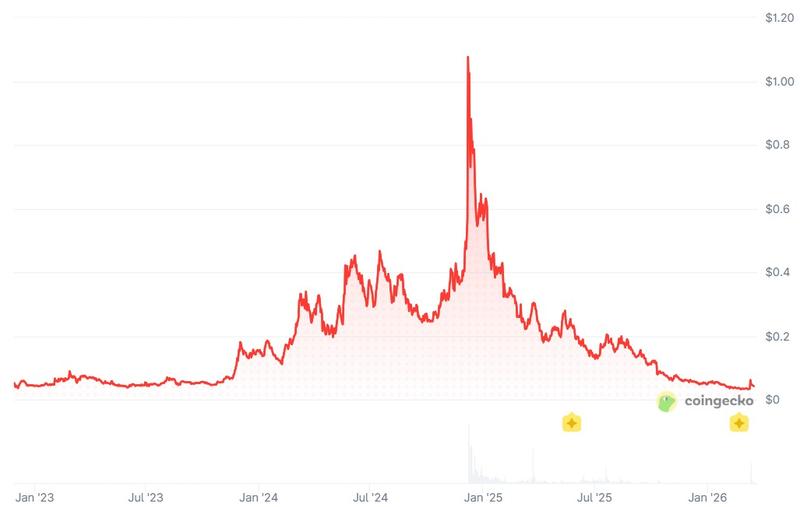
"We launched the Across token very early, at a very low valuation, and with a very broad airdrop. We picked this strategy so that we could build value in public with our community," Lambur said on X. "Today, the macro environment has changed. Tokens are undervalued and underappreciated."
The core business focus of Across revolves around stablecoin infrastructure solutions, which provides context for understanding its corporate transition strategy. The protocol's objective is to facilitate cross-stablecoin fund transfers at parity rates, with transaction fees being covered by stablecoin issuers or business partners instead of being passed to users. According to Lambur, negotiating such business arrangements necessitates formal contracts and off-chain payment structures that prove incompatible with decentralized DAO organizational frameworks.
ShapeShift abandoned corporate status in favor of DAO governance
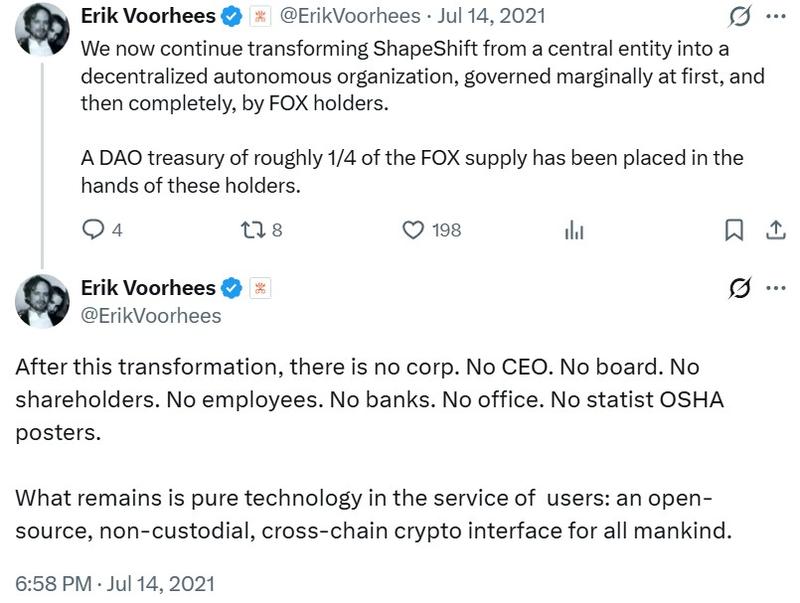
While protocols like Across reconsider their DAO structures, ShapeShift presents an alternative trajectory. The cryptocurrency exchange platform underwent a transformation into a DAO in 2021, dismantling its traditional corporate structure in favor of token-based governance by community members.
According to Tim Black, product lead at ShapeShift DAO, numerous projects embraced DAO organizational structures during the previous market cycle primarily as a narrative-driven decision, without thoroughly considering the operational challenges that would follow.
"What Across is proposing is essentially admitting that. They're saying the DAO experiment helped bootstrap the network, but a company structure is better suited to the next phase," Black told Cointelegraph.
"Many teams quietly operate like companies already," he added. "Shapeshift was innovative in using workstreams, mirroring departments, but they still create more friction than collaboration over time."
Online discussions have gravitated toward tokenized equity as a preferable alternative to conventional corporate structures, with Ignas asserting that such an approach would represent advancement for the broader industry. However, Black believes this perspective reveals more about deficiencies in existing token design rather than validating the underlying concept, noting that numerous governance tokens already operate as de facto equity instruments.
"The original idea behind governance tokens was coordination, not ownership… If they just become equity substitutes, then the experiment has basically collapsed back into the corporate model it was supposed to challenge," he said.
Across Protocol's corporate transition remains under consideration
Should organizational transitions similar to Across' become increasingly prevalent, the result may not be a unified direction for the decentralized finance ecosystem, but rather a bifurcation in how protocols structure themselves and conduct operations.
"One side becomes corporate crypto, protocols run like fintech companies with tokens functioning more like shares. The other side stays genuinely decentralized and accepts the operational friction that comes with that," said Black.
This transformation is being accelerated by the integration of institutional investment capital and real-world assets, which bring compliance and structural requirements that traditional DAO frameworks frequently cannot accommodate.
"That is why we are seeing DAOs taking the regulatory black pill and dropping the D that made them decentralized autonomous organisations," Pinnock said.
As various protocols navigate these challenges, certain projects are migrating toward more defined legal structures and centralized operational frameworks, while alternative projects maintain their commitment to open community participation and decentralized governance mechanisms.
Despite Across Protocol's consideration of a corporate organizational model, the protocol maintains its DAO governance structure at present. The project characterized its proposal as a "temperature check" designed to indicate that no binding decision has yet been finalized. The transition still requires approval through a governance vote and must receive authorization from the token holder community.