Cryptocurrency tokens plunge average 61% post-breach with minimal recovery prospects, Immune analysis reveals
Security breaches trigger consequences extending far beyond initial financial damage, including extended operational disruptions, market liquidity crises and diminished investor confidence, with interconnected DeFi ecosystems spreading the damage throughout markets.

Recent security research published by Immunefi reveals that cryptocurrency breaches maintain a consistent frequency, though financial damages are increasingly concentrated within a limited number of large-scale attacks.
Through examination of 425 publicly disclosed security events spanning from 2021 through 2025, the analysis determines that contemporary hacks typically result in approximately $25 million in compromised assets. During the 2024 and 2025 period specifically, 191 separate incidents generated $4.67 billion in total damages, with merely five individual breaches representing 62% of aggregate losses.
Although comprising a smaller proportion of total incidents, security compromises at centralized exchanges were responsible for the bulk of financial damage. A total of twenty exchange-related hacks generated approximately $2.55 billion, representing roughly 55% of cumulative losses, demonstrating how substantial quantities of customer assets remain vulnerable at concentrated failure points.
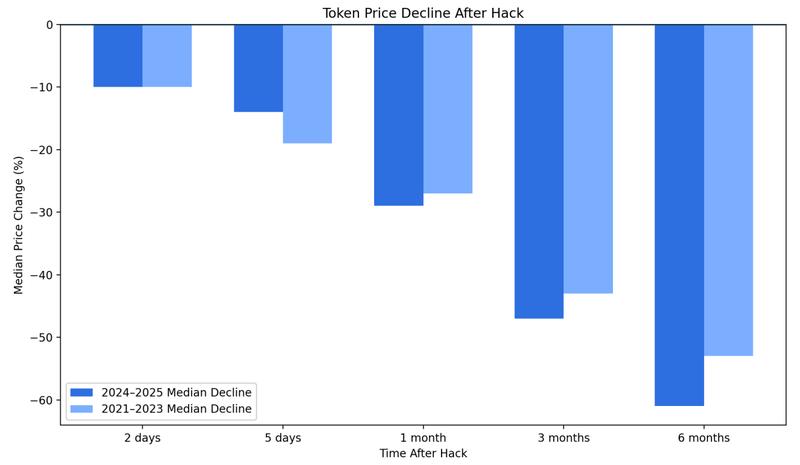
Market responses to security incidents have also intensified significantly. Among 82 compromised tokens monitored throughout the research, valuations declined by a median 61% over six-month periods, with 83.9% continuing to trade beneath their breach-day valuations throughout that timeframe.
"Market participants have grown substantially less tolerant given that expectations have evolved," Immunefi CEO Mitchell Amador explained to Cointelegraph, noting that security compromises are increasingly interpreted as indicators of fundamental weaknesses in technical architecture, organizational oversight and operational durability.
According to Amador, the sustained consequences of security exploits frequently reach far beyond the immediate financial impact:
The stolen funds are only the first layer of damage. What follows is often more destructive: sustained token price suppression, reduced treasury capacity, leadership disruption, lost development time, and erosion of user trust.
The analysis further emphasized how the interdependent nature of DeFi protocols can magnify the consequences stemming from individual security events, with breakdowns propagating throughout lending mechanisms, collateralization frameworks and liquidity infrastructure.
A notable case study examined the failure of Elixir's deUSD stablecoin during November 2025. Elixir had allocated approximately 65% of deUSD's collateral reserves to Stream Finance, which subsequently revealed a $93 million loss attributed to an external asset manager. Following Stream's stablecoin xUSD declining 77%, deUSD's collateralization degraded, redemption mechanisms ceased functioning and widespread selling pressure emerged in Curve pools, eventually driving deUSD downward by more than 97%.
Recent exploits highlight ongoing security risks in crypto
Despite cryptocurrency-focused breach damages declining to $26.5 million throughout February, marking the smallest monthly figure in approximately twelve months according to PeckShield, multiple security compromises have already emerged during March.
Security analysts at Google disclosed a novel exploit toolkit designed to target Apple iPhone owners, created specifically to compromise cryptocurrency wallet recovery phrases. The malicious software package, identified as Coruna, incorporates numerous exploit sequences capable of compromising devices operating different versions of Apple's iOS platform and has been associated with fraudulent websites impersonating cryptocurrency services.
The Bitcoin-oriented DeFi platform Solv Protocol additionally disclosed that one of its token storage vaults suffered a breach resulting in approximately $2.7 million in damages, impacting under 10 individual users. The organization indicated it would compensate the losses and extended a 10% bounty to the perpetrator in return for fund repatriation while security specialists examine the compromise.
In a separate incident, the domain associated with Bonk.fun was commandeered following attackers obtaining unauthorized access to a team member's account and implementing a wallet-draining operation through the website. The project issued warnings advising users to avoid interacting with the platform during the team's efforts to recover domain control.
Additionally, NFT lending service Gondi deactivated a defective smart contract following an exploitation that enabled an attacker to misappropriate approximately $230,000 in NFT assets. The project announced plans to reimburse impacted users during the ongoing investigation of the security flaw, which involved a contract designed to facilitate escrowed NFT sales and loan repayments.