
Bitcoin's hedge promise falls short as gold reclaims its throne
With the dollar losing strength, gold emerges as the preferred safe haven — both in traditional and tokenized forms — as Bitcoin settles into a secondary position for currency risk protection.

Throughout the previous twelve months, market participants have renewed their interest in the age-old precious metal via conventional pathways as well as distributed ledger technology. Digital gold tokens such as XAUt are experiencing increased adoption in parallel with physical market values, delivering blockchain-based access to a time-tested store of value as worries about inflation and monetary instability grow more acute.
Bitcoin continues to maintain relevance in investment portfolios, albeit progressively as a complementary asset. Exchange-traded funds with active management strategies are combining BTC alongside gold as paired protections against the devaluation of government-issued currencies, framing Bitcoin not as a battle-tested inflation hedge but rather as a more volatile counterpart to tangible hard assets.
The current edition of Crypto Biz examines this transformation, covering everything from blockchain-based precious metal products and multi-asset ETFs to the financial industry's expanding adoption of stablecoins and cryptocurrency banking licenses. During times of monetary uncertainty, gold continues to take the lead position. The cryptocurrency sector is adapting to play a supporting role.
Tokenized gold surges as dollar hits four-year low
Traditional market participants aren't the only ones allocating capital to gold. Cryptocurrency market investors are showing growing interest in blockchain-based representations of the yellow metal as the United States dollar loses purchasing power and anxieties surrounding monetary debasement and rising prices become more pronounced.
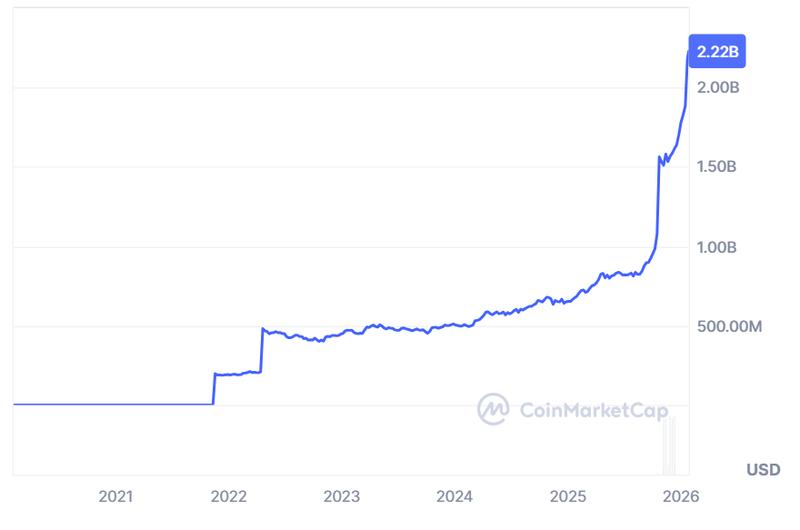
Tether reported that its precious metal-backed digital token, Tether Gold (XAUt), now represents over fifty percent of the entire tokenized gold sector, with an aggregate market capitalization exceeding $2.2 billion. By the conclusion of the fourth quarter, 520,089 XAUt tokens were actively circulating, with each unit supported by a one-to-one ratio of actual gold bullion, based on company disclosures.
The spike in market interest arrives as gold valuations rose beyond $5,300 per troy ounce, representing approximately 90% appreciation throughout the preceding year, concurrent with the ongoing deterioration of the US dollar. The Bloomberg spot US dollar index recently declined to its weakest point in four years.
Bitwise pairs Bitcoin and gold in actively managed ETF
Investment management firm Bitwise has introduced a new exchange-traded fund structured to shield investors from the erosion of currency value by combining Bitcoin alongside gold and additional precious metals.
The Bitwise Proficio Currency Debasement ETF made its market debut on the New York Stock Exchange trading under the symbol BPRO. This actively managed investment vehicle is constructed to provide protection against the diminishing purchasing capacity of the US dollar along with other government-backed currencies.
The fund's composition incorporates allocation to Bitcoin, precious metal commodities and shares of mining companies, and is tailored for financial advisors pursuing Bitcoin market participation without making direct commitments to cryptocurrency-focused investment products.
Fidelity unveils US dollar stablecoin
Fidelity is preparing to introduce its proprietary dollar-denominated stablecoin as the company expands further into the regulated digital asset ecosystem.
Designated as the Fidelity Digital Dollar (FIDD), this forthcoming stablecoin is anticipated to conform with the GENIUS Act's federal regulatory framework for payment-oriented digital currencies, encompassing requirements for reserve backing and regulatory supervision. Company leadership from Fidelity has characterized stablecoins as essential infrastructure for instantaneous transaction settlement and around-the-clock payment processing capabilities, indicating a transition toward widespread adoption beyond cryptocurrency trading activities.
This development emerges as established financial services giants investigate blockchain-based infrastructure and government regulators develop more comprehensive frameworks for United States stablecoins, representing another milestone in institutional integration of cryptocurrency-native settlement mechanisms.
Nomura-backed digital asset company eyes US banking charter
Laser Digital, a digital asset enterprise supported by Nomura, has purportedly submitted documentation for a US national bank trust charter through the Office of the Comptroller of the Currency, signifying a substantial effort to incorporate cryptocurrency services within the United States regulated banking infrastructure.
Should the application receive approval, the charter would authorize Laser Digital to conduct operations across the entire country under one consolidated federal license, eliminating the need for individual state-level custody authorizations, while providing spot market trading for digital assets without accepting customer deposit accounts.
This strategic action arrives during a wider wave of cryptocurrency charter submissions amid an increasingly accommodating US regulatory environment, with multiple digital asset enterprises pursuing federal trust bank designation to strengthen their connections with conventional financial services.
Crypto Biz is your weekly pulse on the business behind blockchain and crypto, delivered directly to your inbox every Thursday.