Developer Prosecutions Challenge America's 'Crypto Capital' Status
While the Trump White House promotes the GENIUS Act as part of its cryptocurrency-friendly approach, ongoing legal cases against Tornado Cash and Samourai developers raise questions about whether US software creators face genuine protection.

President Donald Trump received commendation from the White House for establishing the United States as the "crypto capital of the world," with officials positioning the Guiding and Establishing National Innovation for US Stablecoins (GENIUS) Act as the driving force behind America becoming the "global leader in cryptocurrency."
An official communication shared via X recently featured the phrase "promises made, promises kept," referencing Trump's efforts to terminate what was characterized as the Biden administration's "crusade to crush crypto."
Beyond mere political messaging, the US Commodity Futures Trading Commission (CFTC) and the US Securities and Exchange Commission (SEC) revealed plans for a collaborative event scheduled for Thursday to address "harmonization between the two agencies and their efforts to deliver on President Trump's promise."
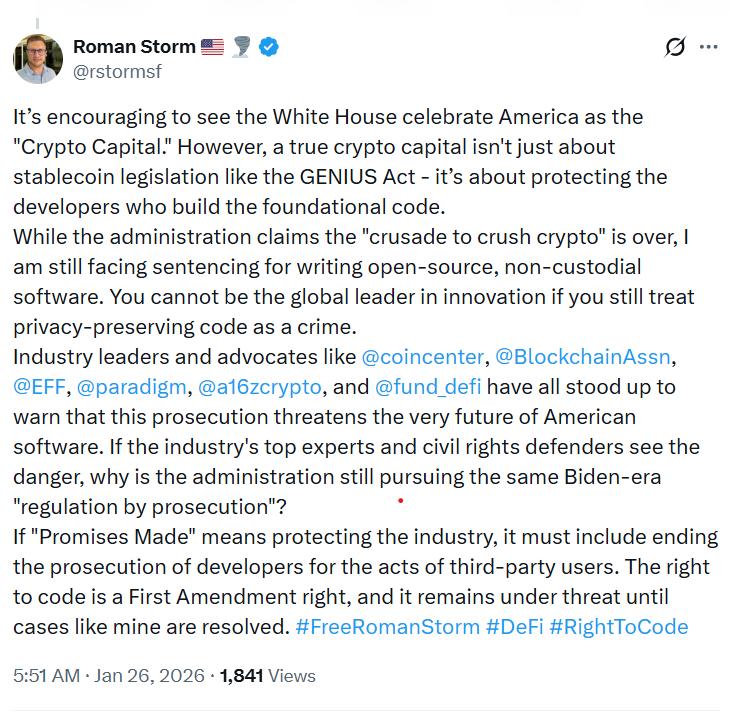
Although numerous industry participants might acknowledge that policy orientation has undergone transformation, individuals such as Roman Storm, the Tornado Cash co-founder who faces sentencing, find it challenging to accept that the regulatory crackdown has genuinely concluded given the continuing prosecutions targeting developers.
Storm responded to the White House on Monday, expressing that while seeing America position itself as the crypto capital was heartening, authentic leadership "isn't just about stablecoin legislation like the GENIUS Act – it's about protecting the developers who build the foundational code."
The intersection of code development and regulatory compliance remains unclear
The prosecution of Samourai Wallet highlights this ongoing concern, with founders William Lonergan Hill and Keonne Rodriguez both receiving substantial prison sentences in November 2025 following claims by US authorities that they enabled illegal financial flows via Samourai, notwithstanding the platform's non-custodial architecture.
From the perspective of numerous developers, the imposition of custodial-level penalties on non-custodial infrastructure obscures the distinction between code publication and operation of a financial intermediary service.
This dynamic amplifies concerns that future enforcement actions might encompass any privacy-focused or decentralized finance (DeFi) tools accessible to US users, irrespective of whether the developers exercise control over client assets.
This apprehension has already manifested in Capitol Hill discussions, where Senators Ron Wyden and Cynthia Lummis recently put forward the Blockchain Regulatory Certainty Act to explicitly establish that non-custodial developers and infrastructure operators who lack control over user assets should not be classified as money transmitters under federal regulations.
In conversation with Cointelegraph, Max Shannon, senior research associate at Bitwise, characterized the White House's messaging as an indication of the significant policy shift away from the Operation Chokepoint period associated with former President Joe Biden, former SEC Chair Gary Gensler and Senator Elizabeth Warren. Shannon highlighted multiple achievements under the current administration, ranging from the GENIUS Act to the establishment of the Crypto Task Force.
Nevertheless, Shannon indicated that Bitwise's analysis suggests markets continue to incorporate a "CLARITY Act discount" into valuations. He explained that until a stable regulatory framework defining responsibilities between agencies and addressing complex issues such as DeFi, privacy protections and yield-bearing stablecoins becomes established, market valuations will continue to reflect underlying legal uncertainty.
Shannon identified the definition of "control" within CLARITY's developer protections as a crucial dividing line, noting that while the legislation promises safeguards for those who "do not control customer funds," ambiguity persists regarding whether this language applies exclusively to private key custody or extends to multiple signature (multisig) configurations, wallet interfaces, sequencers and front-end systems.
Ambiguous custody definitions may force developers to relocate internationally
Andrew Gibb, CEO of Twinstake, an institutional-grade, non-custodial staking provider, expressed a comparable perspective. Gibb informed Cointelegraph that the GENIUS Act represented a "sizable and meaningful step" in providing institutional participants with the regulatory clarity necessary to expand their operations within the US, while emphasizing that prominent cases such as Storm's prosecution continue to transmit a discouraging message to developers, despite the overall positive policy direction.
Gibb advocates for legislators to establish unambiguous distinctions between infrastructure providers and financial intermediaries, founded upon principles of custody, control and discretionary authority, supplemented by explicit safe harbor provisions ensuring that non-custodial validators and interface providers receive protection from classification as banks or money transmitters.
Without resolution of these ambiguities during the upcoming markup process, Gibb cautioned that "a real risk the US framework will be seen as unpredictable, pushing developers offshore" exists.
The Senate Agriculture Committee had originally scheduled a review of the digital asset market clarity (CLARITY) bill for Tuesday, though the session was rescheduled to Thursday due to winter weather conditions.