
Understanding the EU's Cryptocurrency Tax Reporting Framework: A Guide for Platforms and Individual Users
Starting 2026, cryptocurrency platforms operating in the EU must report comprehensive user information and transaction details to tax authorities, marking a fundamental transformation in digital asset tax compliance.

Essential points to understand
- Rather than creating additional taxes, the EU's updated crypto tax framework strengthens fiscal transparency by mandating that cryptocurrency transactions be documented and distributed among member nations.
- Crypto-asset service providers bear the primary responsibility for reporting, with obligations to gather customer identity data, tax jurisdiction information and transactional records using uniform standards.
- Platform-collected information undergoes automatic distribution among EU member state tax agencies, closing international reporting loopholes for cryptocurrency holders.
- The system harmonizes with the Organisation for Economic Co-operation and Development's international cryptocurrency reporting benchmark, facilitating interoperability with territories beyond EU borders.
Cryptocurrency transaction monitoring for taxation purposes in the European Union is poised for substantial improvement. Commencing on Jan. 1, 2026, revised reporting requirements mandate that cryptocurrency platforms conducting business within the EU or catering to EU residents must furnish comprehensive details about their clientele and associated transactions to governmental tax agencies. This development brings digital currencies into closer alignment with transparency standards that have been well-established in traditional financial sectors for years.
The primary legislative instrument facilitating this transformation is Council Directive (EU) 2023/2226, widely referred to as DAC8. This directive broadens the EU's current infrastructure for automated tax information sharing to encompass cryptocurrency holdings. When combined with the Markets in Crypto-Assets (MiCA) regulation, DAC8 constitutes a substantial advancement in cryptocurrency sector governance. Its concentration remains specifically on taxation matters rather than exclusively addressing market behavior or authorization procedures.
This comprehensive guide clarifies the operational mechanics of the EU's novel cryptocurrency tax documentation infrastructure, delineates platform responsibilities and analyzes the consequences for individual cryptocurrency holders as these regulations become operational.
The rationale behind DAC8: Bridging the divide between traditional banking and blockchain technology
Throughout more than ten years, member states within the EU have utilized the Directive on Administrative Cooperation (DAC) to share tax-relevant financial information automatically across international boundaries. Earlier versions encompassed banking accounts, earnings from investments and specific digital service providers, yet cryptocurrency transactions remained mostly excluded from standard reporting protocols.
With cryptocurrency utilization expanding throughout Europe, this exclusion established evident vulnerabilities for potential fiscal evasion. Authorities within the EU considered it contradictory to exempt cryptocurrency purely on the basis of its technological foundation.
DAC8 seeks to eliminate this vulnerability by officially integrating cryptocurrency holdings within the tax transparency infrastructure, guaranteeing that transactional information gets collected, documented and distributed in a fashion comparable to conventional financial data. The European Commission has stressed that cryptocurrency warrants no unique exemption from tax compliance mechanisms.
Harmonization with the OECD's Crypto-Asset Reporting Framework (CARF)
The foundation of DAC8 was constructed upon the CARF, which debuted in 2023. The CARF establishes an international standard for cryptocurrency transaction documentation by defining:
- The categories of crypto assets subject to reporting requirements
- The organizations obligated to submit reports
- The precise customer and transactional information needed.
Through embracing the CARF framework, the EU advances uniformity with worldwide benchmarks, facilitating streamlined information sharing with countries outside the EU that adopt comparable regulations.
Did you know? Prior to cryptocurrency-focused regulations, numerous EU tax agencies depended on blockchain analysis companies rather than official reporting mechanisms to calculate crypto activity, frequently generating substantially divergent numbers for identical markets.
DAC8's coverage: Assets and platforms included
DAC8 primarily targets crypto-asset service providers (CASPs) functioning within EU territory. Such entities encompass centralized trading platforms, brokerage services, custodial wallet providers and comparable intermediary organizations. The regulations apply to an extensive array of digital assets, incorporating most digital currencies, stablecoins, tokenized instruments and particular non-fungible tokens that operate more as investment mechanisms than as simple collectibles. The priority rests on transferability and investment application rather than on particular classifications.
These requirements reach beyond platforms headquartered in the EU. Providers based outside the EU who service EU clientele may equally face compliance obligations, emphasizing the directive's reach across jurisdictional boundaries.
DAC8's rollout schedule and execution
Following its adoption in October 2023, DAC8 necessitated incorporation into domestic legislation by Dec. 31, 2025, with enforcement commencing on Jan. 1, 2026. By the beginning of 2026, certain member nations have encountered implementation delays or received infringement notifications for inadequate transposition, although the EU anticipates complete enforcement.
Important milestone dates comprise:
- Collection of pertinent information by platforms initiated on Jan. 1, 2026.
- Initial reports, documenting 2026 transactions, will reach national tax agencies in 2027, generally within nine months following year conclusion.
- Tax agencies subsequently exchange the information automatically on an annual basis with fellow EU nations.
The commission has communicated expectations for prompt and comprehensive implementation. Multiple nations have been issued formal warnings regarding delays in incorporating the regulations, emphasizing that compliance will be mandatory.
Did you know? Preliminary versions of EU cryptocurrency tax proposals included discussions about whether self-custody wallets might eventually face reporting requirements, illustrating the complexity of regulating decentralized ownership structures.
Platform obligations under DAC8 reporting standards
DAC8 mandates that CASPs conduct strengthened verification procedures and provide comprehensive information to their respective domestic tax authorities. This encompasses customer particulars including complete name, residential address, tax jurisdiction and tax identification number (TIN), when obtainable.
Transactional information encompasses:
- Categories of cryptocurrency transactions, including sales, conversions and movements
- Total proceeds from asset dispositions
- Transaction dates and monetary values.
Following compilation, this data undergoes automatic distribution among EU tax authorities. A customer's nation of residence obtains the applicable information regardless of the platform's physical location.
For platforms, DAC8 transforms cryptocurrency tax reporting into an organized, ongoing compliance responsibility. It bears greater resemblance to financial disclosure than sporadic announcements.
DAC8's consequences for cryptocurrency holders
Among the most substantial modifications for cryptocurrency holders involves heightened tax reporting transparency introduced by DAC8. Domestic tax authorities now possess visibility into transactions executed through reporting platforms.
This might lead to:
- Demands for more comprehensive tax jurisdiction or identification documentation during account creation or modifications
- Enhanced capability for authorities to correlate cryptocurrency activity against income declared on tax submissions
- Simplified identification of discrepancies between documented information and tax declarations.
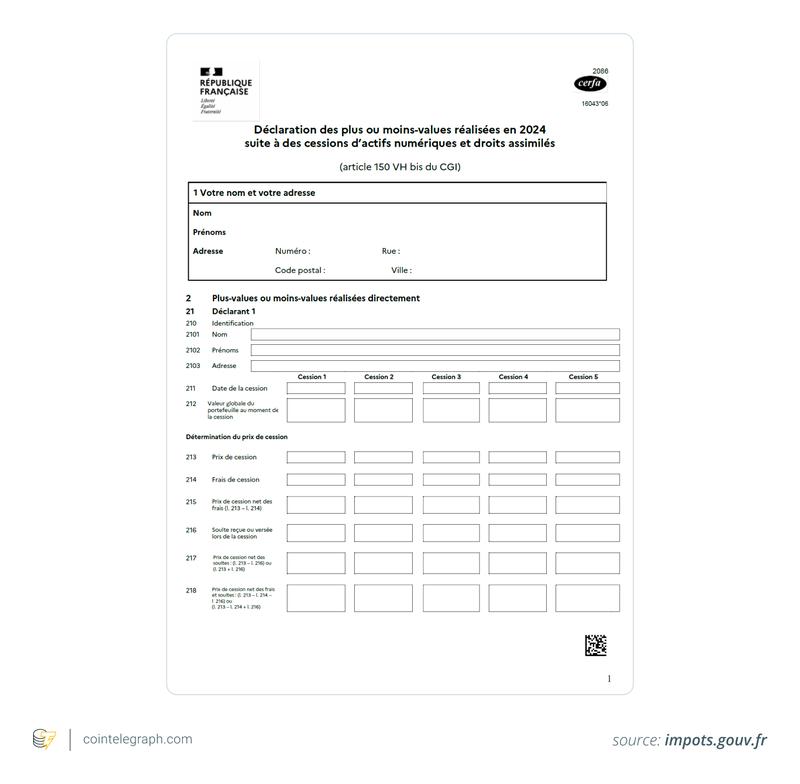
DAC8 neither establishes novel taxes nor standardizes taxation rates throughout the EU. Individual member states preserve control over cryptocurrency taxation frameworks, as the directive concentrates exclusively on information distribution. Although DAC8 automates information exchange among authorities, individuals remain obligated to document their cryptocurrency transactions via their individual national tax declarations.
Platform compliance obstacles under DAC8
DAC8 implementation demands substantial infrastructure enhancements, encompassing precise transaction monitoring, tax jurisdiction confirmation and protected information retention. Smaller organizations or those with limited resources might find difficulty satisfying these requirements alongside MiCA and Anti-Money Laundering obligations.
Failing to comply introduces the possibility of sanctions, encompassing financial penalties for delayed, insufficient or absent documentation. Certain platforms have suggested that regulatory compliance expenditures might affect their operational jurisdiction decisions.
Users might additionally encounter bewilderment in comprehending DAC8 within the MiCA context. DAC8 handles tax transparency operations behind the scenes, whereas MiCA addresses authorization, investor protections and market practices.
The two function complementarily: DAC8 guarantees tax information circulation once operations are functioning, whereas MiCA establishes permissible activities. Combined, they establish a thorough supervisory structure for the cryptocurrency sector.
Particular elements remain ambiguous under DAC8, including how decentralized finance (DeFi) integrates when no centralized intermediary exists for reporting purposes. Privacy proponents have expressed apprehensions regarding extensive information gathering and distribution, though EU representatives indicate that the General Data Protection Regulation (GDPR) and additional data protection statutes remain applicable. The practical operation of these protective measures awaits observation.
Did you know? Comparable cryptocurrency tax reporting frameworks are under consideration in Asia-Pacific and Latin American regions, indicating that EU-style transparency might evolve into an international standard instead of remaining a regional anomaly.
DAC8 within the larger framework
DAC8 represents one component of a worldwide movement as cryptocurrency becomes incorporated into conventional finance. National governments internationally are progressively treating it as integral to the mainstream financial infrastructure rather than as an alternative economy regarded with distrust.
Through implementing OECD-compatible standards and facilitating cross-border information exchanges, the EU emphasizes that cryptocurrency will encounter identical transparency requirements as conventional assets. For individuals and platforms throughout Europe, the era of minimal formal tax monitoring is definitively concluding.