
Trump's Impact on Bitcoin Prices: A Comprehensive Analysis
President Donald Trump's policies and public statements regarding cryptocurrency have significantly shaped digital asset market dynamics, with his ambitious crypto initiatives creating notable price fluctuations.
During the recent weekend, President Donald Trump revealed a series of fresh tariff measures as a response to a Supreme Court ruling that declared numerous previous tariff increases as unconstitutional.
In the aftermath of these tariff announcements, cryptocurrency markets experienced significant declines in a pattern that has become disturbingly familiar to the sector since April 2025, the month when Trump rolled out his initial wave of aggressive trade barriers.
Market experts have consistently observed the negative impact these tariffs have imposed on cryptocurrency valuations. However, the nation's 47th president possesses an equally remarkable capacity to invigorate market activity.
Optimistic remarks emanating from the White House have similarly influenced market performance, demonstrating that Trump's policy decisions and verbal communications both carry substantial weight. What follows is an examination of key moments when Trump has driven cryptocurrency market movements.
World Liberty Financial (WLFI), the cryptocurrency venture associated with the Trump family, acquired multiple digital tokens mere hours prior to his inauguration oath on Jan. 20, 2025. These purchases encompassed wrapped Bitcoin (WBTC), Ether (ETH), Tron (TRX), Aave (AAVE), Ethena (ENA) and Chainlink (LINK).
This assertive purchasing activity represented a powerful signal of crypto support in advance of his formal blockchain policy rollout.
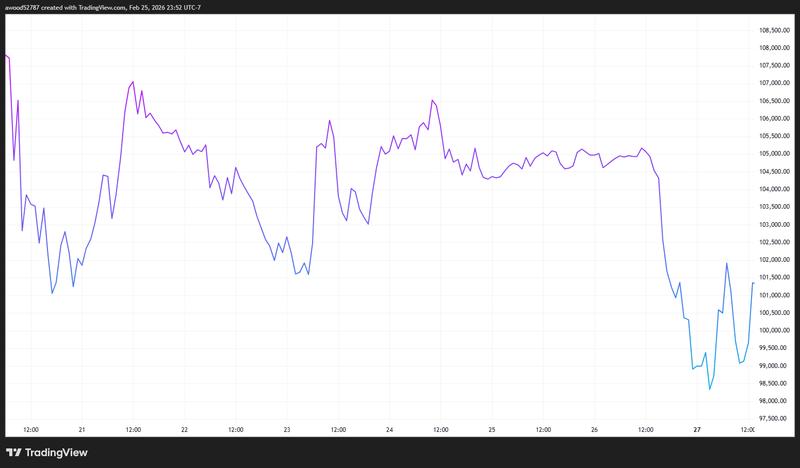
Within 24 hours, Bitcoin's valuation climbed 4.5%. The seven-day performance reflected a decline of 1.47%.
Jan. 23, 2025: Trump announces crypto task force
Merely three days following his inauguration, Trump executed executive order 14178. This directive prohibited the development of a US central bank digital currency and established the Presidential Working Group on Digital Asset Markets designed to "strengthen U.S. leadership in digital finance."
This action signaled the commencement of the Trump administration's cryptocurrency-friendly policy direction. Pro-crypto Senator Cynthia Lummis captured the sentiment perfectly on that same day, declaring, "Big things are coming."
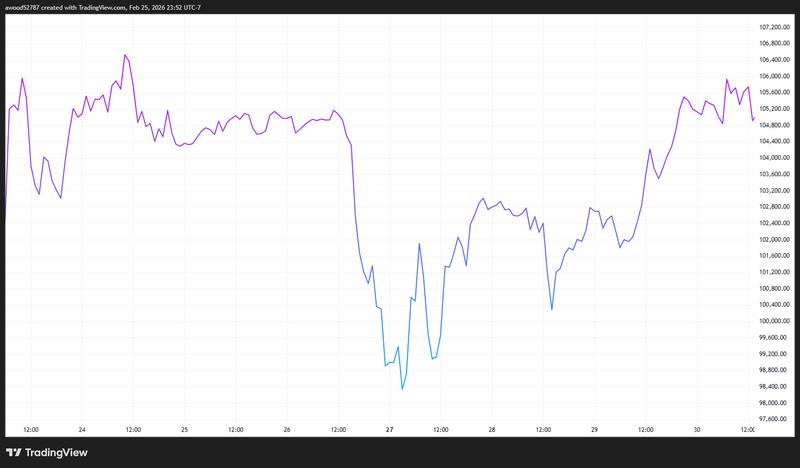
Bitcoin's value rose 1.34% during that trading day. Over the following week, it registered a modest increase of 0.79%.
March 2-7, 2025: "Crypto Reserve" announced
Trump unveiled a proposal establishing a US "Crypto Reserve," designating several major digital tokens as strategic digital holdings.
Four days following this announcement, he executed an order creating the Strategic Bitcoin Reserve and US Digital Asset Stockpile. The Bitcoin reserve would consist of BTC confiscated by federal law enforcement agencies during criminal investigations. The digital asset stockpile featured a diverse collection of cryptocurrencies, most notably XRP (XRP), Solana (SOL) and Cardano (ADA).
Certain Bitcoin proponents expressed dissatisfaction, having anticipated that the federal government would outline a strategy for actively purchasing Bitcoin.
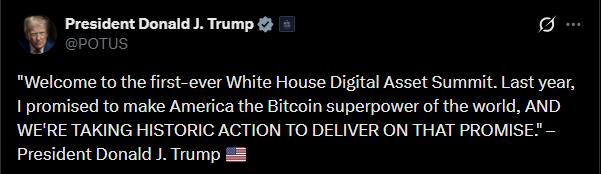
Directly after signing the executive order, the White House convened its inaugural "Crypto Summit," assembling industry executives and government officials to deliberate on digital asset regulations. Trump declared, "This is a tremendous opportunity for economic growth and innovation in our financial sector and will really go a long way."
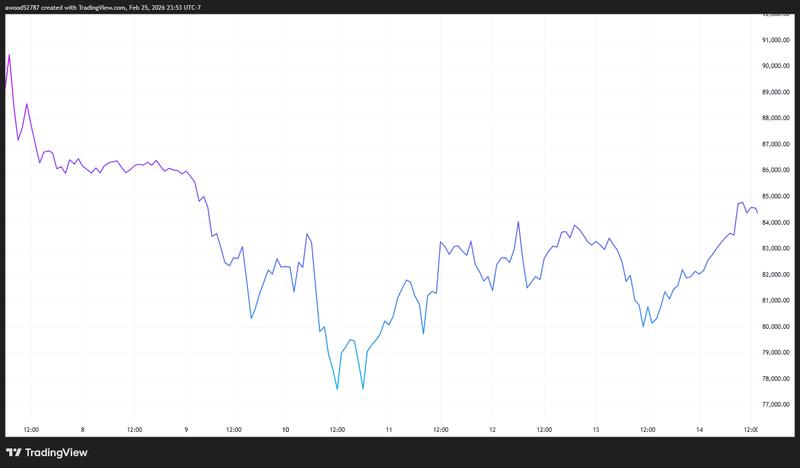
Bitcoin's price experienced minimal fluctuation in the 24 hours afterward, dropping 0.75%. Over the weekly period, it declined 2.56%.
March 17, 2025: WLFI token sale completion
The public token offering from World Liberty Financial concluded with approximately $550 million in WLFI tokens distributed, representing one of the most substantial fundraising achievements connected to the Trump-associated initiative to that point.
Skeptics and analysts started expressing apprehension regarding Trump's capacity to shape policy decisions — actions that directly impact his personal and family wealth. Reports suggest the Trump family has generated over $1 billion in revenue from WLFI since the project's launch.
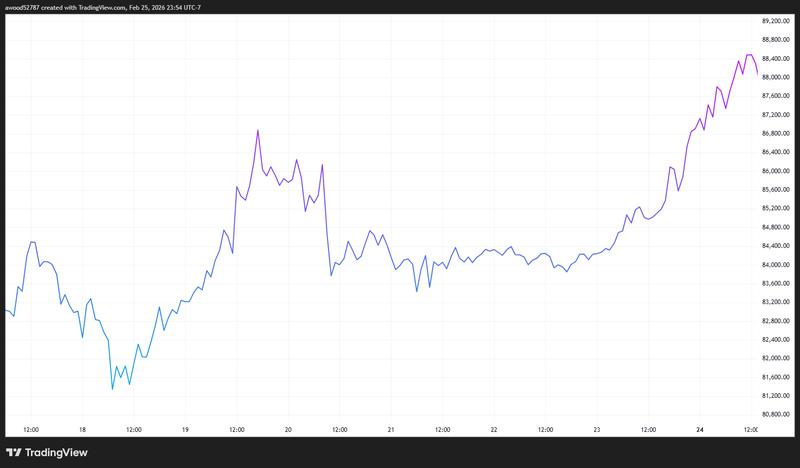
Bitcoin's price dropped momentarily by 1.59% that day. The weekly performance showed improvement with a 3.5% increase.
March 20, 2025: Blockworks Digital Asset Summit address
Trump presented a pre-recorded keynote presentation at the Blockworks Digital Asset Summit held in New York City, advocating for American dominance in cryptocurrency and more transparent legislative structures.
Trump condemned the Biden administration's cryptocurrency policies, declaring he would swiftly terminate the "lawless" regulatory enforcement campaigns against cryptocurrency firms that began under "Operation Chokepoint 2.0."
While this wasn't Trump's initial appearance at a cryptocurrency conference, it represented his first as an acting president and demonstrated his willingness to participate directly with the cryptocurrency sector at its dedicated venues and forums. "It's not gonna be easy, but we're way ahead," he stated.
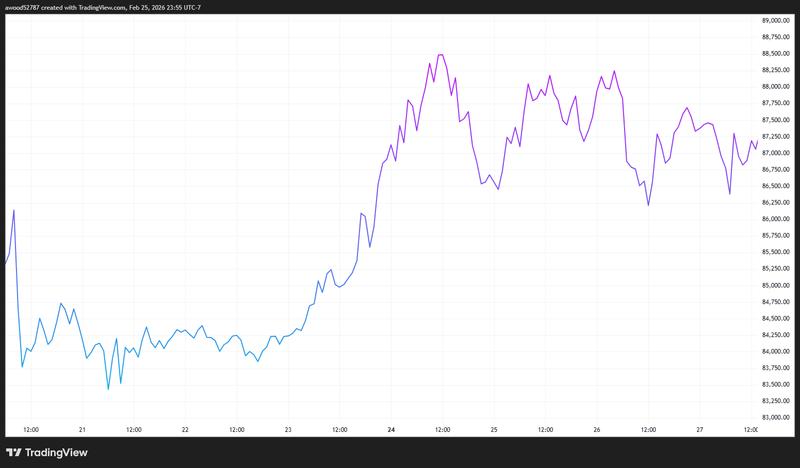
Bitcoin's valuation remained largely stable on the 24-hour timeframe, declining merely 0.1%. During the week, it climbed +3.46%.
April 5, 2025: Trump announces "Liberation Day tariffs"
Speaking from the White House Rose Garden, Trump declared comprehensive, universal tariff increases on every nation conducting trade with the United States. These tariffs began at a baseline of 10%, with supplementary percentages calculated based on individual country trade deficits or surpluses.
The mathematical formula employed by the administration faced widespread reports of containing calculation errors. It received criticism for incorporating "mathiness" — essentially, deceptive mathematics utilized to achieve or advance an economic objective.
Financial markets, including cryptocurrency, initially reacted pessimistically to the potential of a revived international trade conflict and elevated costs for imported products in the US. Nevertheless, "buy the dip" investment strategies and traders recalibrating their macro risk evaluations resulted in rapid market recovery.
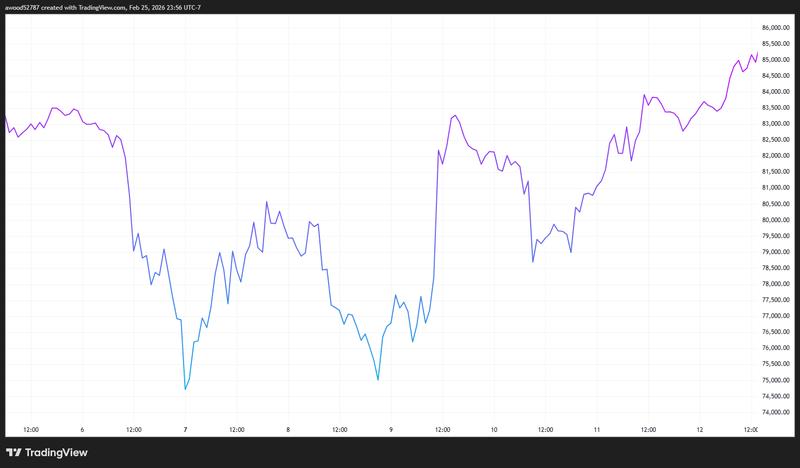
The immediate market reaction created panic, pushing Bitcoin's price down 5.7%. During the week, it rebounded to achieve a 2.14% increase.
June 27, 2025: UAE fund invests $100 million in WLFI
The Aqua 1 Foundation, headquartered in the UAE, committed $100 million toward WLFI tokens, emerging as a leading publicly acknowledged institutional supporter. This investment was intended to accelerate the development of a "blockchain-powered financial ecosystem."
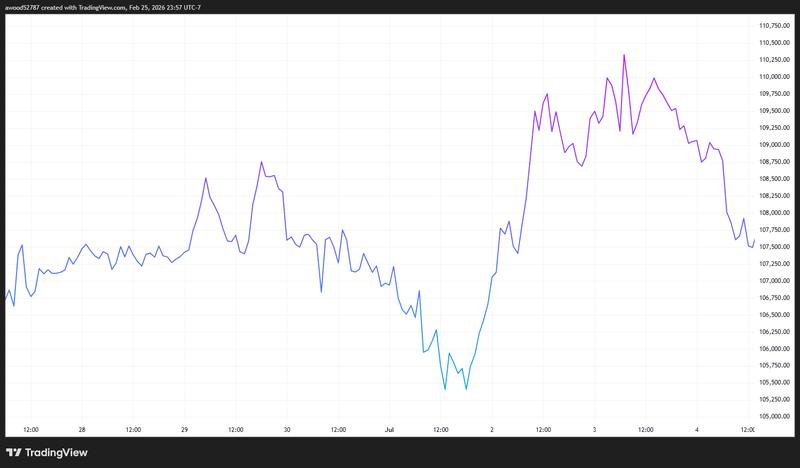
Bitcoin's price stayed largely unchanged, rising 0.23% that day and 0.9% during the subsequent week.
July 17, 2025: WLFI tradability approved
WLFI token holders voted decisively to enable WLFI token trading, converting the financial platform from restricted participation to permitting secondary market development. The governance proposal achieved overwhelming approval.
Market sentiment regarding WLFI token developments didn't extend to broader cryptocurrency markets. By July 18, Bitcoin had decreased 0.86%, and seven days later it registered a minor decline of 2%.
Sept. 1, 2025: WLFI tradable launch
The WLFI token commenced trading on prominent cryptocurrency exchanges such as Binance. Initial investors faced restrictions allowing only 20% of their token holdings to be sold, and according to Barron's, founders including Trump and his son Donald Trump Jr. faced complete selling prohibitions on their allocations.
Nevertheless, the token listing enabled substantial secondary market formation and illustrated the promotional power of the Trump brand alone for a digital asset. Original WLFI purchases came with limitations: Purchasers were prohibited from selling or transferring their tokens. The enormous demand for token purchases, even during the non-tradable phase, revealed that Trump could effectively leverage his brand recognition for cryptocurrency promotion.
Despite briefly declining in the hours immediately following WLFI trading authorization, Bitcoin registered a 1.8% gain that day, and seven days afterward, it had increased 1.96%.
Nov. 5, 2025: "Bitcoin Superpower" speech in Miami
Trump delivered remarks at the American Business Forum in Miami, the identical city where he participated in the internationally renowned Bitcoin conference as a presidential candidate in 2024.
During the conference, Trump drew comparisons between US cryptocurrency policy and that of geopolitical competitors, proclaiming, "We're making the United States, the Bitcoin superpower, the crypto capital of the world and the undisputed leader in artificial intelligence."
Although less dramatic than his inaugural cryptocurrency-focused appearance in Miami, it nonetheless generated a positive, though temporary, effect on Bitcoin's valuation. However, the CLARITY Act was experiencing legislative gridlock in the US Senate, and the price would subsequently decline.
Bitcoin's price remained unaffected by Trump's remarks. BTC decreased 1.8% the following day and 1.5% after seven days.
Jan. 23, 2026: US "leads world" in crypto at Davos
Trump addressed the World Economic Forum in Davos during a period of heightened geopolitical tension surrounding Greenland.
During a wide-ranging speech before gathered international leaders, Trump, beyond asserting that the US required Greenland for national security purposes, highlighted American leadership in cryptocurrency policy relative to perceived competitors.
"We have to make it so that China doesn't get the hold of it, and once they have that hold, we're not going to be able to get it back."
Cryptocurrency markets expressed relief following his comments, though this likely stemmed from reports that the US had purportedly reached an agreement with Denmark and would not pursue military action regarding Greenland.
Bitcoin's price temporarily stabilized when Trump indicated that negotiations with Denmark over Greenland would yield a peaceful resolution. Continuing concerns about trade policy and escalating international tensions resulted in Bitcoin declining 6% over the following week.
Feb. 18, 2026: World Liberty Forum at Mar-a-Lago
Financial executives from Wall Street gathered at Mar-a-Lago, the Trump family's resort property in Florida. The conference, organized under World Liberty Financial's auspices, included Goldman Sachs CEO David Solomon alongside pardoned former Binance co-founder Changpeng "CZ" Zhao.
The gathering demonstrated a wider, cryptocurrency-supportive transformation among American banking institutions.
During the event, Franklin Templeton CEO Jenny Johnson described her vision of blockchain integration with conventional finance. "To me, I'm always trying to understand how this is evolving and particularly at the crossroads of TradFi and DeFi," she said.
Eric Trump, the president's son, also referenced the attitude shift regarding cryptocurrency and increased receptiveness toward the Trump family more broadly, "There's people in this room that were probably on the opposite side of us, that were canceling bank accounts for us, that were kicking us out of their big banks for no reason other than the fact that my father was wearing a hat that said, 'Make America Great Again.'"
Bitcoin received a temporary boost following the forum and rose 1.3% the next day. Over the weekly period, it remained essentially flat, declining 0.87%.
Feb. 22, 2026: Trump threatens further tariffs
In the legal matter of Learning Resources v. Trump, the US Supreme Court determined that the president had exceeded his constitutional authority when imposing certain tariffs that have become characteristic of his administration.
In practical terms, it nullified the tariffs Trump had enacted utilizing the 1977 International Emergency Economic Powers Act (IEEPA).
Trump expressed his frustration with the Supreme Court, especially regarding the justices he had personally appointed during his initial presidential term. He subsequently imposed a 10% worldwide tariff, this time invoking the Trade Act of 1974 as legal justification.
Tariffs reasserted negative pressure on financial markets.
Bitcoin seems to be maintaining a consolidation phase, declining 0.77% one day following the Supreme Court ruling and down 1.3% at the time of publication.
Which moves Bitcoin more: Policy or oratory?
Throughout its existence, Bitcoin has experienced numerous occasions where prices fluctuated based on statements from influential individuals.
A notable illustration is Tesla CEO Elon Musk, who triggered a nearly 20% Bitcoin price surge in 2021 simply by incorporating the word "#bitcoin" into his X profile biography. His declaration that Tesla would begin accepting Bitcoin for payments drove the price from approximately $39,000 to $44,000.
Regarding pure percentage movements, Trump hasn't generated comparable price swings, but the market environment has evolved considerably.
The cryptocurrency sector is achieving substantial progress in the US. Congressional legislators are developing a comprehensive crypto regulatory structure, and cryptocurrency acceptance is expanding at the highest governmental levels.
More significant concerns for cryptocurrency investors and institutional financial participants include the stalled progress on the CLARITY Act. Tariffs simultaneously generate economic unpredictability and inflate consumer goods prices.
As cryptocurrency achieves deeper integration with conventional financial markets, these dominant macroeconomic variables exert greater influence on Bitcoin's price than any optimistic rhetoric possibly can.