
Tracking Down $61M in Romance Scam Cryptocurrency: Inside the US Investigation
An inside look at how federal agents tracked down $61 million in cryptocurrency connected to romance scams by utilizing blockchain analysis tools and stablecoin asset freezing capabilities.

Key takeaways
- North Carolina federal investigators confiscated over $61 million in USDT, exposing the mechanics of pig-butchering schemes that merge emotional exploitation with fake cryptocurrency investment platforms to steal from victims on a massive scale.
- Law enforcement utilized blockchain's transparent, permanent record-keeping to follow victim payments through numerous digital wallets. Even though criminals tried to hide their tracks, each transaction stayed permanently accessible and could be traced back.
- Through blockchain analysis tools, officials grouped connected wallet addresses by examining transaction patterns, timing data and points where funds were consolidated, enabling them to link scattered wallets to the larger fraud operation.
- Since the fraudulent proceeds were stored in USDT, Tether's capacity to freeze tokens at particular addresses following official legal requests proved instrumental in stopping the funds from vanishing for good.
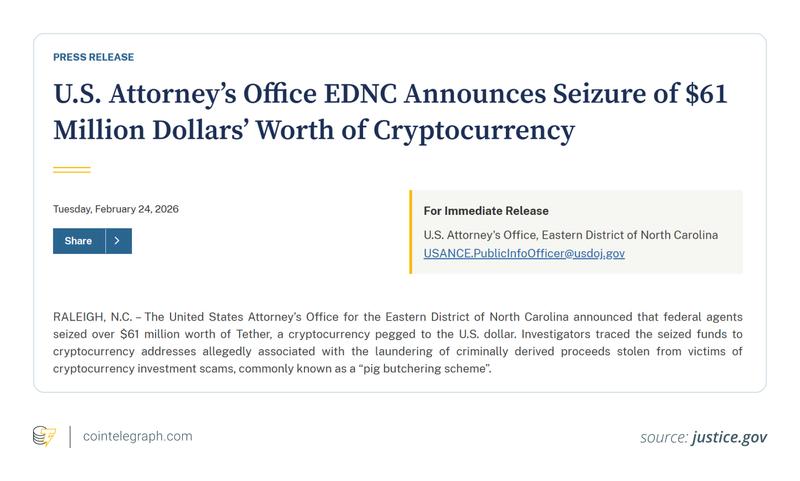
In February 2026, federal law enforcement in North Carolina confiscated upward of $61 million in Tether's USDt (USDT), revealing the mechanisms behind an extensive cryptocurrency fraud operation.
The probe focused on a romance-based scam, commonly referred to as a pig-butchering scam, a fraudulent scheme where criminals establish romantic relationships with targets to convince them to use fake investment applications. Though the recovered sum was substantial, what makes this case remarkable is the technical proficiency shown by investigators. Through following digital traces across numerous accounts and unraveling sophisticated money laundering methods, investigators managed to freeze the assets before they could vanish.
This piece examines the methods used by US federal investigators to track down and confiscate assets connected to a romance-based pig-butchering cryptocurrency scam. It describes how blockchain forensic analysis, wallet grouping techniques and stablecoin issuer cooperation helped expose a complicated laundering operation.
The anatomy of a romance crypto scam
Romance cryptocurrency scams start with victim grooming.
Fraudsters often pose as potential romantic interests or friendly acquaintances on social networking platforms, dating websites or messaging applications. They invest weeks or even months establishing trust with their targets. Eventually, they introduce what appears to be an exclusive crypto investment opportunity, frequently claiming insider expertise or access to a specialized trading platform.
Targets are directed to visually impressive yet completely fraudulent crypto sites that display fake trading interfaces, fabricated inflated profits and live price charts that mimic legitimate exchanges.
The appearance of "profits" encourages victims to invest increasingly larger amounts. Yet when withdrawal attempts are made, new requirements emerge for tax payments, processing fees or supplementary deposits. Ultimately, the accounts become completely inaccessible.
At that stage, the money has vanished.
Did you know? Blockchain analysis firms can map millions of wallet addresses into clusters using behavioral fingerprints even when criminals try to obscure ownership through rapid transfers.
The $61-million seizure in North Carolina
Based on information from the US Attorney's Office for the Eastern District of North Carolina, federal investigators confiscated more than $61 million in USDT linked to a romance-based crypto fraud operation.
Agents from Homeland Security Investigations (HSI) followed victim payments through a complex web of digital wallets. The scammers attempted to conceal their path by moving assets through numerous addresses, which is a typical crypto laundering approach. Yet blockchain's transparent, permanent ledger preserves every transaction indefinitely.
This transparency proved to be the key to success.
How investigators traced the funds
The $61-million seizure resulted from a methodical analysis of digital evidence preserved on the blockchain. Investigators rebuilt wallet transaction histories step-by-step, transforming publicly accessible ledger data into actionable evidence.
Tracing transactions on the blockchain
As victims sent money to fraudulent accounts, these payments became transparently visible on the blockchain. Investigators had the ability to:
- Identify the specific addresses where victims deposited their funds
- Track subsequent transfers between different wallets
- Chart transfer pathways across networks of interconnected addresses.
Although the fraudsters rapidly moved funds through different wallets, the complete transaction history stayed accessible on the blockchain.
Blockchain analytical software allowed investigators to categorize wallets according to behavioral indicators such as common transaction flows, locations where funds were combined and timing relationships.
In time, investigators successfully identified multiple addresses containing substantial USDT holdings.
Wallet clustering and laundering patterns
Pig-butchering operations commonly use multi-layered transfer schemes:
- Breaking up assets across different wallets
- Routing them through intermediary accounts
- Combining funds into larger holding wallets.
These approaches are designed to generate confusion and slow down detection, but they cannot eliminate the verifiable transaction record.
By reconstructing the movement path of the funds, investigators connected multiple wallets to the wider fraudulent operation.
After critical holding addresses were identified, officials moved quickly.
Did you know? The US Federal Bureau of Investigation's Internet Crime Complaint Center (IC3) receives thousands of crypto-related fraud complaints annually, with romance-investment scams ranking among the fastest-growing categories.
Tether's key role in freezing the assets
Given that the stolen assets were in USDT, a centralized stablecoin, active involvement from the token issuer was crucial.
The Department of Justice (DOJ) publicly acknowledged Tether's assistance in transferring and freezing the confiscated assets. Issuers of stablecoins have the technical ability to freeze tokens at specific addresses when provided with valid legal orders.
The CEO of Tether stressed that blockchain's inherent transparency enables law enforcement to act quickly and effectively against illicit activity.
This investigation demonstrates that while cryptocurrency transactions function on decentralized networks, numerous stablecoins retain centralized control mechanisms that officials can utilize during criminal investigations.
The issuer's cooperation can significantly impact whether victims have any chance of recovering their stolen funds.
Did you know? Some pig-butchering operations are run from large overseas compounds where victims of human trafficking are forced to carry out online scams under coercion.
The escalating wave of crypto fraud
The $61-million confiscation represents just one case among many.
Cryptocurrency scams have surged in both scale and sophistication. Industry data indicates that total losses from cryptocurrency fraud reached approximately $17 billion in 2025, with AI-powered impersonation schemes demonstrating especially dramatic year-over-year increases.
Pig-butchering operations are particularly devastating because they combine:
- Emotional manipulation and relationship-building
- Prolonged grooming timeframes
- Intense, high-pressure investment tactics
- Polished, professionally built fraudulent platforms.
Increasingly, perpetrators have started employing AI-generated images and deepfake video technology to enhance their perceived legitimacy and deceive victims more convincingly.

Legal consequences have become significantly harsher. Early in 2026, a key figure in a pig-butchering-related money laundering operation connected to over $73 million in illegal funds was sentenced to 20 years in federal prison. This demonstrated the increased priority authorities now assign to breaking up these criminal enterprises.
Why blockchain transparency is a game-changer
This investigation dispels a common misconception that cryptocurrency transactions cannot be tracked.
Although privacy-oriented coins and mixing services are available, the overwhelming majority of commonly used cryptocurrencies, including Bitcoin (BTC) and Ether (ETH), operate on completely public blockchains. Each transaction is permanently documented on an open, unchangeable ledger.
For law enforcement and forensic investigators, this transparency provides significant benefits:
- Comprehensive, permanent access to historical transaction information
- Sophisticated wallet clustering capabilities to connect related addresses
- The capacity to correlate blockchain data with Know Your Customer (KYC) information from regulated exchanges
- Identification of behavioral patterns spanning multiple networks.
Whenever illegal funds interact with regulated exchanges, custodial platforms or other identifiable entities, the probability of linking anonymous wallets to actual individuals increases substantially.
Why crypto price volatility doesn't shield criminals
Another common misconception suggests that criminals can simply "wait out" law enforcement by storing stolen funds in volatile assets until attention diminishes.
In this particular seizure, though, the assets were stored in a dollar-pegged stablecoin, USDT. While this price stability preserves the value of the stolen assets, it also maintains them within the traceable ecosystem.
Since blockchain records are permanent and publicly searchable, investigators can methodically build cases over months or years. The digital evidence typically remains accessible indefinitely, permitting authorities to revisit and execute seizures well after the original crime took place.
What this means for scam victims
For people who fall victim to romance-based crypto scams, retrieving stolen assets remains extremely difficult.
After funds reach self-custodied wallets controlled by the scammers, successful asset recovery depends on multiple crucial elements:
- Immediate reporting by victims once the fraud is discovered
- Effective coordination among law enforcement agencies internationally
- Active cooperation from cryptocurrency exchanges
- The capability of stablecoin issuers to freeze assets quickly.
The $61-million seizure in North Carolina demonstrates that substantial recoveries are possible. Nevertheless, they require close collaboration between victims, federal investigators, blockchain forensic experts and cooperative crypto companies.
The shifting landscape of crypto enforcement
This prominent seizure illustrates a distinct evolution in how law enforcement addresses cryptocurrency crime:
- Law enforcement teams are continuously enhancing their proficiency in blockchain tracing methods.
- Leading stablecoin issuers are demonstrating increased readiness to support ongoing criminal investigations.
- Judges and prosecutors are imposing considerably longer prison sentences on individuals involved in large-scale fraud and money laundering operations.
Although pig-butchering schemes are becoming increasingly sophisticated and convincing, investigative capabilities and international cooperation are developing at a similar rate.
The primary question has shifted from whether cryptocurrency transactions can be traced. The actual challenge now revolves around timing. The question is how rapidly authorities and their partners can freeze and confiscate assets before the funds are dispersed across inaccessible wallets or jurisdictions.