
Riot Platforms offloads 3,778 BTC in Q1 as mining industry faces profitability challenges
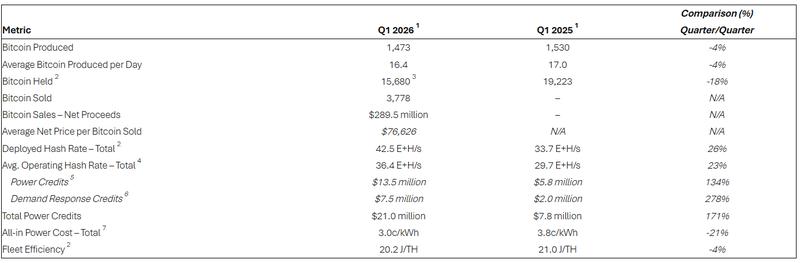
During the first quarter of 2026, Riot Platforms liquidated 3,778 Bitcoin for $289.5 million as the mining sector grapples with escalating energy expenses and challenging market dynamics.

During the first three months of the year, Riot Platforms liquidated 3,778 Bitcoin, contributing to a broader trend of cryptocurrency companies selling digital assets as they navigate challenging market dynamics.
According to an operational update that the miner published on Thursday, the Bitcoin (BTC) was liquidated at an average selling price of $76,626, generating proceeds of $289.5 million for Riot. As of Friday, Bitcoin was changing hands at $66,867.
Throughout the quarter, the miner generated 1,473 Bitcoin and maintained a treasury of 15,680 coins at the conclusion of Q1. On Thursday, blockchain intelligence platform Arkham also detected a transfer of 500 Bitcoin from a wallet they identified as belonging to Riot Platforms.
This activity is part of a broader pattern of cryptocurrency mining companies and related firms offloading Bitcoin in recent months. Over the past seven days, several companies such as MARA Holdings, Genius Group and Nakamoto Holdings disclosed that they had collectively liquidated 15,501 Bitcoin, with MARA accounting for the majority of these sales.
According to Kadan Stadelmann, a blockchain developer, investor and co-founder of AI company Compance, the primary driver behind miner sales is the surge in energy costs, which have been exacerbated by military conflict in the Middle East region.
Miners are selling off Bitcoin due to increasing energy costs, highlighted by the ongoing oil price shock, which represents one of the main costs of mining Bitcoin. As energy costs rise, the miners are forced to sell off their Bitcoin in an attempt to cover their operational costs.
The conflict in the Middle East, which saw an escalation during February, has pushed oil prices upward while simultaneously driving cryptocurrencies and traditional financial markets downward.
Less efficient miners are turning off rigs
According to Stadelmann, mining operations with lower efficiency are being forced to shut down their equipment due to increasing operational expenses, and he anticipates additional capitulation in the sector, which will allow larger mining operations to capture more market share.
"This leads to a fall in hashrate and difficulty in Bitcoin mining. This makes it easier and more profitable to mine Bitcoins for those miners who remain online," he told Cointelegraph.
On March 20, the Bitcoin mining difficulty experienced a decline from approximately 145 trillion down to 133 trillion, while the network hash rate has similarly decreased since the beginning of the month, falling from 1.16 zettahash to roughly 990 exahash as of Friday, based on data from CoinWarz.
Nevertheless, Stadelmann also indicated that a possible reduction in energy costs combined with an upward movement in Bitcoin's market price could result in less efficient mining operations coming back online.
"Hashrate and difficulty could increase if efficient miners expand their operations as a result of the friendlier mining environment, possibly through investments in hardware or acquisitions of other miners. Alternatively, energy prices could decline, leading to the return of less efficient miners," he added.