
Rate Mortgage Lender Launches New Program Accepting Cryptocurrency as Asset Holdings
Borrowers can now leverage their cryptocurrency portfolios to satisfy mortgage qualification criteria through the new RateFi program, eliminating the need to liquidate digital assets.

American mortgage provider Rate has introduced a new nationwide initiative enabling eligible borrowers to utilize their verified digital currency portfolios to satisfy underwriting criteria without the need to sell their holdings, representing a significant move toward incorporating cryptocurrency into conventional residential lending.
Known as RateFi, the offering functions within the company's current non-qualified mortgage structure and enables borrowers to include verified cryptocurrency assets as qualifying reserves and, under certain conditions, as a source of income.
In an interview with Cointelegraph, Kate Amor, EVP and head of enterprise products at Rate, explained that for underwriting objectives, RateFi evaluates digital asset portfolios using a proprietary valuation methodology that incorporates market price, liquidity and asset-specific volatility. This methodology allows particular crypto assets to contribute toward borrower qualification without requiring liquidation, while simultaneously maintaining traditional mortgage risk assessment standards.
Nevertheless, any digital assets utilized for a down payment or closing costs are still required to be converted to cash.
The introduction arrives as over 10% of Americans indicate they own digital assets, according to the company, yet the majority of traditional mortgage programs fail to acknowledge cryptocurrency as qualifying collateral unless it undergoes liquidation first.
The liquidation or sale of assets frequently triggers a taxable event or other tax implications, restricting borrowers to pledged-asset loan structures.
According to Amor, RateFi is structured to operate with a carefully selected group of established, high-liquidity large-cap cryptocurrencies and major US dollar-backed stablecoins, although she declined to specify which particular assets are supported.
Qualifying crypto assets are required to be held with approved custodians or centralized exchanges, and borrowers must submit proof of ownership and asset seasoning, generally through monthly statements.
In her conversation with Cointelegraph, Amor indicated that housing affordability pressures represent a significant factor fueling interest in crypto-enabled home financing solutions. She said:
Younger generations are entering their peak homebuying years at a time when traditional paths to ownership are increasingly out of reach, yet they're also the most active participants in the digital asset economy.
She further noted that the program "is about recognizing how wealth is actually built today and modernizing access to homeownership accordingly, vs. promoting crypto for its own sake. For many younger Americans, crypto is a foundational part of their financial planning."
According to Rate, the program implements standard anti-money laundering (AML) and know-your-customer (KYC) verification and is accessible through its current digital mortgage platform.
Crypto wealth meets US housing affordability crisis
The affordability of housing continues to represent a significant economic challenge across the United States, especially for younger Americans, and has received heightened attention from the Trump administration and lawmakers in recent months.
In the absence of any legislation that would expand crypto-backed mortgage lending to the wider US market, policymakers have started investigating how digital assets might be integrated into housing finance frameworks.
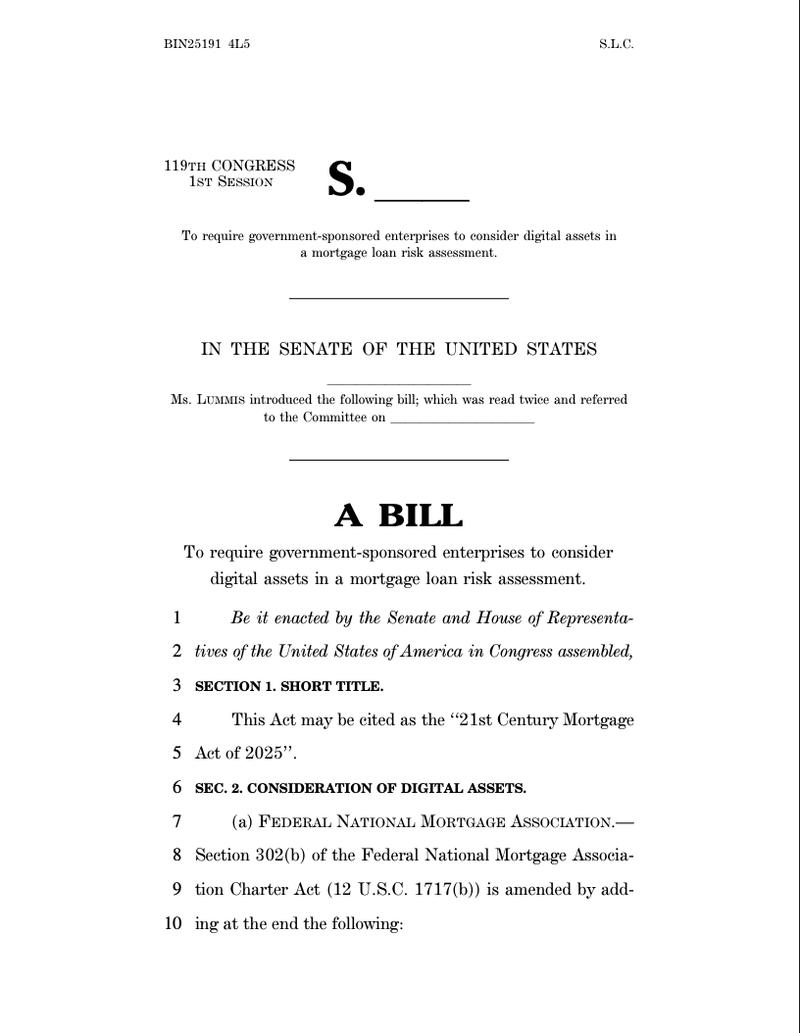
During July, Senator Cynthia Lummis introduced the 21st Century Mortgage Act to codify that directive into law.
A specialized market for crypto-backed real estate financing is already in existence. Lending institutions such as Nexo provide loans backed by more than 40 digital assets, while Ledn delivers Bitcoin-backed mortgage products that enable borrowers to pledge Bitcoin (BTC) as collateral.
A January survey of 1,000 Americans published in the OKX Insights series found a pronounced generational divide in attitudes toward digital assets, with younger respondents far more likely to view crypto as credible and central to the future of finance.