
Messari Report Reveals DePIN as Undervalued $10B Industry Defying Skeptics
Despite widespread dismissal, DePIN has evolved into a $10 billion sector with substantial revenue growth, according to Messari's latest analysis showing increasing practical adoption and sustainable cash generation.

Though many market participants have declared decentralized physical infrastructure networks (DePINs) defunct, a fresh "State of DePIN 2025" analysis from Messari and Escape Velocity demonstrates the industry has consistently expanded into a $10 billion ecosystem that produced $72 million in onchain revenue during the previous year.
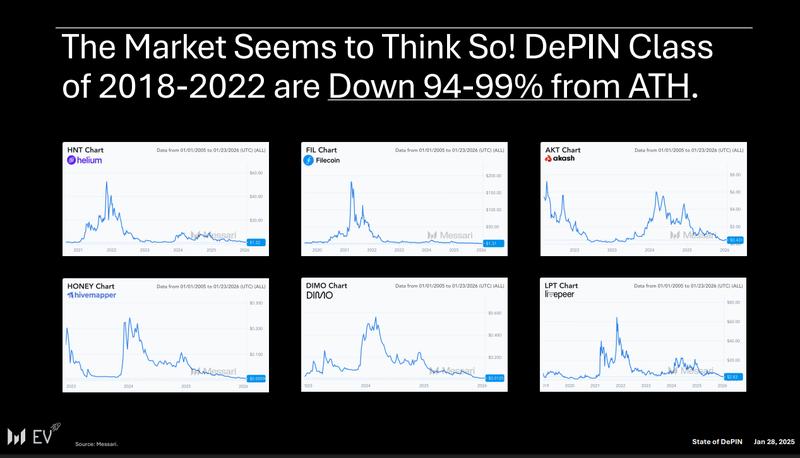
The report reveals that DePIN tokens from the "class of 2018-2022" have experienced catastrophic declines of 94-99% from their peak valuations. Despite this, top-tier projects currently demonstrate verifiable recurring revenue streams and are valued at approximately 10-25x revenue multiples, figures that Messari describes as significantly undervalued considering their growth trajectories.
The research indicates this evolution represents a fundamental shift away from subsidy-dependent expansion toward networks generating income through practical real-world applications, especially within sectors including bandwidth provision, computational resources, energy infrastructure and sensor data collection.
Markus Levin, co-founder of XYO, a data and DePIN platform launched in 2018, explained to Cointelegraph that within the DePIN industry, revenue generation holds greater significance than token valuation, and that as the sector advances, "valuations are starting to reflect real economic activity that holds up even when token prices are flat."
DePIN: From hype to revenues
The report's authors draw a distinction between "DePIN 2021" and "DePIN 2025," noting that earlier market cycles were characterized by pre-revenue networks featuring elevated token inflation rates, limited demand, and price discovery driven primarily by retail investor speculation.
Contemporary market leaders, by comparison, are producing verifiable onchain revenue streams, maintain minimal to zero supply inflation, and experience expansion fueled by practical utility and competitive cost structures rather than subsidy mechanisms.
Levin emphasized that the DePIN industry stands apart as "fundamentally different" from the wider cryptocurrency ecosystem due to its provision of "real-world utility to end users."
He noted that successful performance manifests "first in usage and cash flow, not in speculative price action."
Messari's DePIN leaders
The DePIN Leaders Index compiled by Messari showcases 15 projects spanning bandwidth infrastructure, computational services, energy systems and sensor networks that satisfy specific criteria, including a minimum of $500,000 in annual recurring revenue, and at least $30 million in capital raised.
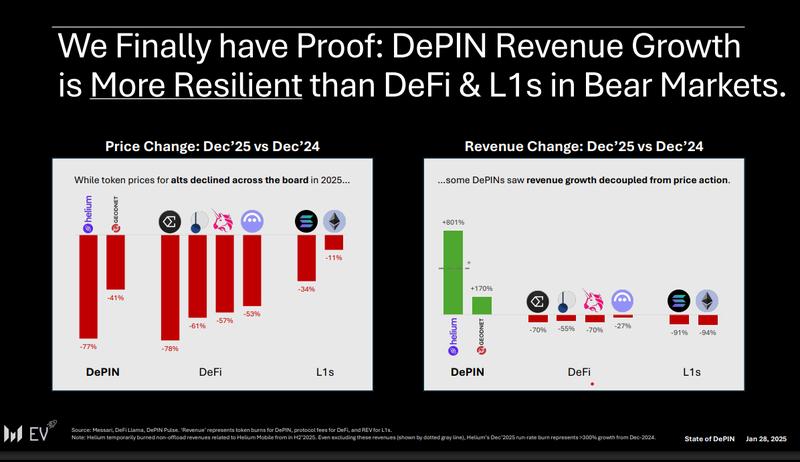
Among the report's most significant discoveries is evidence that DePIN's revenue expansion has demonstrated greater durability than both decentralized finance (DeFi) protocols and layer-1 blockchains during the ongoing bear market conditions.
Despite price declines of 77% and 41% for DePIN tokens such as Helium (HNT) and GEODNET (GEOD) between December 2024 and December 2025, their onchain revenue figures grew by approximately 8x and 1.7x, respectively, during the identical timeframe, contrasting sharply with significant revenue contractions experienced by prominent DeFi protocols and smart contract platforms.
Levin identified the "big divider" separating different DePIN categories as "whether the network can earn money from real customers without constantly leaning on incentives."
He explained that DePIN remains "not tied to a single market economically," with certain sectors such as positioning technologies, mapping services and robotics applications starting to demonstrate recurring usage patterns while other areas continue to face "more constrained by regulation and competitive pressure."
InfraFi and DePIN's emerging infrastructure trade
The previous year marked a record fundraising period for DePIN, with approximately $1 billion in capital raised throughout the sector, representing an increase from $698 million in 2024 and substantially exceeding funding levels from earlier cycles.
The analysis highlights "InfraFi" as a developing hybrid DePIN/DeFi framework wherein stablecoin investors provide financing for tangible infrastructure projects and receive yield generated by these underlying assets.
Projects including USDai, Daylight and Dawn are referenced as pioneering InfraFi implementations within compute infrastructure, energy systems and bandwidth networks, with USDai expanding to approximately $685 million in user deposits allocated toward financing graphics processing unit fleets.
Messari contends that the leading DePIN tokens currently function as next-generation infrastructure enterprises operating within bandwidth, storage, computational power, and sensing capabilities, yet are being valued at price levels that "imply little chance of survival, let alone success."
Levin stated that the networks positioned to "capitalize the most" will be those that "can deliver to enterprise and artificial intelligence-driven demand sectors reliably."