
Industry Leaders Debunk Viral Theory That Bitcoin's Fixed Supply Has Been Compromised
Industry experts reject widespread assertions that derivative products have effectively eliminated Bitcoin's 21-million coin limit, emphasizing that paper BTC creates no new supply.
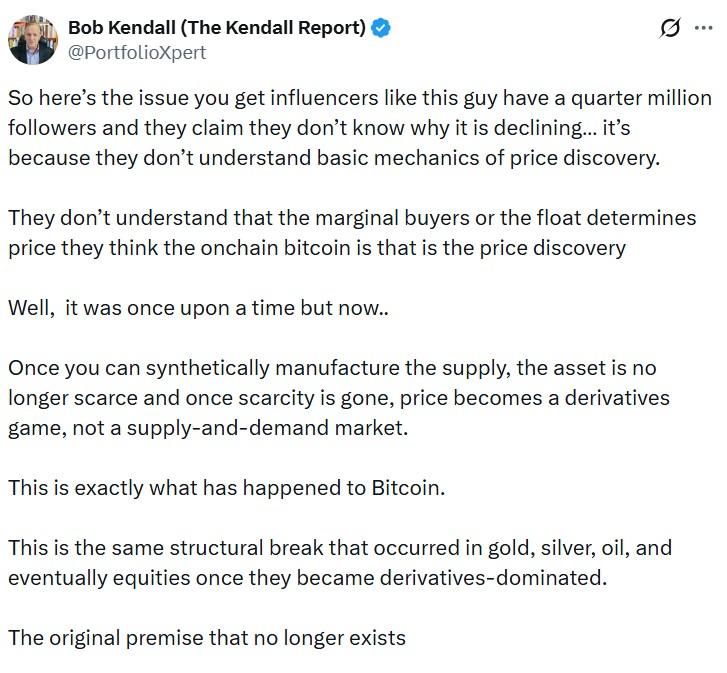
An investment commentary that has garnered nearly 5 million views on X asserts that the availability of Bitcoin derivatives has effectively transformed the digital currency's fixed 21-million-coin maximum into one that is "theoretically infinite."
While previous Bitcoin (BTC) price declines came with obvious triggers, the steep plunges witnessed during early 2026 have generated multiple explanations, including theories about digital asset treasuries (DATs) collapsing under market stress and persistent aftereffects from the October mass liquidation event.
In his widely shared post on X, Robert Kendall, the writer behind "The Kendall Report," suggested he had identified the root cause. His argument centered on the idea that Bitcoin's value proposition anchored in limited supply "died" after the introduction of cash-settled futures, exchange-traded funds (ETFs) and similar financial products built on the underlying asset.
Nevertheless, industry professionals and analysts throughout the cryptocurrency sector have pushed back against Kendall's interpretation. Multiple sources informed Cointelegraph that while leverage impacts price behavior, it does not alter the fundamental supply of Bitcoin itself.
In an interview with Cointelegraph, Harriet Browning, vice president of sales at institutional staking firm Twinstake, stated, "When institutions allocate via ETFs and DATs, they are not diluting scarcity, as there will still only ever be 21 million. They are not minting new Bitcoin."
"Instead, they are putting Bitcoin into the hands of long-term institutional holders who deeply understand its value proposition, not speculative traders looking for a quick exit," she added.
Scarcity, lost coins and the question of effective float
During Bitcoin's earliest days, the only methods for obtaining it were purchasing from fellow enthusiasts, mining operations or famously exchanging it for pizza. Before long, cryptocurrency exchanges emerged and provided retail investors access to spot market trading.
Fast forward to 2026, and market participants can also achieve exposure via financial instruments constructed on top of spot cryptocurrency. Put differently, Bitcoin has developed its own paper marketplace. Yet those who question Kendall's thesis maintain that such a paper market fails to undermine Bitcoin's fundamental scarcity.
"Gold has a massive paper market in futures, ETFs and unallocated accounts that dwarfs physical supply, yet nobody argues gold isn't scarce. Paper claims don't change the amount of gold in the ground, and the same logic applies to Bitcoin," Luke Nolan, a senior research associate at CoinShares, told Cointelegraph.
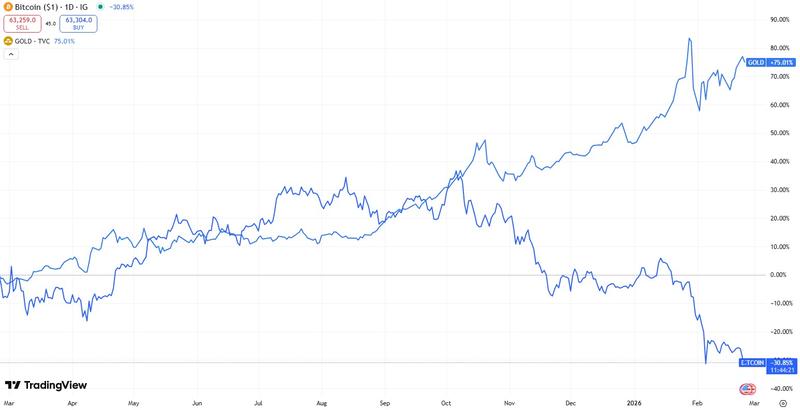
The comparison between Bitcoin and gold frequently arises due to shared characteristics, including leading the digital generation's equivalent of a gold rush, functioning as a store of value and serving as protection against currency devaluation. Bitcoin also features a rigid supply ceiling that remains constant regardless of how many investment vehicles are constructed around it, similar to how a physical gold bar wouldn't spontaneously multiply through its derivative products.
Similar to precious metals, fresh Bitcoin supply enters circulation through mining operations. Rather than excavating earth, the protocol compensates participants who validate blockchain transactions approximately every 10 minutes. These compensation amounts are reduced by half every four years, causing Bitcoin's supply expansion to decelerate progressively, alongside the quantity of newly created Bitcoin entering circulation.
By February, approximately 19.99 million BTC has been extracted through mining, although Nolan characterizes this figure as deceptive, since not every one of these coins remains accessible to market participants. Password loss and deceased holders mean coins can become permanently inaccessible. Estimates suggest up to 4 million coins have been irretrievably lost.
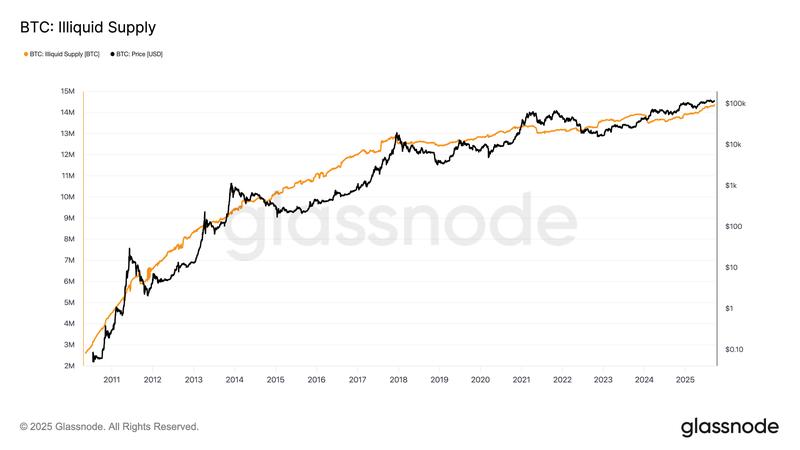
As increasing amounts of spot Bitcoin become permanently unavailable, Nolan contended that institutional investment vehicles actually strengthen Bitcoin's scarcity proposition.
"Spot ETFs require physical BTC to be held in custody, and in 2025 alone, combined ETF and corporate treasury holdings grew significantly. That is real supply being pulled off the market," he said.
Bitcoin's shift to derivatives-led price formation
Even those who challenge Kendall's supply-based argument recognize that Bitcoin's immediate-term price discovery currently depends substantially on instruments connected to institutional trading venues.
Derivative market activity has progressively migrated toward traditional finance platforms. CME futures surpassed Binance in BTC futures open interest during late 2023, though Binance has since reclaimed the top position.
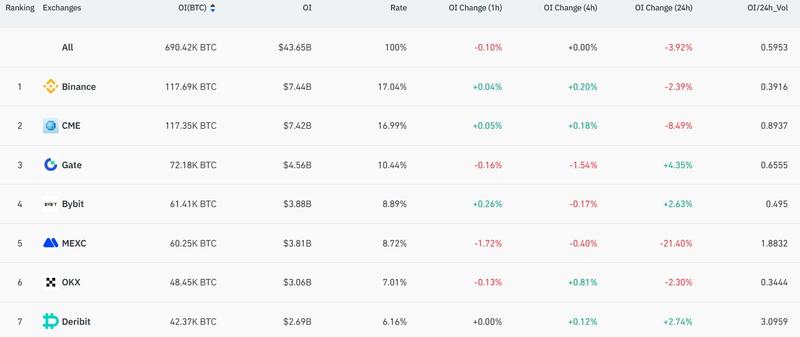
"Derivatives markets have become the primary venue for expressing institutional views on Bitcoin, and as a result, they now play a central role in spot price discovery," said Browning.
According to Browning, derivatives and ETFs affect Bitcoin's spot pricing through three principal transmission mechanisms.
Initially, venues such as CME drive near-term price discovery since institutional market participants establish their optimistic or pessimistic positions in futures ahead of spot market activity. Whenever futures pricing deviates from spot values, traders pursue arbitrage opportunities, including basis trades, to eliminate the differential. Browning notes that hedge funds routinely buy spot Bitcoin or its ETFs while shorting CME futures to capture the premium between the two.
Additionally, when financial institutions sell Bitcoin-linked structured products to their clients, they usually hedge their risk exposure by purchasing Bitcoin via ETFs, which effectively generates additional spot market demand.
Furthermore, crypto-native perpetual futures contracts can influence the spot market through funding-rate arbitrage mechanisms. During periods of positive funding rates, concentrated long positioning incentivizes traders to buy spot Bitcoin and short futures to collect funding payments, which increases spot demand. Conversely, when funding rates turn negative, this dynamic can reverse direction and create downward price pressure.
"Today, derivatives volumes frequently exceed spot volumes, and many institutional participants prefer derivatives, alongside ETFs, for capital efficiency, hedging and short exposure," Browning said.
"Spot markets increasingly serve as the settlement and inventory layer, while derivatives increasingly influence marginal price discovery, and new price levels are negotiated."
Derivatives don't delete Bitcoin's scarcity from the blockchain
Bitcoin's expanding paper marketplace signifies that market participants no longer need to maintain direct BTC ownership to obtain exposure.
Futures contracts and perpetual instruments enable investors to take bullish or bearish positions, manage portfolio risk or utilize leverage. Comparable derivative instruments have existed for extended periods in commodity markets without modifying the actual physical quantities of gold, oil or other underlying assets available.
Nima Beni, founder of crypto leasing platform BitLease, told Cointelegraph:
"The premise that synthetic exposure destroys scarcity is as flawed as a misapplied commodity-market analogy used about paper gold. It was wrong then; it's wrong now."
Following an influx of Bitcoin supporters armed with counterarguments flooding his viral post, Kendall stood by his original position.
"I'm not arguing [derivatives] 'delete' scarcity from the blockchain. What I'm saying is they shift where marginal price is set," he said.
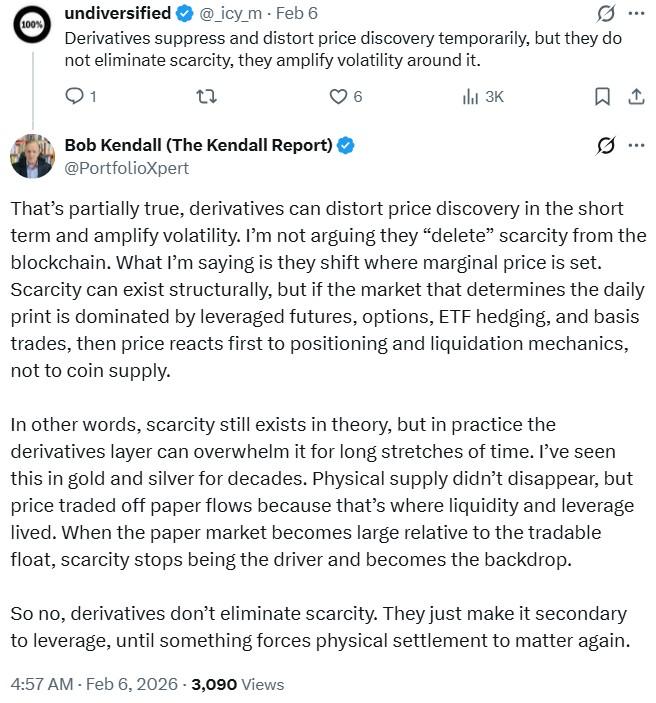
The 21-million cap on Bitcoin supply persists unmodified within the protocol code. No derivative instrument, ETF or structured financial product possesses the capability to generate additional coins exceeding that fixed threshold. What has transformed surrounding Bitcoin is the mechanism of price discovery.
Derivative instruments increasingly determine marginal price establishment before market flows eventually return to spot markets. This development modifies the processes and venues through which Bitcoin's valuation gets determined.
Ultimately, both Kendall and those criticizing his analysis find common ground on that particular point.