
Hypothetical 2028 corporate memo envisions AI-driven unemployment and crypto payment shift
A speculative 2028 analysis from Citrini Research depicts artificial intelligence dramatically boosting business earnings while devastating employment and consumer spending, alongside a silent transition of worldwide transactions to stablecoins operating on low-cost blockchain networks.

A global macro and thematic equity analysis company called Citrini Research has released a thought-provoking post that envisions what the year 2028 might look like, painting a picture of an economic landscape radically reshaped by the advancement of artificial intelligence technology.
According to Citrini's conceptualization of this approaching future, artificial intelligence systems ultimately fulfill their long-promised productivity gains, leading businesses to reduce their workforce dramatically while simultaneously seeing profit margins expand and stock valuations climb higher. Structured as if it were an actual macro-level memorandum dated June 2028, the analysis has gained significant traction and circulation across the social media platform X.
Within Citrini's hypothetical timeline, stock markets at first embrace this unprecedented efficiency transformation with enthusiasm. The S&P 500 index "flirted with 8000," while the Nasdaq "broke above 30k," with market participants welcoming what appeared to be a revolutionary productivity epoch.
However, sentiment undergoes a dramatic reversal when employees who lost their jobs reduce their consumption patterns, leading to a contraction in consumer demand, which in turn prompts corporations to deploy even more AI-powered solutions in an attempt to protect their profit margins. This creates additional waves of workforce reductions and further weakening of demand, establishing a self-perpetuating cycle that gradually erodes the human foundation of economic activity.
Negative feedback loop with no natural brake
Within this imagined future version of the United States economy, the wealthiest 10% of income earners account for over half of total consumer expenditures. Product managers and business analysts, who previously commanded annual salaries of $180,000, find themselves supplanted by automated software systems.
Citrini describes this phenomenon as "ghost GDP." Economic output appears to skyrocket according to official statistics while actual wage earnings deteriorate in practical terms. Productivity metrics display impressive numbers, yet dining establishments and shopping centers gradually decline in an economy that expands without compensating its participants.
The critical breaking point emerges in the housing sector, where approximately $13 trillion worth of mortgage obligations rest upon the expectation of continuous employment opportunities.
The authors note that in 2008, mortgage loans were "bad on day one." By contrast, in their 2028 scenario, these loans started out completely sound until economic conditions underwent a fundamental shift, unemployment surged to reach 10.2%, and the S&P experienced a decline ranging from 40% to 60% relative to its highest point. Despite this, financial markets display minimal reaction, as algorithm-driven liquidity provision conceals the underlying human suffering.
AI pushes payments onto crypto rails
Cryptocurrency market participants are closely monitoring the implications this scenario holds for the payments infrastructure landscape, and what it suggests regarding the appetite for stablecoins and alternative crypto assets serving as the preferred settlement mechanism for AI-powered agents.
According to Citrini's analysis, autonomous artificial intelligence agents exhibit no loyalty to corporate brands, focusing exclusively on transaction speed, expense levels and programming accessibility.
These agents circumvent traditional card processing networks such as Visa and Mastercard with their 2-3% interchange charges and cross-border complications, instead initiating settlements using stablecoins across economical, high-capacity blockchain platforms like Solana and Ethereum.
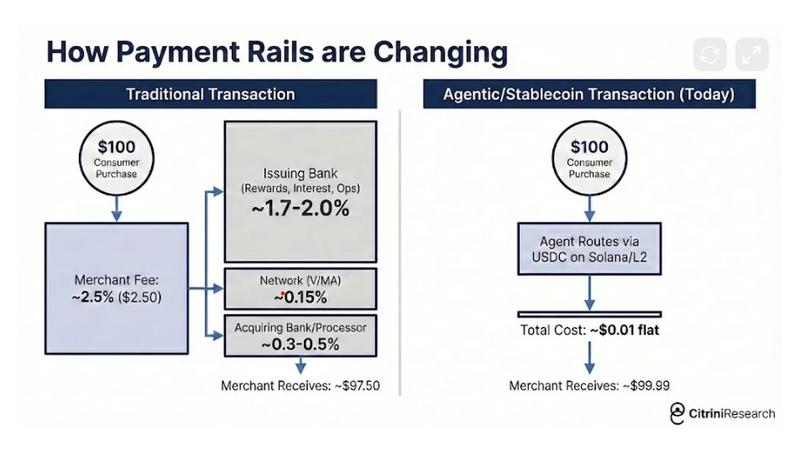
With labor expenses eliminated from the equation, the resulting benefits accumulate to those who control computational resources, while their AI infrastructure discreetly redirects increasing volumes of commercial transactions onto cryptocurrency networks and away from conventional payment processors, a transition that devastates the interchange fee-dependent revenue model of traditional card networks.
Wealth inequality widens, asset owners thrive
Jeff Park, who serves as an advisor to Bitwise, articulated the inherent contradiction, noting that "wealth inequality widens to unseen levels," and that possessing assets becomes "more powerful than labor as AI reduces the latter to zero. Bitcoin breaks through $1 million."
The most disturbing element of this analytical piece may well be its publication date. This forecast wasn't actually composed in 2028; rather, it originates from Feb. 2026.
With workforce reductions accelerating, consumer expenditure decelerating, and cryptocurrency payment infrastructure experiencing expanded settlement transaction volumes, each sequential consequence outlined by Citrini appears to have already commenced unfolding.
Cryptocurrency trader and artificial intelligence proponent Miles Deutscher reflected on this reality, stating, "I've never been more bullish on AI. And I've never been more terrified of what that means."