
Geopolitical Tensions, Economic Headwinds, and Credit Market Turmoil Challenge Bitcoin's Path to $75K
Can Bitcoin still reach $75,000 amid deteriorating US economic conditions, escalating conflict in Iran, and significant selling pressure from institutional BTC investors?

Key takeaways:
- Concerns over private credit exposure and disappointing US employment figures push Bitcoin prices down, though potential opportunities may exist.
- Selling activity from Bitcoin ETF investors and mining operations puts pressure on BTC prices, yet the Federal Reserve's limited options for managing national debt could ultimately benefit assets with fixed supply.
Bitcoin (BTC) encountered resistance at the $69,000 price level on Wednesday following a speech by President Donald Trump that stopped short of confirming a resolution to the ongoing conflict in Iran. The address triggered a spike in oil markets, and compounding traders' anxieties over geopolitical instability, distress signals from private credit markets are eroding confidence among investors across various asset classes.
Despite Bitcoin managing to hold support at the $66,000 threshold during the week, market participants continue to express apprehension about potential downward price movement over the coming weekend, given that both US and European financial markets will remain shuttered on Friday in observance of Easter.
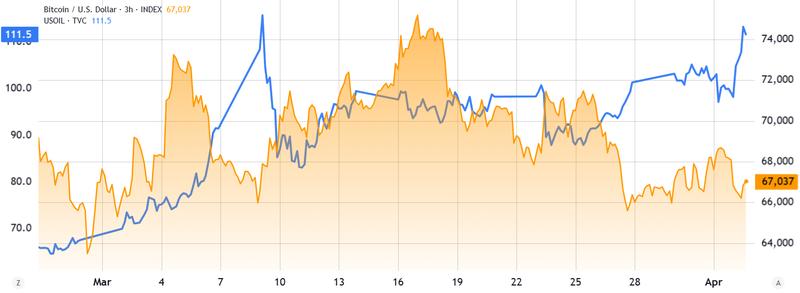
The possibility of further military intervention by the United States in Iran drove WTI crude oil valuations beyond $110, prompting investors to retreat from high-risk asset categories. Market participants opted to reduce their positions in both Bitcoin and equity markets after the US Treasury Department voiced apprehensions about the $2 trillion private credit sector on Wednesday. Regulatory authorities overseeing insurance companies, both within the United States and internationally, will be polled through the beginning of May.
Private credit markets sound the alarm: Will BTC respond?
Blue Owl, an alternative asset management firm controlling $307 billion in assets, revealed "extraordinary redemption requests" affecting two of its private credit investment vehicles in correspondence sent to shareholders on Thursday. According to statements made during a quarterly earnings presentation, more than 70% of Blue Owl's lending portfolio consists of software sector companies. The asset manager imposed a 5% ceiling on withdrawal requests, introducing additional uncertainty into credit market dynamics.
Further contributing to near-term pessimistic sentiment among market participants was an increase in US continuing jobless claims, which climbed to 1.84 million for the week concluding March 21, compared to 1.82 million in the previous week. While this employment data does not necessarily spell doom for stock markets, the global outplacement firm Challenger, Gray & Christmas observed that the majority of workforce reductions stemmed from corporations "shifting budgets toward AI investments at the expense of jobs."
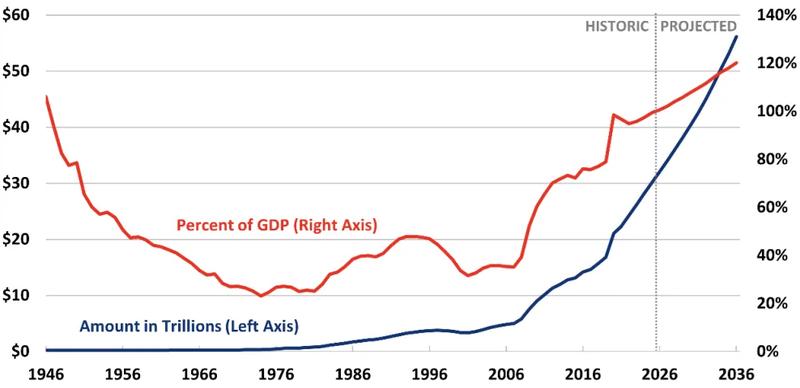
The probability of economic stimulus measures being implemented in response to deteriorating economic conditions may prove beneficial for Bitcoin's valuation over the intermediate timeframe. The United States federal deficit is projected to balloon to an enormous $1.9 trillion in 2026, providing policymakers with limited options beyond increasing monetary liquidity, a scenario that typically advantages assets with limited supply characteristics.
A shift in how investors perceive Bitcoin's risk profile will prove critical for any potential price surge beyond $75,000. Significant headwinds have emerged from net capital withdrawals from US-listed spot exchange-traded funds (ETFs), the selling of holdings by corporations that had previously prioritized building Bitcoin treasury reserves, and the reduction of positions by publicly traded mining companies.
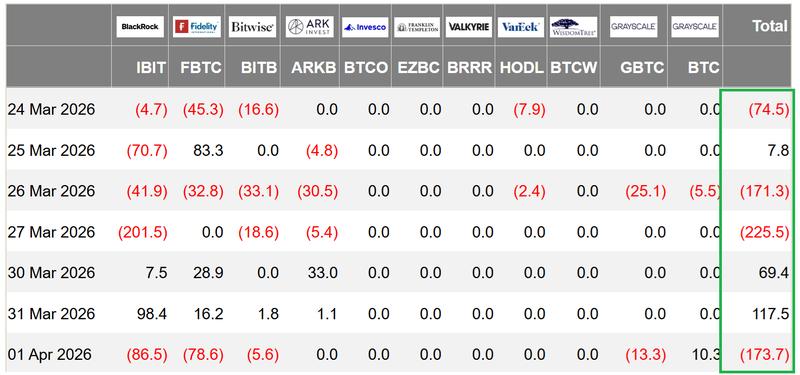
Bitcoin ETFs listed in the United States have experienced $450 million in net capital withdrawals beginning March 24, functioning as an indicator of subdued institutional investor appetite. Market participants harbor concerns about continued selling pressure given that the sector manages $88 billion worth of Bitcoin, with BlackRock's iShares Bitcoin Trust (IBIT US) holding the largest position at $53.9 billion. That said, these capital outflows are expected to decelerate should Bitcoin maintain its resilience around the $66,000 price level.
MARA Holdings (MARA US) disclosed the disposition of 15,133 BTC during March at a valuation significantly beneath the company's estimated acquisition cost basis. Concurrently, Riot Platforms (RIOT US) allegedly moved 500 BTC for liquidation on Wednesday. Furthermore, Nakamoto Holdings (NAKA US) revealed a transaction involving 284 BTC, notwithstanding the company's prior public commitment to ongoing asset accumulation.
So long as corporations including Strategy (MSTR US) and Metaplanet (MTPLF US) persist in offsetting portions of this selling activity, market participants will presumably acknowledge that Bitcoin functions as protection against expanding monetary supply. Governmental entities will exhaust available measures to prevent economic recession, increasing the likelihood that Bitcoin's trajectory toward $75,000 remains viable notwithstanding deteriorating macroeconomic indicators.