
Federal Court Battle Over Polymarket Could Reshape Prediction Market Oversight in America
A federal lawsuit filed by Polymarket against Massachusetts authorities may establish whether prediction markets fall under exclusive CFTC jurisdiction or remain subject to individual state gambling regulations.

Key takeaways
- A federal lawsuit brought by Polymarket against Massachusetts may settle the question of whether the CFTC has sole regulatory authority over prediction markets or if states retain enforcement powers.
- The central legal question revolves around classifying event contracts either as financial derivatives governed by the Commodity Exchange Act or as gambling activities subject to state law.
- State regulators in Massachusetts and Nevada have taken action against platforms including Kalshi, seeking to limit sports-related prediction contracts within their borders.
- Should Polymarket prevail, the decision might create a unified federal regulatory framework and block the emergence of inconsistent state-by-state rules.
Platforms known as prediction markets allow participants to purchase and sell contracts tied to outcomes of future events. These platforms have recently drawn considerable attention because of an unfolding legal confrontation in the United States concerning which government entities hold regulatory power. At the heart of this controversy is a federal lawsuit that Polymarket has brought against the Commonwealth of Massachusetts. The resolution of this legal matter may settle whether prediction markets answer solely to federal regulators or if individual states retain the power to impose their own restrictions.
This examination delves into Polymarket's federal court action against Massachusetts. It considers the wider regulatory conflict surrounding whether prediction markets belong exclusively under the oversight of the US Commodity Futures Trading Commission (CFTC) or fall within the scope of state-level gambling legislation. The analysis also considers potential consequences for regulatory jurisdiction, platform accessibility, and the trajectory of event-based trading services across the United States.
A federal lawsuit with broad implications
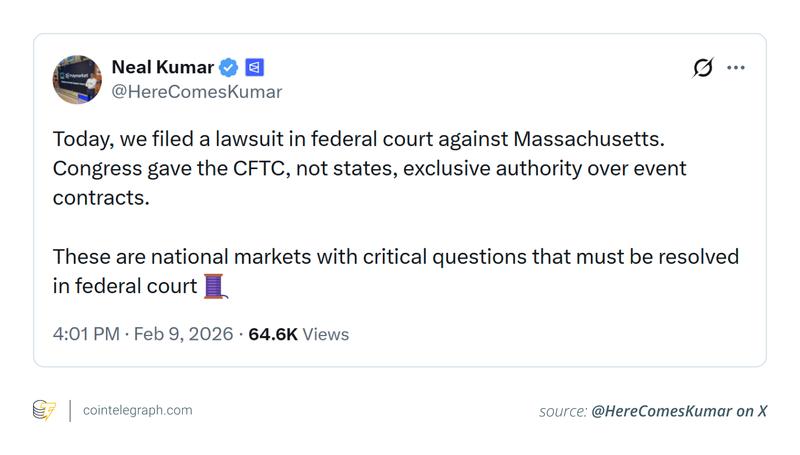
During February 2026, Polymarket initiated legal proceedings in the US District Court for the District of Massachusetts with the goal of preventing state enforcement actions that would compel the platform to adhere to Massachusetts gambling regulations. The platform maintains that Congress has vested exclusive regulatory power over "event contracts," which constitute the fundamental offerings of prediction markets, with the CFTC. In Polymarket's legal argument, this federal authority makes any state attempts to halt or constrain its activities unlawful.
Neal Kumar, serving as Polymarket's chief legal officer, maintains that because the controversy concerns markets operating on a national scale, the underlying legal issues warrant resolution within the federal court system. The platform stands firmly against fragmented enforcement actions initiated by separate state authorities. Kumar has stated that imposing restrictions on these markets could impede the growth and development of the entire industry.
Where it all started: State actions against Kalshi
The timing of Polymarket's legal filing was strategic and intentional. The lawsuit arrived soon after Massachusetts courts took enforcement measures against Kalshi, a competing platform, by prohibiting sports-related contracts under the state's gambling statutes. A Massachusetts judge maintained a preliminary injunction that required Kalshi to block residents from participating in specific markets unless the platform obtained appropriate gaming licenses. The judicial ruling mandated that these particular markets be classified as unlicensed sports wagering operations.
The regulatory stance adopted by Massachusetts toward prediction markets has found reinforcement through comparable state-level enforcement actions in other jurisdictions. Nevada's regulatory authorities secured a temporary restraining order targeting Polymarket's sports-related contract offerings, contending that such products violated the state's established framework for regulating sports betting activities.
Did you know? Corporations have used prediction markets to forecast product launches and internal project deadlines. Some companies quietly rely on employee-based markets because aggregated crowd opinions often outperform traditional executive forecasts.
What is at stake: Federal vs. state authority
The legal action revolves around a fundamental jurisdictional question. Polymarket asserts that its event contracts, regardless of whether they pertain to elections, economic indicators, or sports outcomes, constitute financial derivatives falling under the CFTC's Commodity Exchange Act authority. According to this interpretation, federal legislation takes precedence over state gambling statutes, thereby barring states from independently prohibiting or regulating these marketplace activities.
Massachusetts alongside other states counter that whenever prediction markets bear resemblance to gambling activities, especially concerning sports events, these platforms must satisfy state gambling regulatory frameworks to protect consumers and preserve local licensing requirements and age verification standards.
Should federal courts rule in Polymarket's favor, such a decision might reinforce arguments for standardized national regulation, blocking the development of a "patchwork" comprising divergent state-level restrictions or outright bans. On the other hand, affirming state regulatory authority would empower individual states to enforce their own gambling legislation against platforms conducting business across the entire nation.
Did you know? Prediction markets sometimes rival opinion polls in forecasting election outcomes. Universities have studied them for decades as tools for measuring collective intelligence and information efficiency.
Why Polymarket's lawsuit matters
The prediction markets sector has witnessed significant expansion, characterized by increasing trading volumes and heightened public awareness. According to information monitored by Dune, prediction markets generated approximately $3.7 billion in trading volume during a single week in January 2026, establishing a record high.
With platforms such as Polymarket and Kalshi achieving greater mainstream recognition and adoption, state governments are increasingly seeking to implement consumer protections similar to those applicable to conventional gambling operations. This regulatory environment has triggered enforcement initiatives across multiple state jurisdictions.
The position taken by the CFTC has introduced additional layers of complexity to this regulatory landscape. Although the federal agency has maintained a longstanding role in regulating derivatives markets, which includes certain categories of event contracts, the agency has encountered political pressure both to refrain from involvement in particular disputes and to impose restrictions on prediction contracts addressing subjects such as warfare or terrorism.
Did you know? Prediction markets are structured using blockchain smart contracts, automatically settling trades once an outcome is verified. This automation reduces counterparty risk but raises new regulatory and oracle-related challenges.
How jurisdictional disputes are reshaping event contracts
The legal challenge initiated by Polymarket constitutes merely one component of the expansive legal and regulatory controversies enveloping prediction markets throughout the United States. Judicial systems in states including Massachusetts and Nevada are presently evaluating the boundaries of state regulatory power, while federal authorities and lawmakers engage in discussions regarding comprehensive regulatory guidance. The determinations reached in these legal proceedings will probably shape how platforms design and present event contracts to users.
Regardless of whether courts ultimately validate Polymarket's federal preemption arguments or uphold the regulatory authority claimed by states, the judicial outcome will carry enduring consequences for the expansion of prediction markets. The decision will determine how users gain access to these trading platforms and influence the equilibrium that regulators establish between fostering innovation and ensuring adequate consumer protection measures.