
February roundup: BTC fails to crack $70K as nations revise cryptocurrency taxation
Throughout February, Bitcoin encountered resistance at the $70,000 threshold, as Japan witnessed declining inflation and multiple nations reconsidered their approaches to taxing digital currencies.

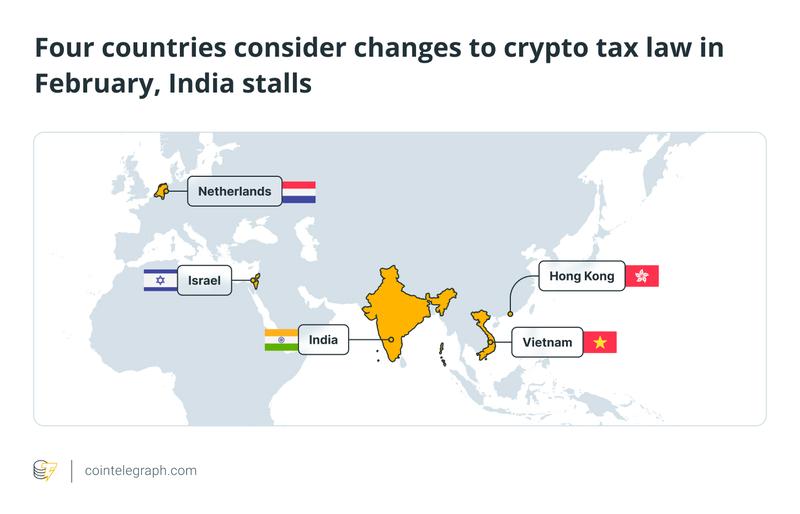
Tax season has arrived with significant implications for crypto. Throughout February, taxation authorities across four different nations initiated efforts to reevaluate their treatment of cryptocurrency taxation.
Across the United States, cryptocurrency ATM installations reached approximately 40,000 units, marking a return to the enthusiasm levels last seen in 2021 for these digital currency kiosks. Installation numbers had experienced a substantial decline following the cryptocurrency market downturn in 2022.
Throughout February, Japan witnessed its inflation rate decline beneath the 2% threshold, establishing a lower rate compared to the United States. Earlier in the year, Warren Buffett, the chief executive of Berkshire Hathaway, indicated that investments denominated in dollars were appearing less appealing given that the yen was offering superior currency stability.
Throughout this month, Bitcoin (BTC) remained unable to surpass the $70,000 threshold. Numerous cryptocurrency market analysts have observed that tariffs imposed by the United States are creating downward pressure on the digital asset. The recent 10% tariff implemented by US President Donald Trump has failed to provide any relief from this situation.
Below is a numerical breakdown of February's developments:
Crypto taxation modifications under consideration by four nations during February
On Feb. 12, the House of Representatives of the Netherlands, which serves as the lower chamber of the national parliament, moved forward with a taxation proposal. Under the draft legislation, a 36% capital gains tax would be imposed on unrealized gains derived from savings and liquid investments, with cryptocurrency included in this category.
Those opposing the measure argue that this tax, which has garnered support from 93 out of 150 parliamentary representatives, will drive capital away from the nation.
Opposition voices seem to have achieved success. The newly formed Dutch cabinet announced its intention to reconsider this particular measure.
There is a lot of criticism of the Actual Return Act. We are not deaf to that ... The bill needs to be amended. The Minister and State Secretary will discuss this with the Senate and parliament.
Dutch cabinet spokesperson
Within Israel, the Israeli Crypto Blockchain & Web 3.0 Companies Forum initiated a lobbying campaign aimed at reforming the nation's cryptocurrency taxation policies. Nir Hirshmann-Rub, who leads the forum, indicated that substantial public backing exists for relaxing regulations pertaining to stablecoins and tokenization, in addition to streamlining compliance requirements.
He emphasized that cryptocurrency ownership and investment are already widespread among Israeli citizens. "More than 25% of the public already has had crypto dealings in the last five years and more than 20% currently hold digital assets," he said.
Over in Hong Kong, Paul Chan, the Financial Secretary, revealed that the special administrative region is making adjustments to its taxation legislation. He indicated that the Inland Revenue Ordinance would incorporate the Organisation for Economic Co-operation and Development's Crypto-Asset Reporting Framework (CARF).
The CARF represents an international tax exchange standard designed for cryptocurrency that seeks to combat tax evasion. Under this framework, cryptocurrency service providers must report information regarding client activity.
Vietnam has put forward a proposal for taxing cryptocurrency transactions. While crypto transfers and trading activities would receive exemption from the standard value-added tax, transferring cryptocurrency assets via licensed service providers would be subject to a 0.1% personal income tax calculated on the transaction value.
Within India, where a flat 30% tax applies to crypto gains and users cannot offset losses, attempts to reform the legislation have not gained traction. Notwithstanding aggressive lobbying efforts, the proposed 2026 Union Budget included no provisions to reform cryptocurrency taxation.
Bitcoin remains beneath $70,000 threshold; Trump implements 10% tariff increase
The past several months have been challenging for Bitcoin, and throughout February, the cryptocurrency encountered difficulty breaking through the $70,000 level.
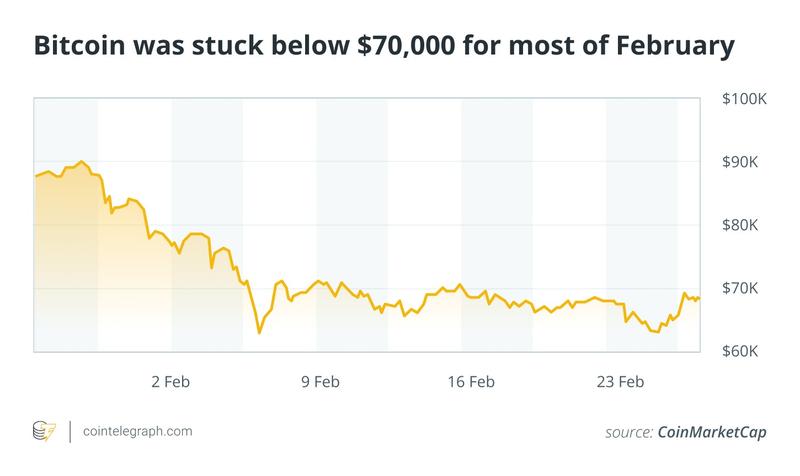
Market analysts have pointed to multiple macroeconomic factors applying pressure to Bitcoin's valuation. A significant factor is the stalled advancement of the CLARITY Act, which represents the United States' proposed regulatory framework for cryptocurrency markets. Congressional members remain divided over ethics provisions and potential bailout clauses, while influential lobbying groups, specifically the cryptocurrency and banking sectors, are engaged in conflict regarding stablecoin interest.
Chris Waller, a governor of the United States Federal Reserve, said, "The lack of passing of the CLARITY Act I think has kind of put people off on this."
Tariffs represent another significant concern. Following the US Supreme Court's invalidation of tariffs that Trump had implemented utilizing the 1977 International Emergency Economic Powers Act (IEEPA), Trump reacted by increasing global tariffs by 10% while employing the Trade Act of 1974 as his legal justification.
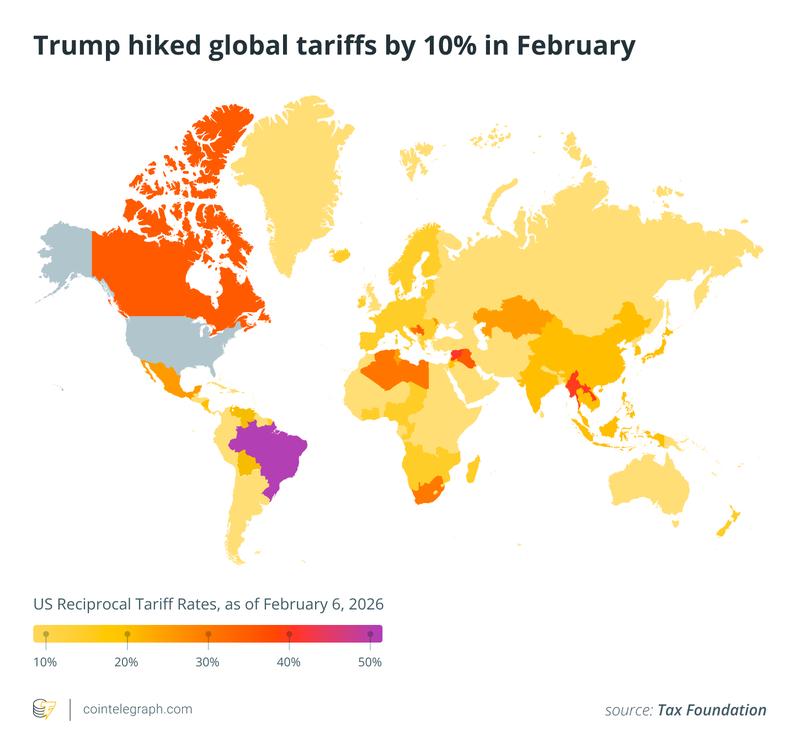
Cryptocurrency analysts and market observers have highlighted the adverse impact tariffs have on markets. Cory Klippsten, CEO of Swan, said, "The biggest drag on Bitcoin price the past year has been tariffs ... That's the drag on risk assets in general, and in particular [with] Bitcoin, there's just uncertainty around what's gonna happen."
Japanese inflation falls beneath 2%, while Takaishi secures electoral victory
The Japanese yen's inflation rate has declined below that of the dollar, dropping beneath 2%, representing its lowest level in three years.
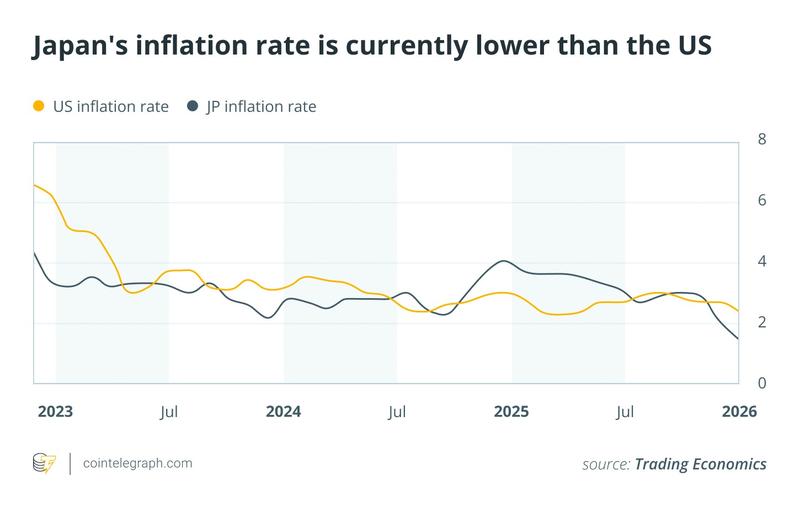
This new inflation low for the yen follows Prime Minister Sanae Takaichi's decision to call for snap elections. The strategic move was designed to restore the Liberal Democratic Party's (LDP) parliamentary majority position.
The strategy proved successful, and the LDP now controls the Japanese House of Representatives, the lower chamber of the National Diet, commanding a commanding two-thirds majority with 316 members.
Japanese stock markets reacted favorably to these developments. The Nikkei 225 (JP225) climbed 10% over the month, experiencing a notable surge following the Feb. 9 election.
According to XWIN Research Japan, this development could present near-term challenges for Bitcoin, which typically demonstrates correlation with US equities. The growing appeal of Japanese bonds has the potential to reduce capital flows into US equity exchange-traded funds.
Buffett announced that his company plans to expand its investments in Japanese trading houses. These encompass five major "sogo shosha," or wholesale companies: Itochu, Marubeni, Mitsubishi, Mitsui and Sumitomo.
Global cryptocurrency ATMs reach 40,000 as operators implement new verification standards
Throughout February, the worldwide number of cryptocurrency kiosks expanded by 290 units, pushing the total count to nearly 40,000, based on data compiled by Coin ATM Radar.
Cryptocurrency kiosk numbers have shown variation across different periods. Following the cryptocurrency market crash in 2022, total numbers experienced a significant reduction.
Worldwide regulatory bodies have expressed apprehensions regarding crypto ATMs and their potential utilization in money laundering schemes, as well as fraudulent activities. Various companies have implemented measures designed to address these concerns.
During February, Bitcoin Depot, which operates as the largest Bitcoin ATM provider in the United States, commenced a gradual implementation of user ID requirements across its terminals throughout the nation. This decision came in response to pressure originating from regulators and lawmakers across the country.