
Ethereum's Buterin Proposes Transaction Simulations for Improved Security
Users would first indicate their desired blockchain operation, then approve or reject it after viewing a simulated preview of the transaction's outcome.

Vitalik Buterin, the co-founder of Ethereum, has put forward a proposal for implementing "transaction simulations" alongside other comparable mechanisms to enhance both the security framework and user experience of Ethereum wallets and smart contract platforms.
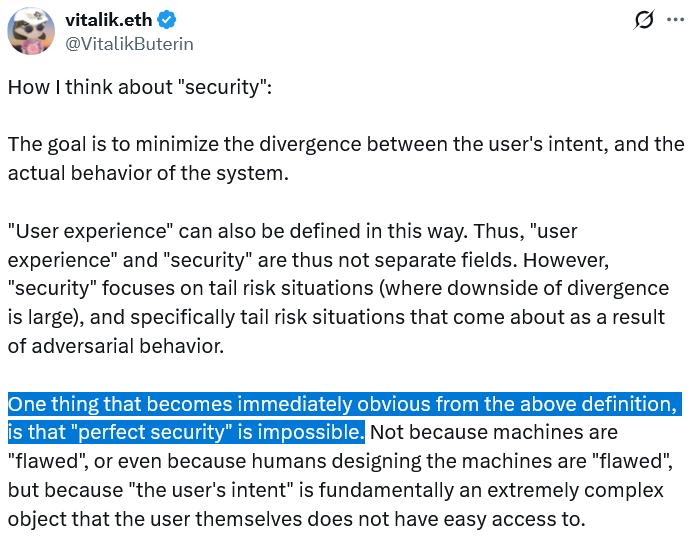
Through a Sunday post on the social media platform X, Buterin made the case that user experience and security should not be viewed as distinct domains, given that both fundamentally center on user intent — making certain that protocols execute exactly what users mean for them to execute.
According to Buterin, an intent-focused security methodology could entail creating systems that verify user actions through confirmation checks, and while this approach could be implemented within Ethereum wallets and smart contracts, it could also extend to wider applications, including hardware devices and operating systems.
"The user specifies first what action they want to take, and then clicks 'OK' or 'Cancel' after seeing a simulation of the onchain consequences of that action," he said.
Additional methods might encompass multisig approvals and spending limits, ensuring execution occurs only when the user's intent, anticipated results, and risk thresholds are all in harmony, he said.
According to Buterin, the outcome should make low-risk operations more accessible while making potentially dangerous actions more difficult to execute.
User intent is difficult to define
Buterin acknowledged, however, that determining user intent is "extremely complex" and represents one reason why a "perfect security" solution remains unattainable:
"[It's not] because machines are 'flawed', or even because humans designing the machines are 'flawed', but because 'the user's intent' is fundamentally an extremely complex object that the user themselves does not have easy access to."
"I would argue that the common trait of a good solution is: the user is specifying their intention in multiple, overlapping ways, and the system only acts when these specifications are aligned with each other," he said.
Within the blockchain trilemma, security represents one of three fundamental components, with the other two being decentralization and scalability.
This theory, which was coined by Buterin, proposes that blockchain networks can maximize two of these three characteristics but are forced to make trade-offs on the third.
In recent years within the Ethereum ecosystem, decentralization and scalability have arguably received greater attention, with scalability being particularly prominent, considering that Ethereum's mainnet has fallen behind in terms of scalability when compared to several of its leading layer 1 rivals.