
ECB Sounds Alarm: Stablecoins Threaten Banking Stability and Policy Control in Europe
Europe's central bank cautions that increasing stablecoin usage will trigger deposit migration from traditional banking institutions, undermining credit provision and the effectiveness of monetary policy measures.

Europe's central banking authority has flagged concerns that increased stablecoin adoption could drain funds from conventional bank deposits and diminish the effectiveness of monetary policy transmission to the lending sector, as outlined in a fresh ECB working paper released on Tuesday.
Increasing utilization of stablecoins, digital currencies typically anchored to fiat money such as the euro or US dollar, is projected to siphon capital away from conventional banking deposits, according to the European Central Bank's newest working paper series titled "Stablecoins and Monetary Policy Transmission," which was made public on Tuesday.
"Our analysis shows that rising interest in stablecoins is linked to a measurable decline in retail bank deposits and a reduction in lending to firms,"the document stated, emphasizing that stablecoins have the potential to diminish the volume of credit that banking institutions extend to the broader economy.
According to the ECB's findings, these impacts are not linear in nature and fluctuate based on factors including the magnitude of stablecoin utilization, the structural characteristics of the tokens, and the regulatory framework governing them.
This publication represents one component of the ECB's continuous initiatives to track stablecoin developments, as their total market capitalization has expanded by more than twofold during the last three years to reach $312 billion, with forecasts suggesting it could climb to $2 trillion by 2028.
Stablecoin impact: Banks, monetary policy and why currency matters
When evaluating how expanding stablecoin usage affects banking institutions, the ECB drew attention to a deposit-replacement phenomenon, wherein both individual consumers and corporate entities transfer capital from traditional retail bank deposits into digital asset vehicles.
"Banks rely heavily on deposits as a stable and low-cost source of funding to support lending to households and businesses,"the research indicated.
"When deposits decline, banks may be forced to rely more on wholesale or market-based funding, which is typically more expensive and less stable,"the study continued.
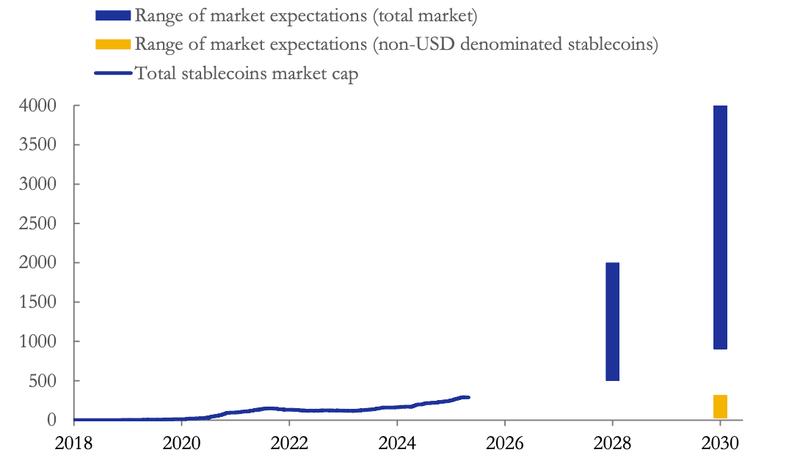
The analysis additionally reveals that stablecoins possess the capability to alter the mechanisms through which policy interest rate adjustments influence bank financing expenses and credit extension activities, with the magnitude of these effects dependent upon the level of adoption, structural design elements and regulatory oversight.
"We find that stablecoin adoption interferes with multiple monetary policy transmission channels, potentially weakening the predictability of policy actions,"the European Central Bank noted.
The monetary authority issued a warning that stablecoins denominated in foreign currencies have the potential to further erode the linkage between national monetary policy measures and banking sector lending activities, with these risks becoming magnified in scenarios where the marketplace is controlled by tokens not denominated in euros.
The research paper reinforced the observation that stablecoins backed by US dollars constitute the overwhelming majority of the total stablecoin marketplace. Information sourced from CoinGecko indicates these dollar-anchored tokens hold a valuation of $301 billion, accounting for 97% of the aggregate stablecoin market capitalization as of the time of publication.