
Crypto Theft Reaches 11-Month Low in February: PeckShield Report
According to PeckShield, a combination of factors including the absence of major security breaches, increased market turbulence, and enhanced security measures may have contributed to cryptocurrency experiencing its smallest losses in almost 12 months.

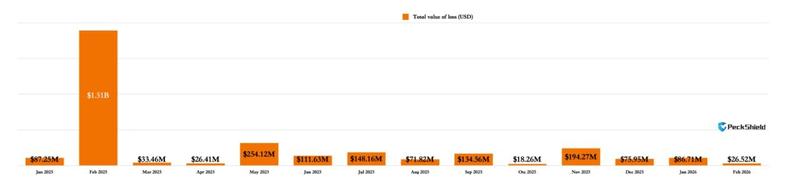
February witnessed cryptocurrency losses from security breaches and fraudulent schemes reach their lowest point since March 2025, totaling $26.5 million in stolen funds throughout the month, according to blockchain security firm PeckShield.
Among the 15 separate incidents recorded during February, just two were responsible for the majority of financial losses, with the most significant being a $10 million heist from YieldBlox's DAO-managed lending pool through a price manipulation attack that occurred on Feb. 21, as detailed in PeckShield's X post published on Sunday.
The exploit ranking second in severity affected IoTeX, a decentralized identity protocol, which suffered approximately $8.9 million in losses due to a private key compromise on Feb. 21. Collectively, February's total figures demonstrate a 69.2% month-on-month reduction compared to January, which saw losses exceeding $86 million.
Speaking to Cointelegraph, a PeckShield spokesperson explained that "mega-hacks," including the $1.5 billion Bybit security breach in February 2025, were absent from last month's data, while market volatility contributed to a substantial reduction in exploit activity.
"A steep market correction during early February, which saw Bitcoin falling below $70,000, redirected the industry's attention toward institutional deleveraging and math-based sell-offs. In these high-volatility environments, the strategic emphasis frequently shifts away from protocol exploits and toward managing market liquidity," the spokesperson elaborated.
Security improvements could be a factor
Dominick John, an analyst at Kronos Research, shared with Cointelegraph that the reduction might also indicate enhanced risk management protocols, more rigorous counterparty standards, and superior real-time surveillance systems implemented across principal platforms.
"Investment capital is growing increasingly discriminating, favoring protocols that demonstrate sophisticated security architectures. Whether losses continue declining will hinge on security standards evolving in tandem with innovation," he explained.
According to John, losses may maintain their downward trajectory throughout the year as security audits, monitoring systems, and institutional risk management frameworks continue maturing.
The influence of artificial intelligence could further accelerate this transformation, enabling automated code reviews, anomaly detection capabilities, and pre-deployment attack simulations that identify vulnerabilities at earlier stages in the development lifecycle, he noted.
"The cryptocurrency security landscape is experiencing significant advancement. Protocols are intensifying their commitment to audits, formal verification processes, and real-time monitoring capabilities, while institutional investors are elevating their standards regarding which projects receive funding," John stated.
"AI-driven checks and automated vulnerability scans are catching issues earlier, though the fast-moving ecosystem keeps the game high-stakes."
Phishing remains a persistent problem
Financial losses attributed to phishing have experienced a decline, with attacks involving wallet drainers decreasing dramatically throughout 2025, falling from $494 million to $83.85 million.
The PeckShield spokesperson noted that these attacks, in which fraudsters impersonate trusted individuals or organizations to obtain sensitive information, continue to represent an ongoing challenge.
"Phishing continues to be the most enduring threat. Rather than attempting to compromise the contract itself, malicious actors are progressively concentrating on exploiting the human element," they explained.
"It is critical for both institutions and whales to adopt multi-sig cold storage solutions and strictly guard their wallets and private keys."