
Class Action Lawsuit Against Uniswap Over Fraudulent Token Schemes Dismissed
Uniswap has emerged victorious in a class action case as a federal judge ruled the platform bears no liability for fraudulent tokens traded by users, with founder Hayden Adams calling the ruling a "sensible outcome."

A four-year legal battle has concluded with Uniswap Labs and its founder Hayden Adams securing victory in a class action lawsuit that attempted to establish their responsibility for fraudulent cryptocurrencies exchanged through the platform.
On Monday, Judge Katherine Polk Failla of the Manhattan federal court dismissed the lawsuit against Uniswap with prejudice, ruling that the plaintiff group cannot attribute liability to Uniswap for the wrongful actions of unidentified third-party token creators.
The dismissal represents the second failed attempt by the class group to pursue legal action against Uniswap. According to Judge Polk Failla's order, the plaintiffs had revised their complaint in May to concentrate on allegations of state-level consumer protection law breaches, contending that Uniswap facilitated "rug pulls and pump and dump schemes."
Nessa Risley led the plaintiff group that initially filed suit against Uniswap, Adams, and venture capital firms Paradigm, Andreessen Horowitz, and Union Square Ventures in April 2022. The initial lawsuit faced dismissal in August 2023, and that decision was subsequently affirmed upon appeal.
Taking to X, Adams from Uniswap characterized the court's decision as a "good, sensible outcome" that establishes a fresh legal precedent.
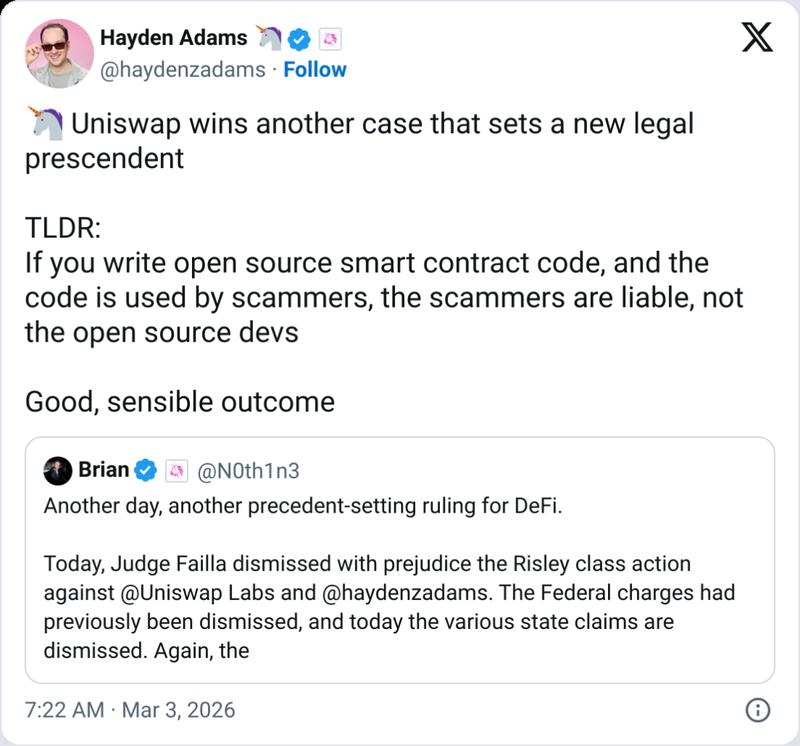
"If you write open source smart contract code, and the code is used by scammers, the scammers are liable, not the open source devs," he added.
Class group failed to claim that Uniswap helped with fraud
In her most recent judicial opinion, Judge Polk Failla determined that the class group had not successfully demonstrated that Uniswap "had knowledge of the fraud and substantially assisted in its commission."
The judge further noted that "merely creating an environment where fraud could exist is not the same as affirmatively assisting in its perpetration."
"No matter how they try to dress up their allegations, Plaintiffs are basically alleging that Defendants substantially assisted fraud by providing ordinary services that anyone could use for lawful purposes, but that some used for unlawful purposes," the judge wrote.
"Such an argument fails for the same reasons why a bank does not substantially assist a money launderer who washes his cash through the bank's accounts, and why WhatsApp does not substantially assist a drug dealer who coordinates a sale on its messaging service: Simply providing the platform on which a fraud takes place is not the same as substantially assisting that fraud," she added.