
Bloomberg projects Coinbase could see sevenfold surge in USDC revenues amid payment expansion
According to Bloomberg Intelligence, revenues from USDC at Coinbase might increase up to seven times as the company navigates potential congressional legislation banning stablecoin rewards, fundamentally altering its revenue structure.

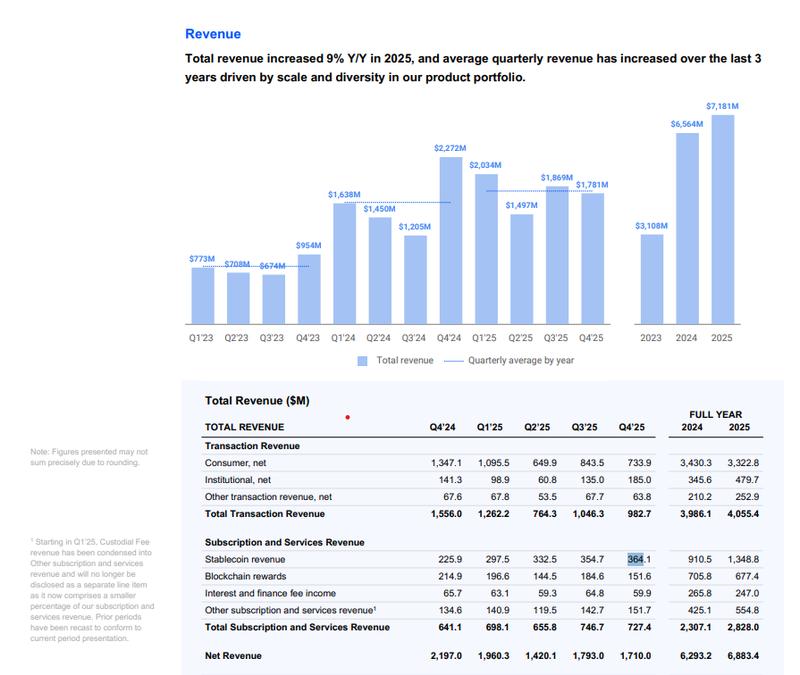
According to projections from Bloomberg Intelligence, the cryptocurrency exchange Coinbase could witness its stablecoin-related revenues multiply between two and seven times, contingent on accelerated USDC adoption within the payments sector. The revenue stream, which stems primarily from the company's USDC partnership and profit-sharing arrangement with Circle, currently represents approximately 19% of Coinbase's overall revenue in 2025.
While Coinbase disclosed a quarterly net loss reaching $667 million during the fourth quarter of 2025 in its Q4 2025 shareholder letter, the exchange still managed to generate roughly $1.35 billion from stablecoin-related activities throughout the previous year.
This represented an increase from $911 million recorded in 2024, with the fourth quarter of 2025 alone contributing $364 million in stablecoin revenue. The interest income generated from USDC balances has emerged as a particularly high-margin revenue stream for the platform when compared to the more unpredictable trading fee income.
In terms of broader adoption, stablecoins have achieved mainstream status. Transaction volumes for stablecoins collectively reached an unprecedented $33 trillion throughout 2025, with USDC representing approximately $18.3 trillion of that total. This places USDC ahead of Tether's USDt when measured by transaction value, although Tether continues to maintain its leadership position in terms of market capitalization.
Politics of stablecoin yield
This explosive growth trajectory is precisely why political debates surrounding stablecoin yield generation have intensified significantly. The Guiding and Establishing National Innovation for US Stablecoins (GENIUS) Act, which received the signature of US President Donald Trump in July 2025, established a federal regulatory framework for payment stablecoins while explicitly prohibiting issuers from distributing interest or yield payments to token holders.
The banking industry lobby has thrown its support behind this provision, concerned that yield-generating stablecoins could drain deposits away from conventional banking institutions.
Traditional banks and their supporters are now pushing to expand these restrictions further during negotiations over the Senate's Digital Asset Market Clarity (CLARITY) Act of 2025. Their goal is to eliminate what they characterize as a regulatory loophole that currently permits non-issuer affiliated entities, including cryptocurrency exchanges like Coinbase, to distribute portions of the interest earned on reserves back to users in the form of "rewards."
Proposed Senate language being considered for inclusion in the market structure legislation could broaden the yield prohibition and block Coinbase from providing any rewards programs connected to stablecoin holdings.
Back in January, Coinbase publicly withdrew its endorsement of the bill following disagreements over provisions that would limit its capacity to provide stablecoin reward programs to its customer base.
The exchange derives a portion of interest income generated from USDC reserves via its collaborative arrangement with Circle, with both companies dividing that revenue stream according to USDC distribution metrics.
In a somewhat paradoxical twist, Armstrong informed investors that should Congress implement a rewards ban, the company would retain a larger portion of the Circle revenue-sharing arrangement, ultimately enhancing the profitability of its stablecoin operations, even though users would forfeit their yield opportunities.
Cointelegraph reached out to Coinbase but had not received a response by publication time.
What's next for CLARITY?
The CLARITY Act, which combines jurisdictional division between the Commodity Futures Trading Commission (CFTC) and Securities and Exchange Commission (SEC) with more restrictive provisions regarding third-party stablecoin yield distribution, is presently advancing through the Senate legislative process.
Senator Bernie Moreno has indicated his expectation that the CLARITY Act could pass through Congress as early as April.
Given that stablecoins already constitute nearly one-fifth of Coinbase's total revenue and blockchain-based dollar transaction volumes continue reaching historic peaks, the final formulation of these yield regulations may prove more consequential for Coinbase's underlying business model than any upcoming cryptocurrency market cycle.