Bitfinex Securities launches new tokenized bond program for digital asset investors
Following four tokenized bond offerings worth $6.2 million since 2023, Bitfinex Securities announces the resumption of USDt-denominated bond issuances on the Liquid Network, a Bitcoin sidechain.

On Monday, Bitfinex Securities announced plans to continue its tokenized bond program for ALTERNATIVE, a securitization fund based in Luxembourg, with anticipated future sales surpassing the $10 million threshold.
The bond offerings, denominated in USDt, will undergo issuance and settlement through the Liquid Network, which functions as a sidechain to Bitcoin, enabling fundraising activities, coupon distributions and principal redemptions to be completed entirely through blockchain technology.
This announcement builds upon the platform's track record of four tokenized bond sales launched since 2023, which collectively raised $6.2 million, with three of these offerings having reached maturity and been completely repaid, resulting in approximately $1 million in principal being returned to bondholders.
Throughout these various offerings, participants in the program collected 20 blockchain-based coupon distributions valued at over $1.1 million upon concluding their initial complete tokenized bond cycle in 2025, the companies reported. These bond products provide investors with access to private credit opportunities in emerging markets, which encompasses financing solutions for small and medium-sized enterprises as well as businesses led by women.
Operating under regulatory licenses granted by the Astana International Financial Centre in Kazakhstan and in El Salvador, Bitfinex Securities manages the processes of issuance, listing and secondary market trading, while token management operations are supported through Tether's Hadron platform. The platform reports that it currently lists approximately $250 million worth of regulated tokenized securities.
In a conversation with Cointelegraph, Jesse Knutson, head of operations at Bitfinex, explained that the primary purchasers have consisted of wealthy cryptocurrency investors and institutional players focused on digital assets from European and Asian markets who are looking to generate returns on their USDt (USDT) reserves.
These tokenized bond products function in parallel with the issuer's traditional monthly bond offering program and generally feature an 11-month term. Transaction records are maintained on the Liquid Network, although critical settlement information remains protected through the network's confidential transaction capabilities.
There's been a lot of discussion this year around yield-generating stablecoins. This product offers a solution with an easy, regulated and established vehicle for earning yield on USDt balances.
Yield vs. no yield debate rages on
The program's reintroduction occurs amid ongoing discussions regarding whether stablecoin products should be permitted to provide yield generation and the regulatory framework such offerings should operate under within the United States.
Following the enactment of the US GENIUS Act in July 2025, stablecoin issuers faced restrictions preventing them from distributing yield directly, though the legislation did not specifically prevent third-party entities from providing returns through alternative product structures. This "loophole" enabled trading platforms or other third-party service providers to develop securities or lending products that produce yield in stablecoins without requiring the issuer to directly distribute interest payments.
Financial institutions have expressed concerns that stablecoin products offering attractive yields could draw deposits away from conventional banking systems. In January, Brian Moynihan, CEO of Bank of America, warned that stablecoins bearing interest could remove up to $6 trillion in deposits from banking institutions across the United States, maintaining that widespread adoption of digital dollar instruments could diminish lending capabilities and elevate funding expenses.
This discussion has emerged as one of the most divisive topics surrounding the CLARITY Act, a proposed legislative framework in the United States designed to create comprehensive regulatory guidelines for digital assets. On Jan. 14, Brian Armstrong, CEO of Coinbase, retracted his endorsement of the proposed bill, identifying the stablecoin yield issue as among the primary reasons for his opposition.
Despite these challenges, certain legislators maintain a positive outlook. On Feb. 18, US Senator Bernie Moreno expressed hope that Congress could advance market structure legislation by April, making these comments to CNBC during an interview at US President Donald Trump's Mar-a-Lago estate in Florida. Armstrong, who participated alongside Moreno in the same interview, also expressed his belief that there exists a pathway forward "where we can get a win-win-win outcome here."
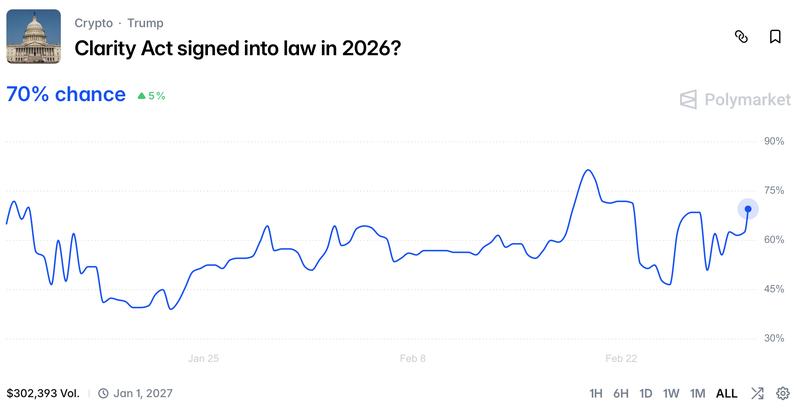
Data from the prediction market platform Polymarket currently indicates a 70% probability that the Clarity Act will receive presidential signature and become law during 2026.