
Bitcoin mining revenue decline pushes TeraWulf past Q4 2025 earnings projections
Despite reporting a Q4 loss of $1.66 per share alongside declining mining revenue, TeraWulf secured $12.8 billion in AI and high-performance computing deals to fuel expansion in 2026.

US-based digital infrastructure firm TeraWulf, which trades publicly, fell short of analyst expectations for its fourth-quarter earnings as Bitcoin price declines throughout the latter part of 2025 dragged down its mining operations revenue.
On Thursday, TeraWulf (WULF) published its 2025 earnings results, disclosing a fourth-quarter per-share loss of $1.66, significantly worse than the $0.21 per-share loss recorded in the same period one year prior. Wall Street analysts polled by Yahoo Finance had projected a loss of $0.16.
The company's revenue for the three-month period concluding on Dec. 31 came in at $35.8 million, comprised of $26.1 million generated from digital assets alongside $9.7 million from high-performance computing (HPC) operations, representing a decline from the $50.6 million reported in the third quarter. Wall Street consensus estimates had anticipated revenue of $44.1 million on average.
Looking at the complete fiscal year, Terawulf saw its revenue climb from $140.1 million in 2024 to reach $168.5 million, with the company anticipating additional growth throughout 2026 backed by $12.8 billion worth of signed contracts in AI and HPC sectors.
We are advancing build schedules and optimizing design to support next‑generation AI workloads at scale.
Nazar Khan, TeraWulf's chief technology officer
TeraWulf plans to double total capacity with Kentucky and Maryland sites
The company has outlined infrastructure expansion initiatives for 2026, including the purchase of a Kentucky facility (MISO) along with a planned Maryland site acquisition (PJM).
Through these strategic acquisitions, TeraWulf anticipates incorporating an additional 1.5 gigawatts (GW) into its existing platform, effectively more than doubling current operational capacity and elevating the company's total owned platform capacity to roughly 2.8 GW distributed across five separate locations.
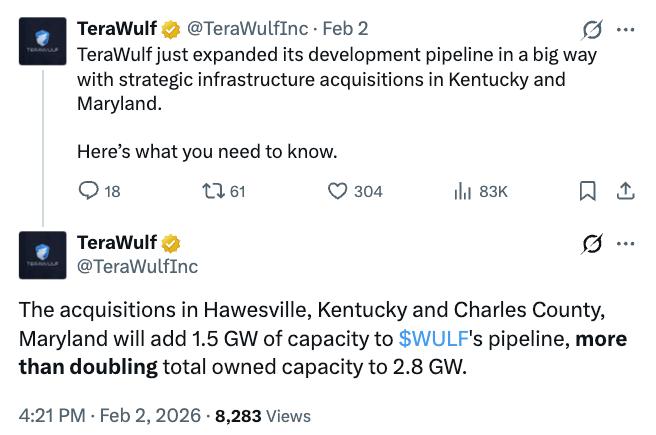
When combined, these facilities establish a multi-year development trajectory with the potential to accommodate 250-500 megawatts (MW) of critical IT capacity on an annual basis, positioning TeraWulf to expand operations in tandem with rising AI sector demand while upholding prudent capital allocation practices and maintaining credit-backed contractual arrangements.
We enter 2026 with 522 critical IT MW of contracted HPC capacity and a gross 2.9-GW multi-regional platform designed for long-term expansion.
Paul Prager, CEO
Companies focused on Bitcoin mining have encountered significant headwinds as the digital currency's valuation dropped from approximately $125,000 in early October down to nearly $60,000 by February 2026, based on data from TradingView.
Currently trading at $67,982 as of publication time, Bitcoin's market value remains substantially beneath the calculated average production cost of $87,310 per coin, as reported by MacroMicro.
This downturn has amplified the urgency for mining operations to transition toward AI and HPC business models, contributing to an industry-wide migration into data center infrastructure services.