
Bitcoin faces pressure from stablecoin decline and tariff turbulence, experts warn
Trade policy uncertainty has triggered capital flows away from cryptocurrency markets toward precious metals and tokenized commodities, while experts caution that weak liquidity conditions in crypto are preventing a broader market rebound.

Dwindling liquidity across cryptocurrency markets represents a worrying indicator for digital asset prices, as market participants shift their investments toward traditional safe-haven instruments such as precious metals against a backdrop of intensifying global trade tensions.
The plateauing supply of stablecoins represents a "notable headwind" for Bitcoin (BTC) and the wider cryptocurrency market, according to digital asset platform Matrixport. "Stablecoins serve as the primary liquidity rail within digital assets and stagnation in supply often signals that capital is being off-ramped back into fiat rather than redeployed within crypto markets," the platform stated in a Tuesday X post.
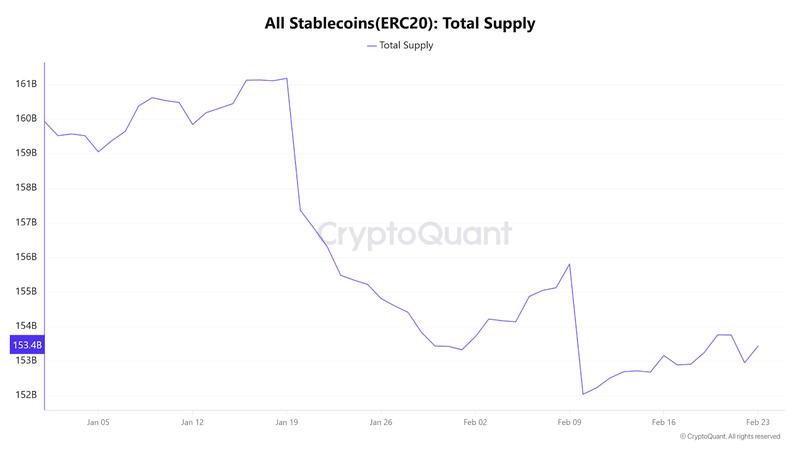
Year-to-date, the total stablecoin supply has decreased by $5.6 billion, declining from $159 billion on Jan. 1, to $153.4 billon on Tuesday, data from analytics platform CryptoQuant indicates. Stablecoin holdings on Binance, the premier cryptocurrency exchange, have also contracted by 19% since November 2025, as Cointelegraph previously reported on Tuesday.
CryptoQuant CEO suggests Bitcoin no longer behaving like "digital gold"
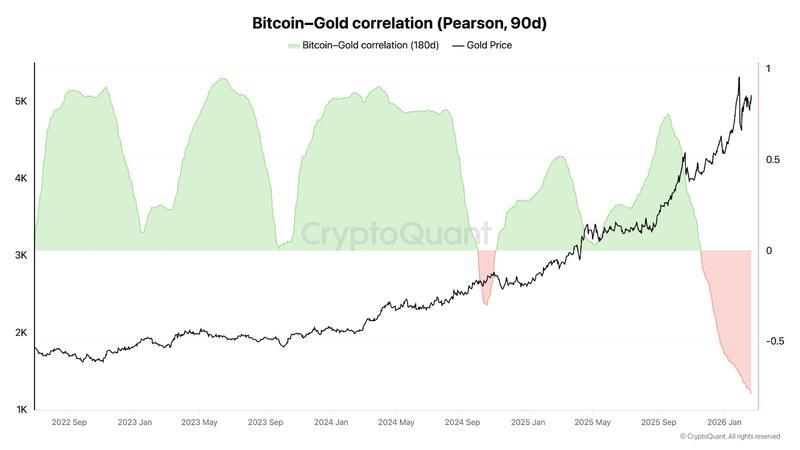
Bitcoin is also showing signs of disconnection from gold over recent timeframes. The 90-day Pearson correlation between BTC and gold has shifted into negative territory, approaching -0.75, based on data from analytics platform CryptoQuant.
The Pearson correlation coefficient indicates the degree to which Bitcoin and gold returns move in tandem during a specific timeframe, where a reading of -1 indicates a perfect inverse correlation.
"Bitcoin is in a 'not digital gold' period," stated Ki Young Yu, the founder and CEO of CryptoQuant, in a Tuesday X post.
Trade policy tensions and precious metals shift draining crypto market liquidity: expert
The situation has become more complex due to fresh tariff-related uncertainty. Last Saturday, US President Donald Trump unveiled a global tariff initiative that has generated considerable uncertainty, implementing a 10% rate immediately while suggesting a potential increase to 15%.
These renewed geopolitical anxieties are hastening the migration of capital from crypto assets toward precious metals, according to Ryan Lee, chief analyst at crypto exchange Bitget.
The tariff-driven concerns are capping potential gains for digital assets, which now face competition from both defensive and growth-oriented assets, the analyst explained to Cointelegraph, adding:
"The ongoing slide in Bitcoin and Ethereum reflects a broader risk-off macro backdrop, where tariff uncertainty, geopolitical tensions, and capital rotation into precious metals and AI-linked equities have thinned crypto liquidity and weakened narratives."
Upside potential for cryptocurrency markets will continue to face constraints until "recovery catalysts" emerge, such as greater clarity in US policy or more "constructive" Federal Reserve signals regarding interest rate cuts, Lee further noted.
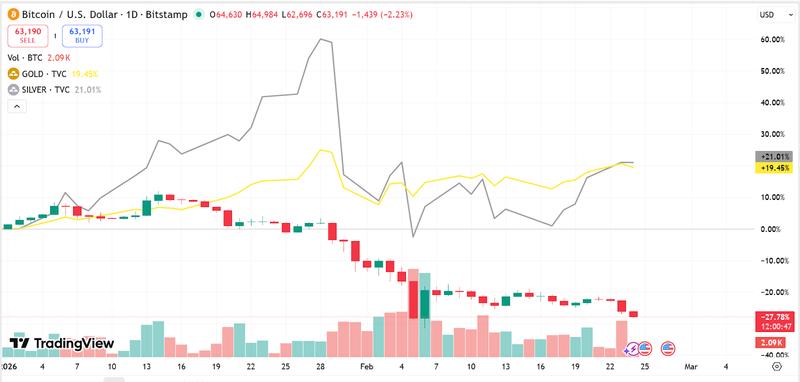
Chart data confirms the precious metal rotation trend, with gold and silver gaining 19% and 21% year-to-date, respectively, while Bitcoin's price has declined by 27%, data from TradingView shows.
Tokenized real-world-assets (RWAs) are similarly exhibiting indicators of capital rotation toward safe-haven instruments, as Tehter Gold's (XAUT) value climbed 20% to $2.7 billion over the past 30 days, while the holder count expanded by 33%, according to data from RWA.xyz.
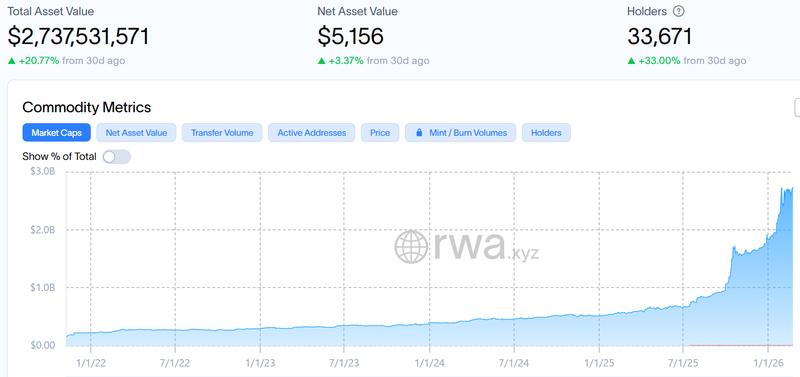
The market for tokenized commodities exceeded $6 billion on Feb. 11, recording a 53% increase in less than six weeks, as additional gold investment activity migrated onto the blockchain.