
Bitcoin faces pressure as US Dollar Index climbs toward three-month peak
Growing strength in the US Dollar Index, potential liquidation of BTC holdings by miners, and Bitcoin's correlation with equity markets spark investor anxiety.

Key takeaways:
- Despite growing strength in the US dollar, Bitcoin demonstrates independence by separating its price action from gold and traditional equity markets.
- Strong institutional appetite for Bitcoin persists, with Bitcoin ETFs recording $1.5 billion in net inflows over a 7-day period.
On Tuesday, Bitcoin (BTC) managed to maintain support above $68,000 even as the Nasdaq 100 Index fell by 1% and gold prices tumbled 3.6%. While Bitcoin initially demonstrated independence from conventional markets, market participants continue to monitor the situation closely as the US dollar gains ground against other leading fiat currencies, despite escalating tensions with Iran that could lead to extended military conflict.
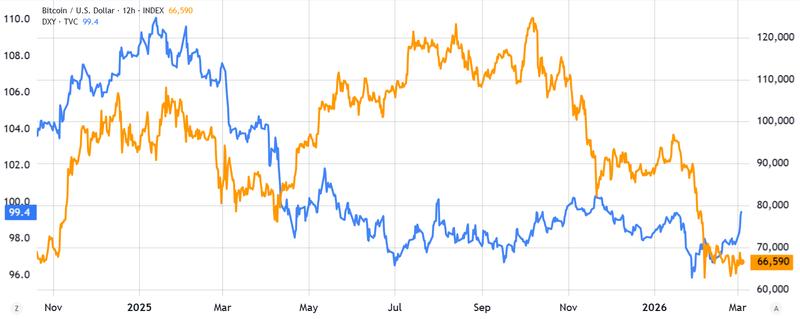
On Tuesday, the US dollar index (DXY) climbed to 99.4, marking an increase from 96.6 just three weeks prior. Analysts attribute this appreciation in the US dollar to market participants moving capital into cash positions and government bonds, patterns commonly linked to risk-averse market conditions. In contrast, when the DXY weakens, Bitcoin tends to post favorable returns, as demonstrated during the bullish phase between March 2025 and August 2025.
That said, when examining a wider timeframe, the US Dollar Index continues to trade significantly beneath the 105–110 band that persisted from November 2024 through March 2025. Over the trailing 12 months, the data actually indicates consolidation patterns rather than persistent dollar strength. The recent divergence between Bitcoin and technology stocks appears more noteworthy, especially considering their correlation had intensified even as the Nasdaq 100 traded merely 6% beneath its record peak.
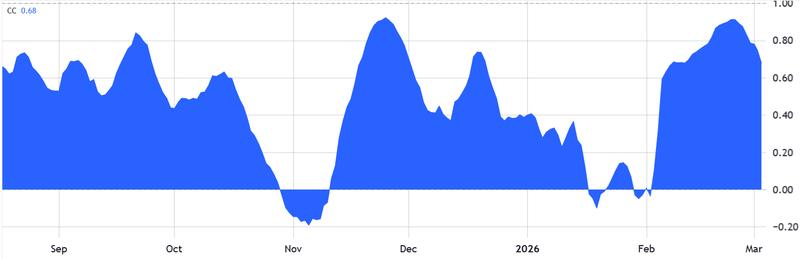
The rolling 30-day correlation coefficient between Bitcoin and the Nasdaq 100 declined to 69% following a peak of 92% recorded seven days earlier. Throughout its history, Bitcoin's market characterization has undergone multiple transformations, with observers categorizing it alternately as a sovereign monetary alternative, a digital store of value, an immutable distributed ledger, or a high-risk speculative asset. As such, forecasting a Bitcoin price collapse based exclusively on dollar strength appears unwarranted.
Nevertheless, an unmistakable absence of upward momentum continues, potentially influenced by several factors including the Oct. 10, 2025, sudden price crash, anxiety surrounding quantum computing threats, frustration regarding the slow development of a US Strategic Bitcoin Reserve, and capital migration toward artificial intelligence investments. Market participants are additionally seeking concrete explanations for the potential decline to $60,000, which amplifies current uncertainty and apprehension.
Negative developments gain amplified attention during Bitcoin's bear phase
A filing submitted to the US Securities and Exchange Commission (SEC) by MARA Holdings (MARA US) recently caused market observers to misconstrue the firm's approach to managing Bitcoin reserves. Concerns emerged among traders that MARA could follow the path of other notable publicly-traded mining operations, including Cango (CANG US), Bitdeer (BTDR UR), and Core Scientific (CORZ US), all of which have recently disposed of their complete Bitcoin stockpiles.

Robert Samuels, MARA's Vice President of Investor Relations, refuted these speculations, clarifying that when the company states it "may buy or sell from time to time," this language does not signal any plan to divest the bulk of their Bitcoin holdings. Some market participants may have reacted hastily prior to receiving this clarification, primarily because Bitcoin remains mired in bearish territory while competing mining firms have pivoted their primary operations toward artificial intelligence data center infrastructure.
Elevated readings in the US Dollar Index ought not to be interpreted as an automatic trigger to exit Bitcoin positions. This perspective holds especially true given that the cryptocurrency demonstrates stability even as gold displays fatigue, retesting the $5,000 support zone after advancing 25% year-to-date through 2026. Bitcoin investors continue to navigate a challenging environment in their efforts to restore complete market confidence following a 52% decline from the record high, although general market sentiment shows signs of gradual improvement.
Since Feb. 24, Bitcoin exchange-traded funds have attracted $1.5 billion in net inflows, providing unmistakable evidence that institutional appetite continues to expand. Even so, market participants will most likely await a decisive price surge beyond $75,000 before determining that bearish conditions have definitively concluded. Until Bitcoin crosses that critical threshold, metrics such as the US Dollar Index will probably maintain some downward influence on Bitcoin pricing, irrespective of the presently diminished correlation between the two.
This article does not contain investment advice or recommendations. Every investment and trading move involves risk, and readers should conduct their own research when making a decision. While we strive to provide accurate and timely information, Cointelegraph does not guarantee the accuracy, completeness, or reliability of any information in this article. This article may contain forward-looking statements that are subject to risks and uncertainties. Cointelegraph will not be liable for any loss or damage arising from your reliance on this information.