
Bitcoin Block Space Faces New Test with Citrea ZK-Rollup Mainnet Debut
The debut of Citrea's Bitcoin-based rollup represents a real-world test of BTC's capacity to accommodate comprehensive DeFi infrastructure and stablecoins, raising questions about appropriate base layer use cases.

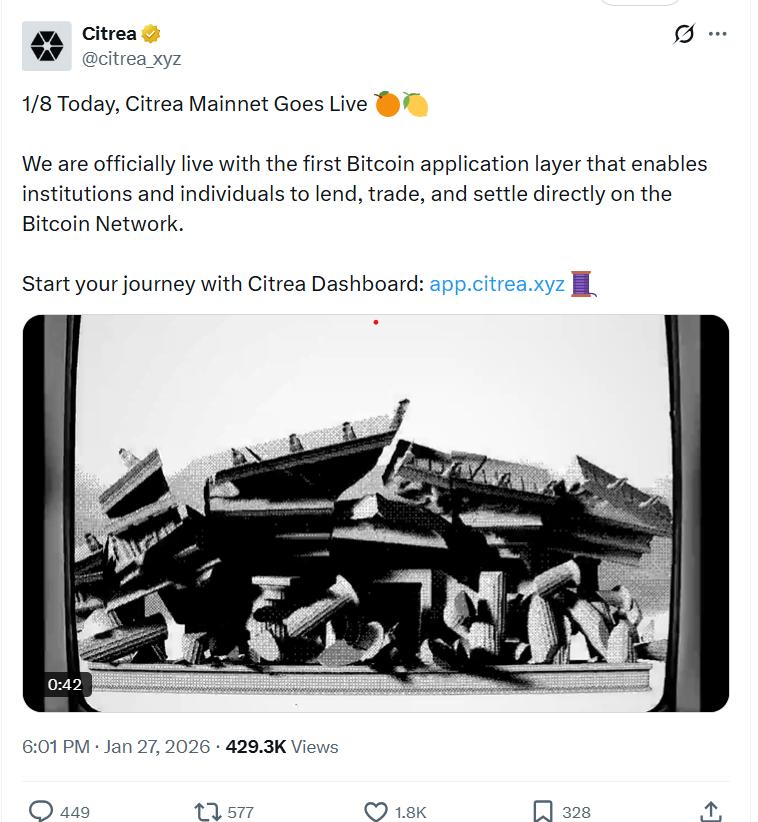
On Tuesday, Citrea, a Bitcoin zero-knowledge rollup (ZK-rollup) supported by Founders Fund and Galaxy Ventures, went live on mainnet featuring BTC collateral lending capabilities, BTC-structured financial products, and ctUSD, a newly introduced US dollar stablecoin.
The primary objective of this launch is to transform what Citrea characterizes as "economically idle" Bitcoin (BTC) into foundational collateral for decentralized finance (DeFi) applications and payment systems, all while securing more of this economic activity to Bitcoin's foundational layer.
According to the project team's projections, active DeFi liquidity should climb to $50 million within the initial weeks following launch, with BTC lending services, BTC-structured financial products, and decentralized exchange functionality operational from the very first day.
The mainnet launch immediately thrust Citrea into the center of a longstanding Bitcoin debate: How should limited BTC block space be allocated and prioritized?
As block rewards continue their programmed decline, numerous developers view non‑payment applications like Citrea as critical for maintaining sustainable miner fee income over the long term.
On the other hand, Bitcoin purists contend that the network's constrained capacity ought to be preserved exclusively for straightforward, censorship‑resistant payment transactions instead of elaborate financial infrastructures constructed on top of the base layer.
CtUSD targets Bitcoin stablecoin liquidity challenges
The ctUSD stablecoin is created by MoonPay, a regulated cryptocurrency payments and infrastructure provider that facilitates fiat currency on and off‑ramps for digital asset users.
The stablecoin maintains a 1:1 backing through cash reserves and short‑term US Treasury securities, positioning itself as a compliance‑oriented alternative to wrapped versions of Tether (USDT) and wrapped USDC (USDC) currently in circulation across Bitcoin‑adjacent technology stacks.
In an interview with Cointelegraph, Orkun Mahir Kılıç, the co‑founder and CEO of Chainway Labs, the development company responsible for Citrea, explained that ctUSD was "natively issued" directly on the rollup platform rather than being bridged from an alternative blockchain, and integrated directly into MoonPay's Iron banking infrastructure.
This configuration incorporates banking‑grade infrastructure components including virtual International Bank Account Numbers (vIBANs), which enable users to transmit fiat currency that undergoes automatic conversion into ctUSD with onchain settlement.
The significance of ctUSD's 'native' architecture
Given that Citrea functions as "the Bitcoin application layer anchored to Bitcoin's security model," ctUSD consequently "inherits the security properties of the Citrea network itself."
This architectural choice mitigates certain risks that plague other DeFi protocols, because bridged assets typically "inherit the security risks of their weakest link," according to Kılıç.
He further emphasized that ctUSD, through its native issuance model, remains protected from external bridge exploits, and is "not dependent on the solvency of a third-party wrapping protocol."
In contrast to other blockchain ecosystems where "liquidity is split across multiple bridged versions of the same asset," ctUSD serves as "the single, preferred stablecoin for Citrea," thereby eliminating the "liquidity fragmentation that typically traps capital and increases slippage for lenders and traders."
Kılıç maintained that the combination of a Bitcoin‑anchored rollup solution with a regulated stablecoin and banking system integrations was intentionally engineered to "systematically boost supply" and transform ctUSD "from a launch asset into the standard liquidity layer for the Bitcoin economy" throughout the coming six to 12 months.
During the testnet phase, Citrea reports that its data availability consumption alone represented nearly 10% of Bitcoin's monthly data bandwidth at its peak, demonstrating that even pre‑launch rollup operations can utilize a substantial portion of Bitcoin block space.
Block space debate reignited by Citrea launch
Jameson Lopp, a Bitcoin core developer and Casa's chief security officer, characterized the deployment as "the next grand experiment in generating sustainable demand for block space."
Nevertheless, one respondent noted that Citrea users aren't actually lending, trading and finalizing transactions directly on the Bitcoin network as suggested, but rather on Citrea's Ethereum Virtual Machine, with Bitcoin serving only to store cryptographic proofs, essentially converting Bitcoin into a "filing cabinet" for rollup transaction receipts.
The critic highlighted Citrea's "single sequencer," offchain treasury management, and "10‑party federation," as trust assumptions that relocate risk rather than eliminate it entirely. "You know the difference. You're pretending you don't," he jibed at Lopp.