
Binance Sees Nearly 20% Drop in Stablecoin Holdings Since Late 2024
The world's leading cryptocurrency exchange has experienced an 18.6% decline in stablecoin reserves over a three-month period, driven by restrictive Federal Reserve monetary policy and diminished capital inflows that have prolonged the ongoing crypto liquidity crisis.

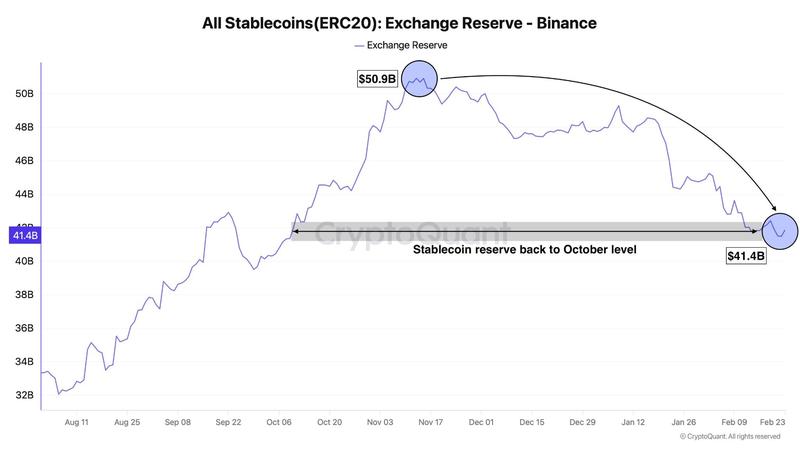
The global cryptocurrency market's largest exchange, Binance, has witnessed its stablecoin holdings retreat to October levels as the digital asset sector grapples with an ongoing liquidity shortage, data from CryptoQuant reveals.
Since November, the platform's stablecoin reserves have contracted by 18.6%, representing a decline of approximately $10 billion from $50.9 billion down to the present level of $41.4 billion, according to CryptoQuant analyst Darkfost's report published on Monday.
Exchange-held stablecoin reserves "typically adjust based on investor demand," while cryptocurrency "liquidity dynamics can be proxied through stablecoin flows," the analyst explained.
Notwithstanding this reduction, Binance continues to hold roughly 64% of the aggregate stablecoin reserves distributed across all cryptocurrency exchanges.
Nevertheless, when an exchange operating at this magnitude starts to demonstrate such a transformation in investor sentiment, "it becomes a signal worth monitoring," they warned.
"For the market to stabilize, a renewed inflow of stablecoins will likely be required to reverse the current liquidity trend."
Crypto liquidity drought continues
When stablecoin reserves on exchanges contract, it typically indicates that market participants are withdrawing liquidity from cryptocurrency markets through conversion back to traditional fiat currencies instead of maintaining stablecoins on platforms for potential market re-entry.
"One of the key headwinds currently weighing on the space is the lack of incoming liquidity," Darkfost observed, adding a warning that "from a broader cross-market liquidity perspective, conditions are unlikely to improve in the near term."
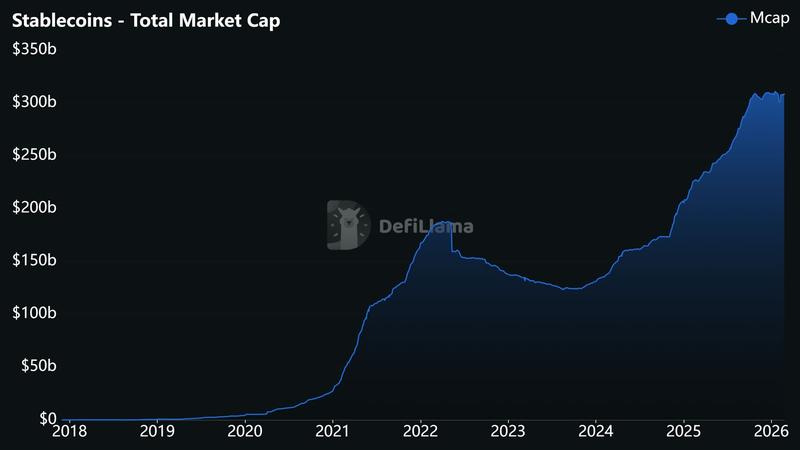
Since October, the aggregate market capitalization of stablecoins has remained flat at slightly above $300 billion, data from DeFiLlama shows. This plateau follows a two-year period of substantial growth that produced 150% expansion in stablecoin supply.
The previous instance of meaningful contraction in stablecoin market capitalization occurred during mid-2022 throughout the bearish market phase that succeeded the Terra/Luna ecosystem collapse, with recovery not materializing until November 2023, a span of 18 months later.
Fed rate reduction in March unlikely
Market liquidity conditions are also significantly impacted by US interest rate policy, and central bank officials do not seem prepared to implement another rate cut.
On Monday, Federal Reserve Governor Christopher Waller indicated he was open to leaving rates on hold at the March meeting if upcoming February labor market data indicates "pivoting to a more solid footing," Reuters reported.
Current projections from CME futures markets show a 95.5% probability of rates remaining unchanged in March, compounding the liquidity challenges facing cryptocurrency markets.