
Aptos Foundation Plans Major Token Economics Revamp to Drive APT Deflationary Model
A comprehensive proposal from the Aptos Foundation includes implementing a 2.1 billion token maximum supply, cutting short-term staking yields, and multiplying gas fees by ten.

A major restructuring of the Aptos token's economic model is being planned by the Aptos Foundation, with the organization unveiling a series of prospective policy modifications aimed at accelerating deflationary pressure on APT.
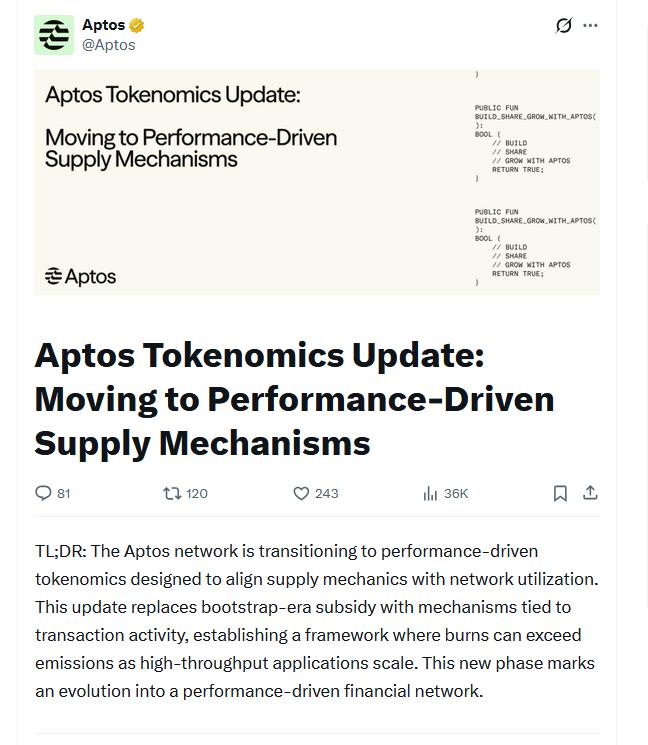
Through a Wednesday announcement on X, the Aptos Foundation revealed its intention to put forward multiple governance proposals designed to help shift the ecosystem from its existing subsidy-based emission model toward an approach that emphasizes "performance-driven mechanisms" and a declining APT token supply.
"The Aptos network is transitioning to performance-driven tokenomics designed to align supply mechanics with network utilization," the Aptos Foundation stated, further explaining:
"This update replaces bootstrap-era subsidy with mechanisms tied to transaction activity, establishing a framework where burns can exceed emissions as high-throughput applications scale."
Among the foundation's key proposals is the establishment of a maximum supply limit of 2.1 billion tokens, given that APT presently lacks any ceiling on its total token supply. According to the team, there are currently 1.196 billion APT tokens in active circulation.
Within the framework of the present emission model, fresh tokens are perpetually created to provide support for the ecosystem through financing various initiatives including development efforts, grant programs, and rewards for staking participation.
At the same time, substantial scheduled token unlocks have been creating pressure on the ecosystem.
Nevertheless, the Aptos Foundation indicated that this particular source of pressure has been diminishing and is expected to further decrease following the conclusion of the upcoming major four-year token unlock period in October, which will lead to a 60% decrease in annualized supply unlocks.
The organization explained that given the ecosystem's evolution to a stage where major institutional players including BlackRock, Franklin Templeton, and Apollo are currently deploying "hundreds of millions onchain," the APT tokenomics framework requires greater sustainability.
"Without reform, emissions continue indefinitely with no hard ceiling, no performance requirements, and no connection between issuance and network activity," the team stated.
Key proposals and policy changes afoot
In addition to the fixed 2.1 billion supply ceiling, the policy modifications being proposed encompass a decrease in the annual staking rewards rate from 5.19% down to 2.6%, along with enhanced rewards for "longer staking commitments."
According to the Aptos Foundation, this approach would lead to diminished overall staking emissions while simultaneously incentivizing participants committed to the long term.
In another proposed change, the organization is advocating for a tenfold multiplication of gas fees, contending that such an increase is feasible considering the network's current low usage costs. Since gas fees denominated in APT undergo burning, this measure would additionally contribute to emission reduction.
"Even with a 10X increase, stablecoin transfers would still be the lowest in the world at around $0.00014, making it the ideal blockchain for stablecoins, payments, and any other similar high-volume transactions," the team explained.
The Aptos Foundation has also put forward a proposal to permanently lock 210 million APT tokens for network staking purposes. According to the team, this action would be "functionally equivalent to a token burn" and the generated rewards would be allocated toward funding foundation operations.
The organization also announced it will modify its grants policy and implement more rigorous KPIs to guarantee superior performance prior to distributing tokens. Additionally, the foundation will investigate the possibility of implementing a token buyback program or establishing an APT reserve to assist in supply balancing.
The Aptos Foundation is far from being the only entity pursuing substantial changes to native token economics. During January, the Optimism governance community gave approval to a proposal from its foundation to launch a buyback program utilizing 50% of Superchain revenue.
In related developments, decentralized exchange Uniswap witnessed approval of a major token burn in December, while PancakeSwap's community similarly approved a supply-reduction proposal last month.