
Aave governance proposal advances despite divided community vote of 52.6%
With a 52.6% to 42% result, the Snapshot Temp Check has advanced the DAO-funded revenue framework to the ARFC phase for further refinements.
The "Aave Will Win" framework proposed for Aave has successfully navigated its Temp Check vote, representing the initial formal milestone within the protocol's governance procedure.
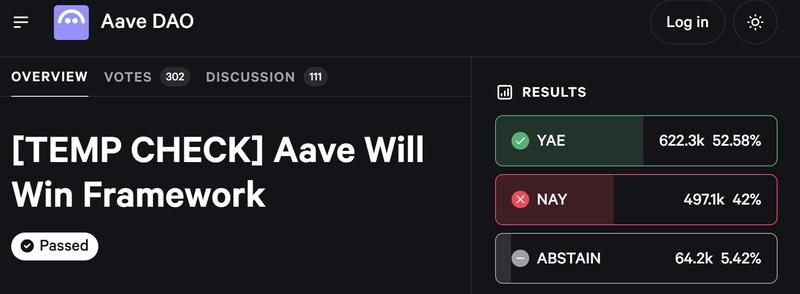
The off-chain Snapshot vote concluded on Sunday, recording 52.58% support, 42% opposition, and 5.42% choosing to abstain. This outcome propels the proposal forward to the Aave Request for Final Comment (ARFC) phase, during which modifications to the terms can be implemented prior to any conclusive on-chain voting process.
Under the proposed framework, tokenholders are being asked to authorize funding of up to $42.5 million in stablecoins alongside 75,000 Aave (AAVE) tokens designated for Aave Labs. As a reciprocal arrangement, the organization has committed to directing 100% of revenues generated from all Aave-branded products directly into the Aave DAO treasury, establishing a DAO-funded operational framework.
The relatively slim voting margin underscores significant division within the governance community as stakeholders weigh fundamental modifications to the protocol's funding mechanisms, revenue distribution alignment, and sustained developmental trajectory.
The upcoming ARFC phase will serve as the proving ground for whether objections voiced throughout the deliberation process will result in tangible amendments before an official Aave Improvement Proposal undergoes on-chain submission.
Divided voting outcome highlights persistent governance friction
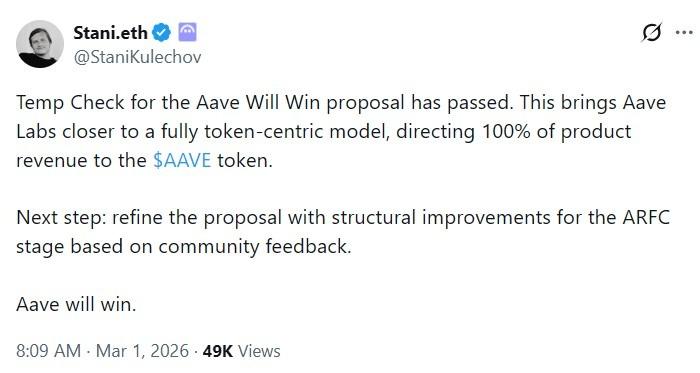
In a post shared on X, Aave founder Stani Kulechov stated that the Temp Check vote represents progress toward implementing a "fully token-centric model" for the protocol, noting that structural enhancements will be integrated during the ARFC phase in response to input from the community.
Opponents of the proposal have raised concerns regarding the magnitude of the requested funding package and the incorporation of 75,000 AAVE tokens, which confer voting rights to their holders.
Additional voices within the community have advocated for more precise definitions and enhanced disclosure requirements concerning governance token holdings.
Ahead of the vote on Feb. 25, dueling analyses from Aave Chan Initiative (ACI) founder Marc Zeller and Aave Labs presented divergent perspectives on historical funding allocations and value generation.
The ACI released a comprehensive transparency report examining Aave Labs' funding history over time, while Aave Labs issued documentation highlighting its contributions to developing the protocol infrastructure beginning in 2017.
Next steps within Aave's governance workflow
According to Aave's established governance structure, proposals generally progress from the Temp Check phase to ARFC before proceeding to an on-chain Aave Improvement Proposal (AIP) vote. Only those AIPs that successfully execute on-chain carry binding authority.
Should the proposal successfully navigate beyond the ARFC stage, tokenholders will cast votes determining whether to officially adopt the DAO-funded operational model and confirm Aave V4 as the protocol's enduring technical infrastructure.
The final decision holds the potential to fundamentally transform how the Aave ecosystem organizes its development activities, revenue allocation mechanisms, and brand governance responsibilities.